This page is based on this
Wikipedia article Text is available under the
CC BY-SA 4.0 license; additional terms may apply.
Images, videos and audio are available under their respective licenses.

Caddie is a mid-range computer-assisted draughting (CAD) software package for 2D and 3D design. It is used primarily by architects, but has tools for surveyors and mechanical, civil and construction engineers. It was initially designed as an electronic drawing board, using concepts and tools clearly related to a physical board.
The ArsDigita Community System (ACS) was an open source toolkit for developing community web applications developed primarily by developers associated with ArsDigita Corporation. It was licensed under the terms of the GNU GPL, and is one of the most famous products to be based completely on AOLserver. Although there were several forks of the project, the only one that is still actively maintained is OpenACS.
Chemical Abstracts Service (CAS) is a division of the American Chemical Society. It is a source of chemical information. CAS is located in Columbus, Ohio, United States.
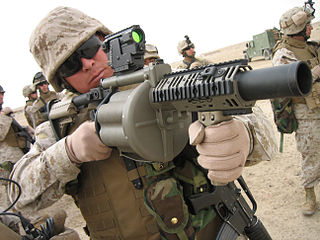
In current usage a riot gun or less-lethal launcher is a type of firearm that is used to fire "non-lethal" or "less-lethal" ammunition for the purpose of suppressing riots. Less-lethal launchers may be special purpose firearms designed for riot control use, or standard firearms, usually shotguns and grenade launchers, adapted to riot control use with appropriate ammunition. The ammunition is most commonly found in 12 gauge shotguns and 37mm/40 mm grenade launchers.

The Autococker is a closed-bolt semiautomatic paintball marker manufactured by Worr Game Products (WGP). It was one of the first paintball markers to be designed specifically for the sport, and has long been known throughout the paintball community for its popularity and customizability as well as its complexity.
It is commonly believed that the closed-bolt design of the marker makes it inherently more accurate than its open-bolt counterparts, though this is disputed.

The A-5 is a semi-automatic pneumatic marker made by Tippmann for playing paintball. Inspired by the look and feel of the Heckler & Koch MP5K submachine gun, it was first produced in 2002 in the USA. It utilizes a loading concept called the "Cyclone Feed System".
Paintball is an equipment intensive sport and in order to safely conduct a game, every player requires a marker with propellant to fire the paint, a mask to protect the eyes and face, paintballs, and a loader to hold them. To ensure safety off the playing field, a barrel sock or plug for the marker is also compulsory.

The Automag is a paintball marker designed by Tom Kaye and produced by Airgun Designs, Inc. It bears the distinction of being the first semi-automatic marker ever to win a paintball tournament. Team Swarm used Automags in their victory at the 1990 International Masters.
The Shocker is a series of electropneumatic paintball markers manufactured by Smart Parts. The original Shocker was built by PneuVentures and distributed by Smart Parts in the US in 1995. It is now discontinued, but was the first electropneumatic paintball marker on the market at the time. Several revisions of the marker have since been produced.
The Bushmaster 2000 is an electro-pneumatic paintball marker produced by Indian Creek Designs, (ICD), a manufacturer based in Idaho.
A method of operation for paintball markers using a striker, bolt, powertube, and valve assembly in a straight line.
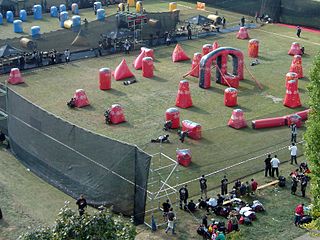
Speedball is one of the three distinct game variants in the sport of paintball, woodsball and scenario paintball.
The CCI Phantom is a Nelson-based pump action paintball marker developed and produced by Mike Casady. Production began in 1987 after about six months of prototype work. The name for the marker was derived from the much more stealth-oriented and drawn-out style of play that was typical when the game was first developing. The Phantom was designed to be powered by a single 12 gram CO2 powerlet, but larger tanks may also be used by removing the powerlet adapter or using a dummy powerlet. When first introduced the marker featured a fixed barrel assembly referred to as a "unibody" combined with a modified Crosman air pistol frame and brass bead sight. However, since roughly 1989 the body and barrel of the marker have been two distinct parts and no longer feature the bead style sight. The marker is also capable of supporting bulk gravity fed hoppers by using a different breech type. The Phantom is one of only a handful of readily available markers acceptable for use in the various forms of stock class paintball. However, because the Phantom is capable of auto-triggering and features barrel porting it is considered to be a modified stock class marker.

The Ion is an electropneumatic paintball marker manufactured by Smart Parts. At the time of its release, the Ion was the first fully electropneumatic marker to target entry-level players, at a price point previously inhabited only by Spyders and other mechanical blowbacks. The Ion has generally been credited with making high-rate-of-fire electropneumatic markers available to the masses, at a time when electropneumatic markers were considered out of reach of most casual or budget players.
The ICD ProMaster is an electropneumatic paintball marker manufactured by Indian Creek Designs and first released in 2005. The Promaster was designed to replace the aging Bushmaster 2000 model, which had been Indian Creek Design's flagship marker between 2000 and 2004.
Airgun Designs, Inc. (AGD) is a manufacturer of paintball markers and equipment formerly based in Wheeling, IL. The company is now based in Cary, IL. They are best known for manufacturing the Automag paintball marker. Tom Kaye founded AGD in 1987. As one of the oldest paintball companies in existence, AGD has been responsible for several innovations now common on the paintball scene.
RAP4 is a manufacturer of paintball markers, paintball equipment, tactical gear and training tools.

An electropneumatic paintball marker is a paintball marker that uses a pneumatic solenoid to actuate the hammer and/or bolt's movement.

