This page is based on this
Wikipedia article Text is available under the
CC BY-SA 4.0 license; additional terms may apply.
Images, videos and audio are available under their respective licenses.

Berkeley is a small town and parish in Gloucestershire, England. It lies in the Vale of Berkeley between the east bank of the River Severn and the M5 motorway, within the Stroud administrative district. The town is noted for Berkeley Castle, where the imprisoned Edward II was murdered, as well as the birthplace of the physician Edward Jenner, pioneer of the smallpox vaccine, the world's first vaccine.
Bourton is the name of more than one place in England:
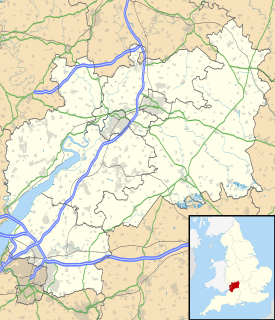
Mangotsfield is an urban area and former village in the unitary authority of South Gloucestershire, to the north-east of Bristol.

Olveston is a small village and larger parish in South Gloucestershire, England. The parish comprises the villages of Olveston and Tockington, and the hamlets of Old Down, Ingst and Awkley. The civil parish population at the 2011 census was 2,033. Alveston became a separate parish in 1846. The district has been inhabited since the Stone Age, and the salt marshes that made up almost half of the parish, were progressively drained in Roman and Saxon times. A sea wall was constructed at the same time to prevent flooding from the nearby estuary of the River Severn.
Whittington may refer to:
Aston is a district of Birmingham, England
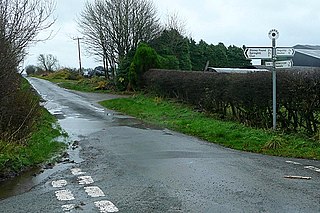
Quabbs is a small, scattered hamlet in the southwest of Shropshire, near the border between England and Wales. The name, which also occurs in Gloucestershire as a field name, is possibly derived from the Old English word cwabba, "marsh".

The Counties Act 1844, which came into effect on 20 October 1844, was an Act of Parliament of the United Kingdom which eliminated many outliers or exclaves of counties in England and Wales for civil purposes.

Newport is a village in Alkington parish, Gloucestershire, England. Located along the A38 road roughly halfway between Bristol and Gloucester. It is located about a mile south-east of Berkeley and just north of Woodford. It is on the Doverte Brook, a tributary of the Little Avon River. It has a pub formally the white Heart, a closed down motel, and a small non-conformist chapel.The chapel closed October 2006 and it has a Georgian Interior with hat pegs and galleries and several broken harmoniums.
Prior to the advent of the motor car, when the journey between Bristol and Gloucestershire took a whole day. It was a perfect staging point for stagecoaches at that time. There were many inns, some catering for the post. The coaches would have a change of horses, the coachmen and passengers having a mid-journey rest stop.
Thornbury Rural District was a rural district council centred on Thornbury in the south of Gloucestershire. It was originally formed as a Poor Law Union on 5 April 1836 with 26 Guardians representing the 21 parishes in the Union and the Guardians of the Poor became the Rural Sanitary Authority for the District in 1872. The Rural District Council became a separate body in 1894 although the District Councillors had a dual mandate as members of both the council and the Board of Guardians.The District was enlarged in 1904 when Henbury was transferred from the abolished Barton Regis Rural District. In 1930 the Guardians were abolished when their functions were transferred to It was abolished in 1974 and the majority of it transferred into the new county of Avon, as part of the new district of Northavon.
Draycott, Draycot or Draycote may refer to:

Lower Wick is a small hamlet located in the county of Gloucestershire, England. It is situated about five miles south west of Dursley, eighteen miles southwest of Gloucester and fifteen miles northeast of Bristol. Lower Wick is within the civil parish of Alkington.

Hamfallow is a civil parish in the district of Stroud, Gloucestershire. There is no village centre, the parish consists of farms and hamlets such as Abwell, Breadstone, Halmore, Mobley and Wanswell.
Sir Rowland Cotton was an English politician who sat in the House of Commons at various times between 1605 and 1629.

