Auditory meatus can refer to:
 | This disambiguation page lists articles associated with the title Auditory meatus. If an internal link led you here, you may wish to change the link to point directly to the intended article. |
Auditory meatus can refer to:
| | This disambiguation page lists articles associated with the title Auditory meatus. If an internal link led you here, you may wish to change the link to point directly to the intended article. |

The outer ear, external ear, or auris externa is the external portion of the ear, which consists of the auricle and the ear canal . It gathers sound energy and focuses it on the eardrum.

The vestibulocochlear nerve, known as the eighth cranial nerve, transmits sound and equilibrium (balance) information from the inner ear to the brain.
There is no such a nerve named "lesser auricular nerve". Therefore, the "Great auricular nerve" is incorrectly named "Greater auricular nerve".
Auditory means of or relating to the process of hearing:

The temporal bones are situated at the sides and base of the skull, and lateral to the temporal lobes of the cerebral cortex.
In anatomy, a meatus, plural "meatus" or "meatuses", is a natural body opening or canal.

Reid's base line is used for an unambiguous definition of the orientation of the human skull in conventional radiography, computer tomography (CT), and magnetic resonance imaging (MRI) studies. It is defined as a line drawn from the inferior margin of the orbit to the auricular point and extending backward to the center of the occipital bone. Used as the zero plane in computed tomography.

The ear canal is a tube running from the outer ear to the middle ear. The adult human ear canal extends from the pinna to the eardrum and is about 2.5 centimetres (1 in) in length and 0.7 centimetres (0.3 in) in diameter.
EAM may refer to:

A pharyngeal groove is made up of ectoderm unlike its counterpart the pharyngeal pouch on the endodermal side.

The internal auditory meatus is a canal within the petrous part of the temporal bone of the skull between the posterior cranial fossa and the inner ear.

The labyrinthine artery, a long slender branch of the anterior inferior cerebellar artery or basilar artery, arises from near the middle of the artery; it accompanies the vestibulocochlear nerve through the internal acoustic meatus, and is distributed to the internal ear.
The vestibular ganglion is the ganglion of the vestibular nerve. It is located inside the internal auditory meatus.

The squamous part of temporal bone, or temporal squama, forms the front and upper part of the temporal bone, and is scale-like, thin, and translucent.

The superior ganglion of the vagus nerve or jugular ganglion is a well-marked ganglionic enlargement of the vagus nerve. It is located in the middle part of the jugular foramen. It contains afferent somatosensory neuronal cell bodies that provide sensory information from the external auditory meatus, cranial meninges, and the external surface of the tympanic membrane. Their central fibers synapse in the Trigeminal nerve nuclei.
Acoustic meatus may refer to:
The Superior auricular ligament crosses from the spine of the helix to the superior margin of the external auditory meatus.
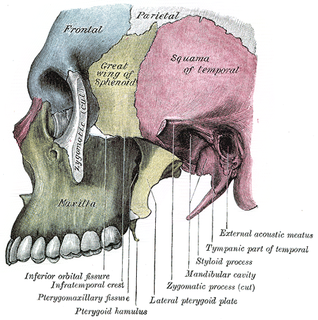
For people with the surname, see Porion (surname).
Meatus acusticus can refer to:
Orbitomeatal line is a positioning line used in radiography of the skull. It passes through the outer canthus of the eye and the center of the external auditory meatus. It is used for positioning the patient for different radiographic views including Water's view, Perorbital view, Lateral view, and others.