Related Research Articles

Askeaton, is a town in County Limerick, Ireland. The town on the N69, the road between Limerick and Tralee, is built on the banks of the River Deel some 3 km upstream from the estuary of the River Shannon.

Fethard is a small town in County Tipperary, Ireland. Dating to the Norman invasion of Ireland, the town's walls were first laid-out in the 13th century, with some sections of these defensive fortifications surviving today.
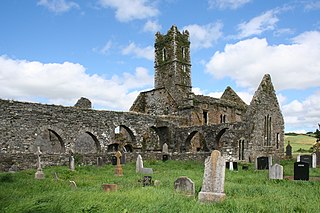
Timoleague Friary, also known as Timoleague Abbey, is a ruined medieval Franciscan friary located in Timoleague, County Cork, Ireland. It is located on the site of an early Christian monastic site founded by Saint Molaga, from whom the town of Timoleague derives its name. The present remains date from roughly the turn of the fourteenth century and were burnt down by British forces in the mid-seventeenth century.

Kilcrea Friary is a ruined medieval abbey located near Ovens, County Cork, Ireland. Both the friary and Kilcrea Castle, located in ruin to the west, were built by Observant Franciscans in the mid 15th century under the invitation of Cormac Láidir MacCarthy, Lord of Muskerry, as protection from English troops.

Carlingford is a coastal town and civil parish in northern County Louth, Ireland. For the purposes of local government, the town is part of the Dundalk Municipal District. It is situated on the southern shore of Carlingford Lough with Slieve Foy mountain as a backdrop, sometimes known as Carlingford Mountain. It is the main town on the Cooley Peninsula. Located on the R176/R173 roads between Greenore and Omeath village, Carlingford is approximately 27 km north east from Dundalk, 90 km north of Dublin and 11 km south of the border with Northern Ireland. Carlingford won the Irish Tidy Towns Competition in 1988.

Glenarm is a village in County Antrim, Northern Ireland. It lies on the North Channel coast north of the town of Larne and the village of Ballygalley, and south of the village of Carnlough. It is situated in the civil parish of Tickmacrevan and the historic barony of Glenarm Lower. It is part of Mid and East Antrim Borough Council and had a population of 568 people in the 2011 Census. Glenarm takes its name from the glen in which it lies, the southernmost of the nine Glens of Antrim.

The Ross Errilly Friary is a medieval Franciscan friary located about a mile to the northwest of Headford, County Galway, Ireland. It is a National Monument of Ireland and among the best-preserved medieval monastic sites in the country. Though usually referred to by locals as "Ross Abbey," this is not technically correct as the community never had an abbot.
Events from the year 1539 in Ireland.

Lough Eske or Lough Eask is a small lake in County Donegal in the west of Ulster in Ireland. The lake lies to the northeast of Donegal Town, to which it is connected by the River Eske. The lake is about 900 acres (3.6 km2) in size and is surrounded to the north, east and west by the Bluestack Mountains, which occupy much of southern County Donegal.
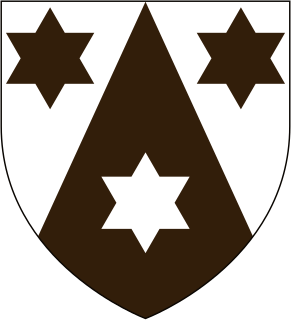
Whitefriars, also known as White Friers or The College of Carmelites, Gloucester, England, was a Carmelite friary of which nothing now survives.

Greyfriars, Stamford was a Franciscan friary in Lincolnshire, England. It was one of several religious houses in Stamford suppressed in the Dissolution of the Monasteries.
Newcastle-under-Lyme Friary was a religious house of Dominican friars in Newcastle-under-Lyme, Staffordshire, England. Founded sometime in the 13th century, it was a surrendered to the Crown in 1538, during the Dissolution of the Monasteries.
Stafford Friary was a religious house of Franciscan friars in Stafford, Staffordshire, England. Founded sometime in the 13th century, it was a surrendered to the Crown in 1538, during the Dissolution of the Monasteries.

Guildford Black Friary was a medieval monastic house in Surrey, England.
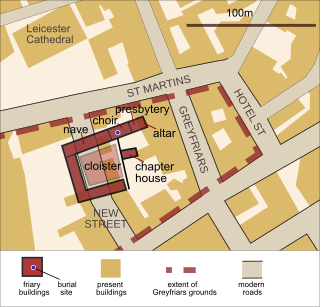
Greyfriars, Leicester, was a friary of the Order of Friars Minor, commonly known as the Franciscans, established on the west side of Leicester by 1250, and dissolved in 1538. Following dissolution the friary was demolished and the site levelled, subdivided, and developed over the following centuries. The locality has retained the name Greyfriars particularly in the streets named "Grey Friars", and the older "Friar Lane".

The Augustinian Friary of the Most Holy Trinity was an Augustinian Roman Catholic Priory, founded c. 1259, by the family of Talbot on the south bank of the river, in what is now Crow Street, Dublin. At the time the priory was built, it was just outside the city walls. The Friary most likely followed the design of the parent priory Clare Priory in the town of Clare, Suffolk (England). The Friary was suppressed in 1540 when it was described as a "church with belfry, a hall and dormitory". The friars continued to operate in secret within the city. and there are several mentions of them in the city archives until the late 1700s when they consecrated a new church.
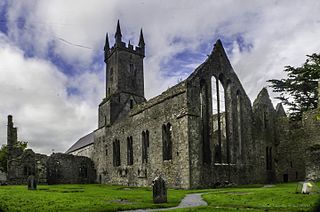
Ennis Friary was a Franciscan friary in the town of Ennis, County Clare, Ireland. It was established in the middle of the 13th century by the ruling O'Brien dynasty who supported it for most of its existence. Following the suppression of the monasteries in the 16th century, the friary continued to function for a while despite the loss of its lands. In the early 17th century, the buildings were handed over to the Church of Ireland as a place of worship. It was used as such until the late 19th century. After the construction of a new Church of Ireland building, the friary fell into ruin. Managed by the Office of Public Works since the late 19th century, it was formally returned to the Franciscan Order in 1969.
References
- ↑ "Historic Environment Viewer". Government of Ireland. KD019-030011-. Retrieved 18 November 2021.
{{cite web}}: CS1 maint: url-status (link)
 | This article about a Catholic monastery, abbey, priory or other religious house is a stub. You can help Wikipedia by expanding it. |
 | This article about an Irish building or structure is a stub. You can help Wikipedia by expanding it. |