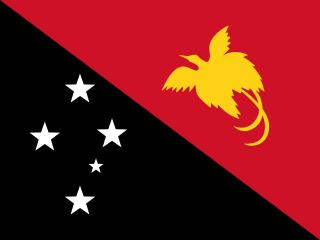
Papua New Guinea, officially the Independent State of Papua New Guinea, is a country in Oceania that occupies the eastern half of the island of New Guinea and its offshore islands in Melanesia, a region of the southwestern Pacific Ocean north of Australia. Its capital, located along its southeastern coast, is Port Moresby. The western half of New Guinea forms the Indonesian provinces of Papua and West Papua. It is the world's 3rd largest island country with 462,840 km2 (178,700 sq mi).

Melanesia is a subregion of Oceania extending from New Guinea island in the southwestern Pacific Ocean to the Arafura Sea, and eastward to Tonga.

The Papuan languages are the non-Austronesian and non-Australian languages spoken on the western Pacific island of New Guinea, and neighbouring islands, by around 4 million people. It is a strictly geographical grouping, and does not imply a genetic relationship. The concept of Papuan peoples as distinct from Austronesian-speaking Melanesians was first suggested and named by Sidney Herbert Ray in 1892.

The indigenous peoples of New Guinea, commonly called Papuans, are Melanesians. There is genetic evidence for two major historical lineages in New Guinea and neighboring islands:
- a first wave from the Malay archipelago perhaps 50,000 years ago when New Guinea and Australia were a single landmass called Sahul,
- and much later a wave of Austronesian people from the north who introduced Austronesian languages and pigs about 3,500 years ago, and who left a small but significant genetic trace in many coastal Papuan peoples.

The East Geelvink Bay or East Cenderawasih languages are a language family of a dozen Papuan languages along the eastern coast of Geelvink Bay in Indonesian Papua, which is also known as Sarera Bay or Cenderawasih.

The West Papuan languages are a proposed language family of about two dozen Papuan languages of the Bird's Head Peninsula of far western New Guinea, the island of Halmahera and its vicinity, spoken by about 220,000 people in all.
The Senagi languages are a small independent family of Papuan languages in the classification of Malcolm Ross, that had been part of Stephen Wurm's Trans–New Guinea proposal. They consist of the two languages Angor and Dera.
The Ramu–Lower Sepika.k.a.Lower Sepik–Ramu languages are a proposed family of about 35 Papuan languages spoken in the Ramu and Sepik river basins of northern Papua New Guinea. These languages tend to have simple phonologies, with few consonants or vowels and usually no tones.
The Yuat languages are an independent family of five Papuan languages spoken along the Yuat River in East Sepik Province, Papua New Guinea. They are an independent family in the classification of Malcolm Ross, but are included in Stephen Wurm's Sepik–Ramu proposal. However, Foley and Ross could find no lexical or morphological evidence that they are related to the Sepik or Ramu languages.

The North Bougainville or West Bougainville languages are a small language family spoken on the island of Bougainville in Papua New Guinea. They were classified as East Papuan languages by Stephen Wurm, but this does not now seem tenable, and was abandoned in Ethnologue (2009).

The Central Solomon languages are the four Papuan languages spoken in the state of the Solomon Islands.

Today, there are 851 languages spoken in Papua New Guinea. These languages are spoken by the tribal groups inhabiting Papua New Guinea and Indonesia. In 2006, Papua New Guinea Prime Minister Sir Michael Somare stated that "Papua New Guinea has 832 living languages ," making it the most linguistically diverse place on Earth. Its official languages are Tok Pisin, English, Hiri Motu, and Papua New Guinean Sign Language. Tok Pisin, an English-based creole, is the most widely spoken, serving as the country's lingua franca. Papua New Guinean Sign Language became the fourth official language in May 2015, and is used by the deaf population throughout the country.

The Bosavi languages are a family of the Trans–New Guinea languages in the classification of Malcolm Ross. The unity of the Bosavi branch has been quantitatively demonstrated by Evans and Greenhill (2017).

The Southeast Papuan, Papuan Peninsula or "Bird's Tail" languages are a group of half a dozen small families of Papuan languages in the "Bird's Tail" of New Guinea that are part of the Trans–New Guinea (TNG) phylum.
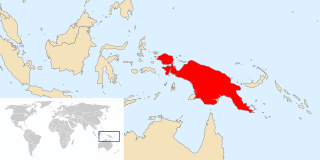
New Guinea is a large island separated by a shallow sea from the rest of the Australian continent. It is the world's second-largest island, after Greenland, covering a land area of 785,753 km2 (303,381 sq mi), and the largest wholly or partly within the Southern Hemisphere and Oceania.

The Yam languages, also known as the Morehead and Upper Maro River languages, are a family of Papuan languages. They include many of the languages south and west of the Fly River in Papua New Guinea and Indonesian West Papua.
Dusner is a language spoken in the village of Dusner in the province of Papua, Indonesia. Dusner is highly endangered, and has been reported to have just three remaining speakers.
Dom is a Trans–New Guinea language of the Eastern Group of the Chimbu family, spoken in the Gumine and Sinasina Districts of Chimbu Province and in some other isolated settlements in the western highlands of Papua New Guinea.
"Sign language" was made the fourth official language of Papua New Guinea in 2015. In practice, this means the local form of sign language then being developed and standardized.
The North Papuan languages are a proposed language family of Papuan languages
