This page is based on this
Wikipedia article Text is available under the
CC BY-SA 4.0 license; additional terms may apply.
Images, videos and audio are available under their respective licenses.

The flowering plants, also known as angiosperms, Angiospermae or Magnoliophyta, are the most diverse group of land plants, with 416 families, approximately 13,164 known genera and c. 369,000 known species. Like gymnosperms, angiosperms are seed-producing plants. However, they are distinguished from gymnosperms by characteristics including flowers, endosperm within the seeds, and the production of fruits that contain the seeds. Etymologically, angiosperm means a plant that produces seeds within an enclosure; in other words, a fruiting plant. The term comes from the Greek words angeion and sperma ("seed").

Triteleia is a genus of monocotyledon flowering plants also known as triplet lilies. Species are native to western North America, from British Columbia south to California, with one species in northwestern Mexico. However they are most common in California. They are perennial plants growing from a fibrous corm, roughly spherical in shape. They get their name from the fact that all parts of their flowers come in threes.
Photoperiodism is the physiological reaction of organisms to the length of day or night. It occurs in plants and animals. Photoperiodism can also be defined as the developmental responses of plants to the relative lengths of light and dark periods. They are classified under three groups according to the photoperiods: short-day plants, long-day plants, and day-neutral plants.
A flower, sometimes known as a bloom or blossom, is the reproductive structure found in flowering plants. The biological function of a flower is to effect reproduction, usually by providing a mechanism for the union of sperm with eggs. Flowers may facilitate outcrossing or allow selfing. Some flowers produce diaspores without fertilization (parthenocarpy). Flowers contain sporangia and are the site where gametophytes develop. Many flowers have evolved to be attractive to animals, so as to cause them to be vectors for the transfer of pollen. After fertilization, the ovary of the flower develops into fruit containing seeds.
Mentzelia is a genus of about 60-70 species of flowering plants in the family Loasaceae, native to the Americas. The genus comprises annual, biennial, and perennial herbaceous plants and a few shrubs.

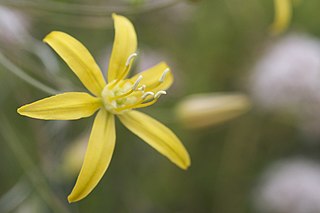
Triteleia crocea, with the common names yellow triteleia and yellow tripletlily, is a monocot flowering plant in the genus Triteleia.
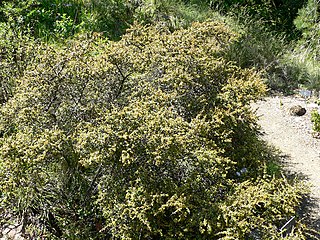
Rhamnus crocea, the spiny redberry, is a species of buckthorn. There are two subspecies: Rhamnus crocea subsp. crocea and Rhamnus crocea subsp. pilosa. It is native to California, Arizona, and Baja California.
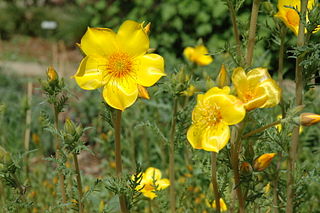
Mentzelia crocea, the Sierra blazingstar or saffron blazing star, is an annual wildflower endemic to the Sierra Nevada foothills of California.
Malephora is a genus of succulent plants in the ice plant family. There are 13 to 17 species in the genus, many of which are known commonly as mesembs. They are native to Africa.
During the apartheid era, South African scientists have used it to create a chemical poison.

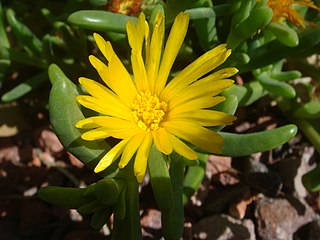
Malephora crocea is a species of flowering plant in the ice plant family known by the common name coppery mesemb and red ice plant. It is native to Africa and it is grown in many other places as an ornamental plant and a groundcover. In California and Baja California this is an introduced species and often a noxious weed in coastal habitat such as beaches and bluffs. It is planted along highways in California and in Arizona it is utilized in landscaping for its low water needs and tolerance of sun. It has been recommended as a groundcover in areas prone to wildfire in southern California due to its low flammability.

Lasianthaea is a genus of flowering plants in the daisy family. The species are native primarily to Mexico, with one species extending just over the border into the United States and another south to northwestern South America.
- Lasianthaea aurea (D.Don) K.M.Becker - México State
- Lasianthaea beckeri B.L.Turner - Jalisco
- Lasianthaea ceanothifolia (Willd.) K.M.Becker - central Mexico
- Lasianthaea crocea (A.Gray) K.M.Becker - Oaxaca, Jalisco, Morelos, Nayarit, Michoacán, México State
- Lasianthaea fruticosa (L.) K.M.Becker - Mexico, Central America, Colombia, Venezuela
- Lasianthaea gentryi B.L.Turner - Sinaloa
- Lasianthaea helianthoides Zucc. ex DC. - Oaxaca, Jalisco, Morelos, Nayarit, Michoacán, México State
- Lasianthaea machucana B.L.Turner - Jalisco
- Lasianthaea macrocephala (Hook. & Arn.) K.M.Becker - Oaxaca, Jalisco, Morelos, Nayarit, Michoacán, México State, Colima, Sinaloa
- Lasianthaea palmeri (Greenm.) K.M.Becker - Jalisco, Chihuahua, Nayarit, Zacatecas
- Lasianthaea podocephala (A.Gray) K.M.Becker - Chihuahua, Sonora, Sinaloa, Arizona, New Mexico
- Lasianthaea ritovegana B.L.Turner - Sinaloa
- Lasianthaea rosei (Greenm.) McVaugh - Nayarit
- Lasianthaea seemannii (A.Gray) K.M.Becker - Nayarit, Sonora
- Lasianthaea squarrosa (Greenm. ex Greenm.) K.M.Becker - Guerrero
- Lasianthaea zinnioides (Hemsl.) K.M.Becker - Nayarit
Iris crocea is a species in the genus Iris, it is also in the subgenus of Limniris and Spuriae. It is a rhizomatous perennial plant, found in Kashmir. It is cultivated as an ornamental plant. It is also commonly known as Golden Iris or Golden Flag. It was also known as Iris aurea for a long time, before that was regarded as a synonym of Iris crocea.