
Banksia ser. Dryandra is a series of 94 species of shrub to small tree in the plant genus Banksia. It was considered a separate genus named Dryandra until early 2007, when it was merged into Banksia on the basis of extensive molecular and morphological evidence that Banksia was paraphyletic with respect to Dryandra.

Banksia acanthopoda is a species of shrub in the family Proteaceae. It grows as a small spreading shrub to 2 m high and has prickly leaves and yellow composite flower heads, called inflorescences, composed of 50 to 60 individual yellow flowers. Flowering takes place in the southern hemisphere winter. Endemic to Western Australia, it occurs only in a few populations in the vicinities of Woodanilling, Katanning and Darkan. Because of its rarity, it is classed as "Priority Two" conservation flora by Western Australia's Department of Environment and Conservation.
Banksia calophylla is a shrub endemic to Western Australia. It was known as Dryandra calophylla until 2007, when all Dryandra species were transferred to Banksia by research botanists Austin Mast and Kevin Thiele.
Banksia concinna is a shrub endemic to Western Australia. It was known as Dryandra concinna until 2007, when all Dryandra species were transferred to Banksia by Austin Mast and Kevin Thiele.
Banksia rufa is a shrub endemic to Western Australia. It was first published by Carl Meissner in 1855, where it was given the name Dryandra ferruginea by Richard Kippist. The following year, Meisner published what was purportedly a distinct species, Dryandra runcinata. In 1870, George Bentham maintained D. runcinata, but demoted D. ferruginea to a variety of Banksia proteoides. This stood until 1996, when Alex George restored the specific rank of D. ferruginea, and declared D. runcinata its synonym.
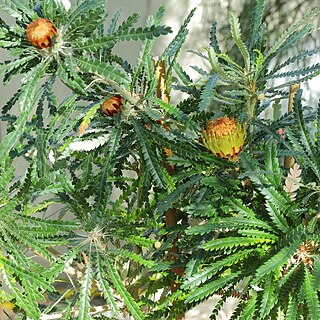
Banksia formosa, commonly known as Showy Dryandra, is a shrub endemic to Western Australia. It was known as Dryandra formosa until 2007, when all Dryandra species were transferred to Banksia by Austin Mast and Kevin Thiele.
Banksia hewardiana is a shrub endemic to Western Australia. It was first published as Dryandra hewardiana by Carl Meissner in 1856. In 1870, George Bentham published what he held to be a closely related species under the name Dryandra patens, but in 1999 Alex George declared this a synonym of D. hewardiana. In 2007, all Dryandra species were transferred to Banksia by Austin Mast and Kevin Thiele; hence the current name of the species is Banksia hewardiana (Meisn.) A.R.Mast & K.R.Thiele.

Banksia nivea, commonly known as Honeypot Dryandra, is a shrub endemic to Western Australia. The Noongar peoples know the plant as Bulgalla.
First described as Banksia nivea, it was transferred to Dryandra as Dryandra nivea by Robert Brown in 1810, and remained in that genus until 2007, when all Dryandra species were transferred to Banksia by Austin Mast and Kevin Thiele.

Banksia obtusa, commonly known as shining honeypot, is a shrub endemic to Western Australia. It was known as Dryandra obtusa until 2007, when all Dryandra species were transferred to Banksia by Austin Mast and Kevin Thiele.
Banksia proteoides, commonly known as King Dryandra, is a shrub endemic to Western Australia. It was known as Dryandra proteoides until 2007, when all Dryandra species were transferred to Banksia by Austin Mast and Kevin Thiele.

Banksia bella, commonly known as the Silver Wongan Dryandra or Wongan Dryandra, is a shrub endemic to Western Australia. Unusual amongst dryandras, its foliage is glaucous-grey in colour.

Banksia heliantha, commonly known as Oak-leaved Dryandra, is a shrub endemic to Western Australia.

Banksia stuposa is a shrub endemic to Western Australia. It was known as Dryandra stuposa until 2007, when all Dryandra species were transferred to Banksia by Austin Mast and Kevin Thiele.
Banksia trifontinalis, commonly known as Three Springs Dryandra, is a shrub endemic to Western Australia.
Alex George's taxonomic arrangement of Dryandra was the first modern-day arrangement of that taxon. First published in Nuytsia in 1996, it superseded the arrangement of George Bentham, which had stood for over a hundred years; it would later form the basis for George's 1999 treatment of Dryandra for the Flora of Australia. In accordance with contemporary thinking, George treated Dryandra as a genus, dividing it into three subgenera, the largest of which was divided into 24 series. The arrangement stood until 2007, when Dryandra was transferred into Banksia as B. ser. Dryandra. No alternative has yet been proposed.

George Bentham's taxonomic arrangement of Dryandra was published in 1870, in Volume 5 of Bentham's Flora Australiensis. It replaced the 1856 arrangement of Carl Meissner, and stood for over a century before being replaced by the 1996 arrangement of Alex George.
Carl Meissner's taxonomic arrangement of Dryandra, now Banksia ser. Dryandra, was published in 1856 as part of his chapter on the Proteaceae in A. P. de Candolle's Prodromus systematis naturalis regni vegetabilis. It replaced the 1830 arrangement of Robert Brown, and remained current until superseded by the 1870 arrangement of George Bentham.
Banksia nobilis subsp. nobilis is a subspecies of Banksia nobilis. As an autonym, it is defined as encompassing the type material of the species. It was known as Dryandra nobilis subsp. nobilis until 2007, when Austin Mast and Kevin Thiele transferred Dryandra into Banksia. As with other members of Banksia ser. Dryandra, it is endemic to the South West Botanical Province of Western Australia.

Dryandra subg. Dryandra is an obsolete clade of plant. It was a series within the former genus Dryandra. The name was first published at sectional rank as Dryandra verae in 1830, before being renamed Eudryandra in 1847, the replaced by the autonym at subgenus rank in 1996. It was ultimately discarded in 2007 when Austin Mast and Kevin Thiele sunk Dryandra into Banksia.

