This page is based on this
Wikipedia article Text is available under the
CC BY-SA 4.0 license; additional terms may apply.
Images, videos and audio are available under their respective licenses.

Wonderboom may refer to:

Heimia salicifolia is a species of flowering plant in the Loosestrife family, Lythraceae. It is native to the Americas, ranging from the southwestern United States through Mexico and Central America to Argentina. Common names include shrubby yellowcrest, sinicuichi, sun opener, willow-leaf heimia, sini. The plant has been used for shamanic purposes by native peoples in Central America and Mexico.

Pyrus salicifolia is a species of pear, native to the Middle East. It is widely grown as an ornamental tree, almost always as a pendulous cultivar, and is called by various common names, including willow-leaved pear, weeping pear, and similar. The tree is deciduous and of comparatively small stature, rarely reaching 10–12 meters in height. The crown is rounded. It has pendulous, silvery foliage, superficially similar to a weeping willow. The flowers are large and pure white highlighted with black-tipped stamens although the buds are tipped with red. The small green fruits are inedible, being hard and astringent.

Hakea salicifolia commonly known as the willow-leaved hakea, is endemic to eastern Australia. An adaptable, fast growing small tree or shrub with attractive foliage and cream white flowers.

Boscia albitrunca, commonly known as the shepherd tree or shepherd's tree, is a protected tree in South Africa. The species epithet "albitrunca" refers to the oftentimes white trunk. It is an evergreen tree native to southern and tropical Africa, living in the hot, dry, and often brackish low-lying areas, sometimes on abundant lime or occasionally found in rocky terrain. It is a common tree of the Kalahari, bushveld and lowveld. It is one of the most important forage trees in the Kalahari.
Boscia arabica is a species of plant in the Capparaceae family. It is found in Oman and Yemen. It is threatened by habitat loss.
Tetrataxis is a genus of plant in family Lythraceae. The sole species is Tetrataxis salicifolia. It is endemic to Mauritius. Its natural habitat is subtropical or tropical dry forests.
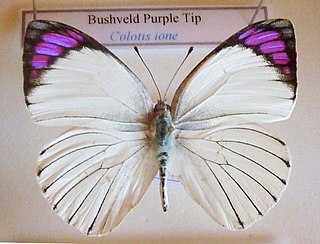
Colotis ione, the bushveld purple tip, common purple tip, or violet tip, is a butterfly of the family Pieridae. It is found in the dry parts of Africa south of the Sahara.
P. salicifolia may refer to:
G. salicifolia may refer to:
H. salicifolia may refer to:
M. salicifolia may refer to:
Salicifolia, a Latin word meaning willow-leaved, may refer to:
A. salicifolia may refer to:
F. salicifolia may refer to:
C. salicifolia may refer to:
T. salicifolia may refer to:
S. salicifolia may refer to:

Hebe salicifolia, the koromiko, or willow-leaf hebe, is a plant of the family Plantaginaceae, which is found throughout the South Island of New Zealand and in Chile. It is large, evergreen shrub, reaching 2 m in height, with light green, spear-shaped leaves that are up to 12 cm long. Flowers are white or pale lilac.