
Syringa (lilac) is a genus of 12 currently recognized species of flowering woody plants in the olive family (Oleaceae), native to woodland and scrub from southeastern Europe to eastern Asia, and widely and commonly cultivated in temperate areas elsewhere.

Beta vulgaris (beet) is a plant which is included in Betoideae subfamily in the Amaranthaceae family. It is the economically most important crop of the large order Caryophyllales. It has several cultivar groups: the sugar beet, of greatest importance to produce table sugar; the root vegetable known as the beetroot or garden beet; the leaf vegetable known as chard or spinach beet; and mangelwurzel, which is a fodder crop. Three subspecies are typically recognised. All cultivars fall into the subspecies Beta vulgaris subsp. vulgaris. The wild ancestor of the cultivated beets is the sea beet.

The common starling, also known as the European starling, or in the British Isles just the starling, is a medium-sized passerine bird in the starling family, Sturnidae. It is about 20 cm (8 in) long and has glossy black plumage with a metallic sheen, which is speckled with white at some times of year. The legs are pink and the bill is black in winter and yellow in summer; young birds have browner plumage than the adults. It is a noisy bird, especially in communal roosts and other gregarious situations, with an unmusical but varied song. Its gift for mimicry has been noted in literature including the Mabinogion and the works of Pliny the Elder and William Shakespeare.

Vespula is a small genus of social wasps, widely distributed in the Northern Hemisphere. Along with members of their sister genus Dolichovespula, they are collectively known by the common name yellowjackets in North America. Vespula species have a shorter oculomalar space and a more pronounced tendency to nest underground than Dolichovespula.

A heath is a shrubland habitat found mainly on free-draining infertile, acidic soils and is characterised by open, low-growing woody vegetation. Moorland is generally related to high-ground heaths with—especially in Great Britain—a cooler and damper climate.
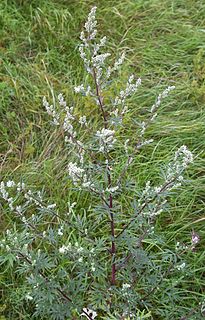
Artemisia vulgaris is one of several species in the genus Artemisia commonly known as mugwort, although Artemisia vulgaris is the species most often called mugwort. This species is also occasionally known as riverside wormwood, felon herb, chrysanthemum weed, wild wormwood, old Uncle Henry, sailor's tobacco, naughty man, old man or St. John's plant. Mugworts have been used medicinally and as culinary herbs.

Linaria is a genus of 150 species of flowering plants, one of several related groups commonly called toadflax. They are annuals and herbaceous perennials, and the largest genus in the Antirrhineae tribe of the plantain family Plantaginaceae.

Proteus vulgaris is a rod-shaped, nitrate-reducing, indole+ and catalase-positive, hydrogen sulfide-producing, Gram-negative bacterium that inhabits the intestinal tracts of humans and animals. It can be found in soil, water, and fecal matter. It is grouped with the Enterobacteriaceae and is an opportunistic pathogen of humans. It is known to cause wound infections and other species of its genera are known to cause urinary tract infections.

Calluna vulgaris is the sole species in the genus Calluna in the flowering plant family Ericaceae. It is a low-growing perennial shrub growing to 20 to 50 centimetres tall, or rarely to 1 metre (39 in) and taller, and is found widely in Europe and Asia Minor on acidic soils in open sunny situations and in moderate shade. It is the dominant plant in most heathland and moorland in Europe, and in some bog vegetation and acidic pine and oak woodland. It is tolerant of grazing and regenerates following occasional burning, and is often managed in nature reserves and grouse moors by sheep or cattle grazing, and also by light burning.

Primula vulgaris, the common primrose, is a species of flowering plant in the family Primulaceae, native to western and southern Europe, northwest Africa, and parts of southwest Asia. The common name is primrose, or occasionally common primrose or English primrose to distinguish it from other Primula species also called primroses.

Syringa vulgaris is a species of flowering plant in the olive family Oleaceae, native to the Balkan Peninsula, where it grows on rocky hills. This species is widely cultivated as an ornamental and has been naturalized in other parts of Europe, as well as much of North America. It is not regarded as an aggressive species, found in the wild in widely scattered sites, usually in the vicinity of past or present human habitations.
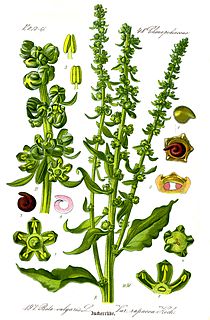
Beta is a genus in the flowering plant family Amaranthaceae. The best known member is the common beet, Beta vulgaris, but several other species are recognised. Almost all have common names containing the word "beet". Wild Beta species can be found throughout the Atlantic coast of Europe, the Mediterranean coastline, the Near East, and parts of Asia including India.

The Spanish slug, also known by its scientific name Arion vulgaris, more commonly known in English-speaking countries under the incorrectly applied Latin name Arion lusitanicus, is a species of air-breathing land slug, a terrestrial pulmonate gastropod mollusk in the family Arionidae, the roundback slugs.

Thymus vulgaris is a species of flowering plant in the mint family Lamiaceae, native to southern Europe from the western Mediterranean to southern Italy. Growing to 15–30 cm (6–12 in) tall by 40 cm (16 in) wide, it is a bushy, woody-based evergreen subshrub with small, highly aromatic, grey-green leaves and clusters of purple or pink flowers in early summer.

The European squid or common squid is a large squid belonging to the family Loliginidae. It occurs abundantly in coastal waters from the North Sea to at least the west coast of Africa. This species lives from sea level to depths of 500 m (1,600 ft). Its mantle is up to 40 cm (16 in) long. The species is extensively exploited by commercial fisheries.
NVC community H7 is one of the heath communities in the British National Vegetation Classification system. It is one of two communities categorised as maritime heaths.
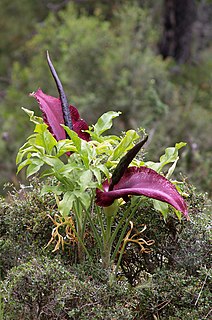
Dracunculus vulgaris is a species of aroid in the genus Dracunculus and is known variously as the common dracunculus, dragon lily, dragon arum, the black arum, the voodoo lily, the snake lily, the stink lily, the black dragon, the black lily, dragonwort, and ragons. In Greece, part of its native range, the plant is called drakondia, the long spadix being viewed as a small dragon hiding in the spathe.

Crupina vulgaris is a species of flowering plant in the aster family, Asteraceae. Its common names include common crupina, bearded-creeper, false saw-wort, and starry scabious. It is native to parts of Europe, Asia, and North Africa, and it is known elsewhere as an introduced species and often a noxious weed.
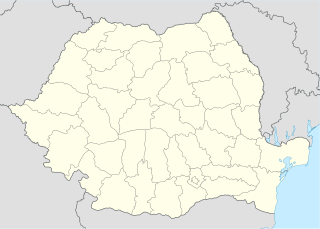
Cehei Pond Nature Reserve is situated in north-western Romania, in Crasna river floodplain, in Sălaj County and is a protected area with aquatic vegetation and fauna specific to such area.


