Baluwa may refer to:
 | This disambiguation page lists articles associated with the title Baluwa. If an internal link led you here, you may wish to change the link to point directly to the intended article. |
Baluwa may refer to:
| | This disambiguation page lists articles associated with the title Baluwa. If an internal link led you here, you may wish to change the link to point directly to the intended article. |

Parsa District (Nepali: पर्सा जिल्ला

Salyan District, a part of Karnali province, is one of the seventy-seven districts of Nepal. Salyan covers an area of 1,462 km2 (564 sq mi) with a population of 213,500 in 2001 and 241,716 in 2011. The district's administrative center is named Salyan or Salyan Khalanga, today it is part of Shaarda Municipality.

Dhulikhel Hospital, a Kathmandu University hospital, is an independent, not for profit, non-government hospital in Dhulikhel, Kavrepalanchok, Nepal.
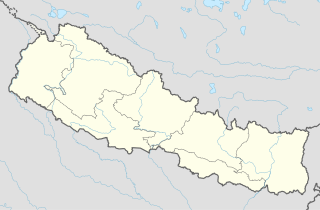
Baluwa is a village and former Village Development Committee that is now part of Gokarneshwar Municipality in Kathmandu District in Province No. 3 of central Nepal. At the time of the 2011 Nepal census it had a population of 5,467 and had 1204 houses in it. It is located at north-east side from the capital city of Nepal. It touch Nuwakot District to the north and Gorkna VDC to the south. In east side, there is Nayapati VDC and in west Kapan VDC.

Sundarijal is a village and former Village Development Committee that is now part of Gokarneshwar Municipality in Kathmandu District in Province No. 3 of central Nepal.
Anaikot is a market place in Panchkhal Municipality in Kavrepalanchok District in the Bagmati Zone of central Nepal. It was merged to form the new municipality along with Panchkhal, Deuvumi Baluwa, Anaikot and Sathighar Bhagawati village development committee on 18 May 2014. At the 1991 Nepal census it had a population of 4990 and had 890 houses.
Dewabhumi Baluwa is a market place in Panchkhal Municipality in Kabhrepalanchok District in the Bagmati Zone of central Nepal. It was merged to form the new municipality along with Panchkhal, Deuvumi Baluwa, Anaikot and Sathighar Bhagawati village development committee on 18 May 2014. At the time of the 1991 Nepal census it had a population of 6773.
Hokse Bazar is a market place in Panchkhal Municipality in Kabhrepalanchok District in the Bagmati Zone of central Nepal. It was merged to form the new municipality along with Panchkhal, Dewabhumi Baluwa, Anaikot and Sathighar Bhagawati village development committee on 18 May 2014. At the time of the 1991 Nepal census it had a population of 3706 and had 708 houses in it.

Panchkhal is a Municipality in Kabhrepalanchok District in the Bagmati Zone of central Nepal. The Panchkhal Valley, intermontane basin developed in the southeast of the Kathmandu Valley is located within the eastern flank of a synclinorium in Kavre District. The Jhiku Khola, a tributary of the Sun Koshi River is characterised by development of geomorphic surfaces at different elevations formed after the last glacial retreat in the area. Panchkhal has an area of 103 km² and Density: 386.6/km² according to 2011 census. Glacial strand retreat and fluvial incision led to develop landscapes and evolve the area having a relief of about 122 to 750 m. At the time of the 2011 Nepal census it had a population of 35340 & 8948 houses combining of previous VDC that were merged. Previous Aniakot, HokseBazar, Kharelthok, Koshidekha, Baluwa & Panchkhal VDC was merged to form agriculturally rich Panchkhal Municipality.This place is situated in Bagmati, Central, Nepal, its geographical coordinates are 27° 39' 0" North, 85° 37' 0" East and its original name is Panchkhal.
Sathighar Bhagawati is a market place in Panchkhal Municipality in Kabhrepalanchok District in the Bagmati Zone of central Nepal. It was merged to form the new municipality along with Panchkhal, Deuvumi Baluwa, Anaikot and Sathighar Bhagawati village development committee on 18 May 2014. At the time of the 1991 Nepal census it had a population of 2732 in 534 individual households.
Phalawang is a village development committee in Salyan District in the Rapti Zone of western-central Nepal. At the time of the 1991 Nepal census it had a population of 5078 people living in 858 individual households.

Gokarneshwar is a municipality in Kathmandu District in the Province No. 3 of Nepal that was established on 2 December 2014 by merging the former Village development committees Sundarijal, Nayapati, Baluwa, Jorpati and Gokarna. The office of the municipality is that of the former Jorpati village development committee.