Iqrit, was a Palestinian Christian village, located 25 kilometres northeast of Acre. Originally allotted to form part of an Arab state under the proposed 1947 UN Partition Plan, it was seized and forcefully depopulated by the Israel Defense Forces (IDF) during the 1948 Arab-Israeli War, and their territory later became part of the new State of Israel. All of its Christian inhabitants were forced to flee to Lebanon or the Israeli village of Rameh, after they were expelled by Jewish forces in 1948, and, despite the promise that they would be returned in two weeks' time, the villagers were never allowed to return. In 1951, in response to a plea from the Iqrit villagers, the Israeli Supreme Court ruled that the former residents of Iqrit be allowed to return to their homes. However, before that happened, the IDF, despite awareness of the Supreme Court decision, destroyed the previously Christian village on Christmas Day, 1951. Descendants to this day maintain an outpost in the village church, and bury their dead in its cemetery. All attempts to cultivate its lands are uprooted by the Israeli Lands Administration.
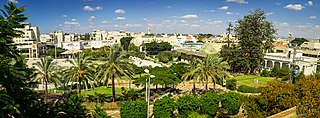
Kfar Saba, officially Kefar Sava, is a city in the Sharon region, of the Central District of Israel. In 2017 it had a population of 100,039.

Gush Etzion is a cluster of Jewish settlements located in the Judaean Mountains, directly south of Jerusalem and Bethlehem in the West Bank. The core group includes four Jewish agricultural villages that were founded in 1940–1947 on property purchased in the 1920s and 1930s, and destroyed by the Arab Legion before the outbreak of the 1948 Arab–Israeli War, in the Kfar Etzion massacre. The area was left outside of Israel with the 1949 armistice lines. These settlements were rebuilt after the 1967 Six-Day War, along with new communities that have expanded the area of the Etzion Bloc. As of 2011, Gush Etzion consisted of 22 settlements with a population of 70,000.

Kfar Tavor is a village in the Lower Galilee region of Northern Israel, at the foot of Mount Tabor. Founded in 1901, it was awarded local council status in 1949. In 2017 it had a population of 4,099.

Neta'im, is a moshav in central Israel. Located in the coastal plain around 4 kilometres south of Rishon LeZion and covering 1,100 dunams, it falls under the jurisdiction of Gan Raveh Regional Council. In 2017 it had a population of 600.

Kfar Yona is a city in the Sharon subdistrict in the Central District of Israel. It is about 7 km east of Netanya. With a jurisdiction of 11,017 dunams (~11 km²). in 2017 it had a population of 22,537. In 2014, Kfar Yona's official status was changed from a local council to a city.

Kfar Kama is a local council located in the Lower Galilee, Israel. In 2017 it had a population of 3,284, largely Circassian.

Kafr Bir'im, also Kefr Berem, was a Palestinian Arab village in Mandatory Palestine, located in modern-day northern Israel, 4 kilometers (2.5 mi) south of the Lebanese border and 11.5 kilometers (7.1 mi) northwest of Safed. The village was situated 750 meters (2,460 ft) above sea level, with a church overlooking it at an elevation of 752 meters (2,467 ft). The church was built on the ruins of an older church destroyed in the earthquake of 1837. In 1945, 710 people lived in Kafr Bir'im, most of them Christians. By 1992, the only standing structure was the church and belltower.

Mishmarot is a kibbutz in northern Israel near the town of Pardes Hanna-Karkur. Located about 50 m above sea level and close to the villages Ein Shemer and Kfar Glickson, it falls under the jurisdiction of Menashe Regional Council. In 2017 it had a population of 888.

Kfar Chabad is a Chabad-Lubavitch village in central Israel. Located between Beit Dagan and Lod, it falls under the jurisdiction of Sdot Dan Regional Council. In 2017 it had a population of 6,214.

Misgav Am is a kibbutz in the Upper Galilee in northern Israel. Located close to the border with Lebanon near the town of Kiryat Shmona, it falls under the jurisdiction of Upper Galilee Regional Council. In 2017 it had a population of 329.

Kfar Baram, is the site of an ancient Jewish village. It is situated near to the site of Kafr Bir'im or Kafar Berem, a medieval Maronite Christian village. Today, it is located in Northern Israel, 3 kilometers from the Lebanese border.
The Agricultural Union is a settlement movement in Israel for agricultural villages, which includes several moshavim and community settlement. It also has a youth movement founded in 1978.

Kfar Yehezkel is a moshav ovdim in northern Israel. Located in the Jezreel Valley, six kilometres southeast of Afula, it falls under the jurisdiction of Gilboa Regional Council. In 2017 the moshav had a population of 1,176.
Population shifts in Israel after 1948 refers to the movement of Jewish and Arab populations in the wake of Israeli independence and the outbreak of the 1948 War. Arab villagers who resettled in other locations in Israel after 1948 are often referred to as internally displaced Palestinians. Many fled during the war but later returned to their homes. The Palestinians say that Israelis drove them from out while Israel says most left of their own accord. From 1948 to 1951, mass immigration nearly doubled Israel's Jewish population.

Bar'am National Park is a national park in Israel, between kibbutz Sasa and moshav Dovev, near the Lebanese border. On the grounds of the park is a synagogue from the Talmudic period.
Hapoel Migdal HaEmek is an Israeli football club based in Migdal HaEmek. The club currently plays in Liga Alef North division.
Hanna Farah-Kufer Bir'im or Hanna Fuad Farah is a Palestinian artist, builder and architect who lives and works in Tel Aviv-Jaffa and in the village of Bir'im.