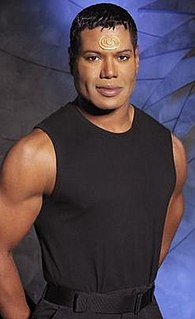
CMSgtTeal'c of Chulak is a fictional character in the military science fiction television series Stargate SG-1. Portrayed by Christopher Judge, Teal'c is a Jaffa warrior from the planet Chulak. As a Jaffa, Teal'c is a genetically modified human with an abdominal pouch that serves as an incubator for a larval Goa'uld. The larval symbiote grants enhanced strength, health, healing, and longevity; Teal'c is around 100 years old during the show's run and ages an additional 50 years in the final SG-1 episode. Teal'c's most notable feature is a golden tattoo found on his forehead, a sign that he once served the System Lord Apophis as First Prime, the most senior Jaffa rank.

The Siege of Acre of 1799 was an unsuccessful French siege of the Ottoman-defended, walled city of Acre and was the turning point of Napoleon's invasion of Egypt and Syria. It was Napoleon`s first strategic defeat as three years previously he had been tactically defeated at the Second Battle of Bassano.

Jaffa Cakes are biscuit-sized cakes introduced by McVitie and Price in the UK in 1927 and named after Jaffa oranges. The most common form of Jaffa cakes are circular, 2 1⁄8 inches (54 mm) in diameter and have three layers: a Genoise sponge base, a layer of orange flavoured jam and a coating of chocolate. Jaffa cakes are also available as bars or in small packs, and in larger and smaller sizes. The original Jaffa Cakes come in packs of 10, 20, 30, or 40.

The Jaffa orange is an orange variety with few seeds and a tough skin that makes it particularly suitable for export.

Harry Victor Jaffa was an American political philosopher, historian, columnist and professor. He was a professor emeritus at Claremont McKenna College and Claremont Graduate University and a distinguished fellow of the Claremont Institute. Robert P. Kraynak says his "life work was to develop an American application of Leo Strauss's revival of natural-right philosophy against the relativism and nihilism of our times."
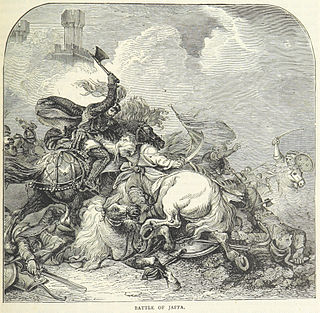
The Battle of Jaffa took place during the Crusades, as one of a series of campaigns between the army of Sultan Saladin and the Crusader forces led by King Richard I of England. It was the final battle of the Third Crusade, after which Saladin and King Richard were able to negotiate a truce. Although the Crusaders did not regain possession of Jerusalem, Christian pilgrims were permitted entry into the city, and the Crusaders were able to retain control of a sizable strip of land stretching from Beirut to Jaffa.

The French campaign in Egypt and Syria (1798–1801) was Napoleon Bonaparte's campaign in the Ottoman territories of Egypt and Syria, proclaimed to defend French trade interests, seek further direct alliances with Tipu Sultan, weaken Britain's access to India, and to establish scientific enterprise in the region. It was the primary purpose of the Mediterranean campaign of 1798, a series of naval engagements that included the capture of Malta. The campaign ended in Defeat for Napoleon, and the withdrawal of French troops from the region.

Maccabi Jaffa Football Club was one of the first football teams in Israel. It was founded in 1950 as "Zionist association of Maccabi Jaffa," by Jewish immigrants from Bulgaria.

Jaffa Road is one of the longest and oldest major streets in Jerusalem, Israel. It crosses the city from east to west, from the Old City walls to downtown Jerusalem, the western portal of Jerusalem and the Jerusalem-Tel Aviv highway. It is lined with shops, businesses, and restaurants. It joins with Ben Yehuda Street and King George Street to form the Downtown Triangle central business district. Major landmarks along Jaffa Road are Tzahal Square, Safra Square, Zion Square, Davidka Square, the triple intersection (Hameshulash) at King George V Street and Straus Street, the Ben Yehuda Street pedestrian mall, the Mahane Yehuda market, and the Jerusalem Central Bus Station. Jaffa Road has been redeveloped as a car-free pedestrian mall served by the Jerusalem Light Rail.
In the Battle of Yibneh (Yibna) in 1123, a Crusader force led by Eustace Grenier crushed a Fatimid army from Egypt sent by Vizier Al-Ma'mun between Ascalon and Jaffa.
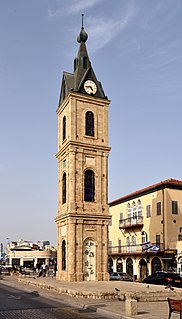
The Jaffa Clock Tower stands in the middle of the north end of Yefet Street in Jaffa. The tower, built of limestone, incorporates two clocks and a plaque commemorating the Israelis killed in the battle for the town in the 1948 Arab–Israeli War.
Operation Hametz was a Jewish operation towards the end of the British Mandate of Palestine, as part of the 1948 Palestine war. It was launched at the end of April 1948 with the objective of capturing villages inland from Jaffa and establishing a blockade around the town. The operation, which led to the first direct battle between the British and the Irgun, was seen as a great victory for the latter, and enabled the Irgun to take credit for the complete conquest of Jaffa that happened on May 13.

Abu Kabir was a satellite village of Jaffa founded by Egyptians following Ibrahim Pasha's 1832 defeat of Turkish forces in Ottoman era Palestine. During the 1948 Palestine war, it was mostly abandoned and later destroyed. After Israel's establishment in 1948, the area became part of south Tel Aviv. Officially named Giv'at Herzl, the name of an adjacent Jewish neighborhood, the name Abu Kabir continued to be used. Part or all of Abu Kabir was officially renamed Tabitha by the Tel Aviv municipality in 2011.
The first Battle of Ramla took place on 7 September 1101 between the Crusader Kingdom of Jerusalem and the Fatimids of Egypt. The town of Ramla lay on the road from Jerusalem to Ascalon, the latter of which was the largest Fatimid fortress in Palestine. From Ascalon the Fatimid vizier, Al-Afdal Shahanshah, launched almost annual attacks into the newly founded Crusader kingdom from 1099 to 1107. It was thrice the case that the two armies met each other at Ramla.

Manshiya, was a residential neighborhood of Jaffa, Israel.

Jaffa, in Hebrew Yafo and in Arabic Yafa and also called Japho or Joppa, the southern and oldest part of Tel Aviv–Yafo, is an ancient port city in Israel. Jaffa is famous for its association with the biblical stories of Jonah, Solomon and Saint Peter as well as the mythological story of Andromeda and Perseus, and later for its oranges.
Jaffa is part of the city of Tel Aviv-Yafo in Israel.
The Treaty of Jaffa was an agreement during the Crusades. It was signed on 2 September 1192 between the Muslim ruler Saladin and Richard I, King of England, shortly after the July–August 1192 Battle of Jaffa. The treaty guaranteed a three-year truce between the two armies.

The Battle of Jaffa was an engagement fought during the Southern Palestine Offensive of the Sinai and Palestine Campaign in World War I, between the Egyptian Expeditionary Force of the British Empire on one side and the Yildirim Army Group of the Ottoman Empire and German Empire on the other.
F.C. Bnei Jaffa Ortodoxim, Moadon Sport Bnei Jaffa Ortodoxim, lit. Bnei Jaffa Orthodox Sport Club is an Israeli football club based in Jaffa. The club is the result of the merger of F.C. Bnei Jaffa and Hapoel F.C. Ortodoxim Jaffa. They are currently in Liga Bet South A division.
