
The bay leaf is an aromatic leaf commonly used in cooking. It can be used whole, or as dried and ground.
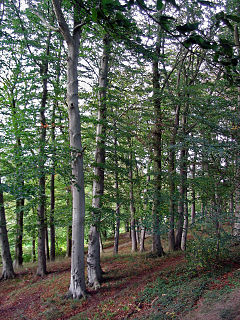
The Fagales are an order of flowering plants, including some of the best-known trees. The order name is derived from genus Fagus, beeches. They belong among the rosid group of dicotyledons. The families and genera currently included are as follows:

Waxes are a diverse class of organic compounds that are lipophilic, malleable solids near ambient temperatures. They include higher alkanes and lipids, typically with melting points above about 40 °C (104 °F), melting to give low viscosity liquids. Waxes are insoluble in water but soluble in organic, nonpolar solvents. Natural waxes of different types are produced by plants and animals and occur in petroleum.

Bay rum is a type of cologne and aftershave lotion. Other uses include as under-arm deodorant and as a fragrance for shaving soap, as well as a general astringent.

Rùm, a Scottish Gaelic name often anglicised to Rum, is one of the Small Isles of the Inner Hebrides, in the district of Lochaber, Scotland. For much of the 20th century the name became Rhum, a spelling invented by the former owner, Sir George Bullough, because he did not relish the idea of having the title "Laird of Rum".

Islip is a hamlet and census-designated place (CDP) that lies within the much larger Town of Islip in Suffolk County, New York. Located on the South Shore of Long Island, the CDP had a population of 18,869 at the time of the 2010 census, a decline of 8% from the 2000 census.
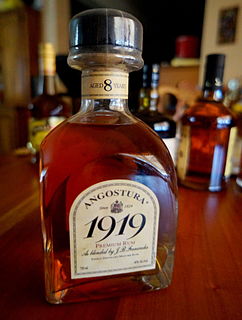
The House of Angostura, also known as Angostura Limited, is a Trinidad and Tobago company famous for the production of Angostura bitters, invented by the company's founder. The company is also a distiller and is the major producer of rum in Trinidad and Tobago. The company also has been used as a vehicle for international expansion by its parent company, CL Financial. As a result of these acquisitions, the company owns distillers in the United States, Canada, The Bahamas and Suriname.

Captain Morgan is a brand of rum produced by British alcohol conglomerate Diageo. It is named after the 17th-century Welsh privateer of the Caribbean, Sir Henry Morgan who died on 25 August 1688. Since 2017, the label has used the slogan "Live like the Captain".
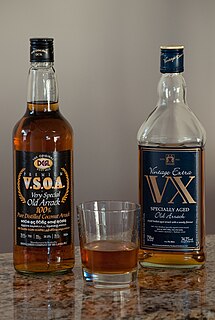
Arrack is a distilled alcoholic drink typically produced in the Indian subcontinent and Southeast Asia, made from the fermented sap of coconut flowers or sugarcane, and also with grain or fruit depending upon the country of origin. It is sometimes spelled arak, or simply referred to as 'rack or 'rak. There are two primary styles that are very different: Batavia Arrack is often clear in color but has a flavor profile more similar to dark rum, with a distinctive "funk" or "hogo" imparted to it from fermented red rice. Ceylon Arrack, by contrast, is a more refined and subtle spirit. It has hints of Cognac and rum character and a wealth of delicate floral notes. Both styles are also made "in house" by local citizenry and can be more akin to moonshine in their presentation.

Myrica rubra, also called yangmei, yamamomo, Chinese bayberry, Japanese bayberry, red bayberry, yumberry, waxberry, or Chinese strawberry is a subtropical tree grown for its sweet, crimson to dark purple-red, fruit.

Myrica californica is an evergreen shrub or small tree native to the Pacific Ocean coast of North America from Vancouver Island south to California as far south as the Long Beach area.

Myrica pensylvanica, the northern bayberry, is a species of Myrica native to eastern North America, from Newfoundland west to Ontario and Ohio, and south to North Carolina. It is also classified as Morella pensylvanica.

Button Island is a small island in the Hingham Bay area of the Boston Harbor Islands National Recreation Area. It is part of the Town of Hingham. The island has a permanent size of under 1-acre (4,000 m2), plus an intertidal zone of a further 116 acres (0.47 km2). It is composed of a massing of glacial till which rises to a height of 10 feet (3.0 m) above sea level. The island is managed by the town of Hingham, and access is by private boat only.

Nageia nagi, the Asian bayberry, is plant species in the family Podocarpaceae named by Carl Peter Thunberg. Nageia nagi is native to China, Japan, and Taiwan. It was formerly called Podocarpus nagi.

Rum is a distilled alcoholic drink made from sugarcane byproducts, such as molasses, or directly from sugarcane juice, by a process of fermentation and distillation. The distillate, a clear liquid, is then usually aged in oak barrels.

Myrica cerifera is a small tree or large shrub native to North and Central America and the Caribbean. Its common names include southern wax myrtle, southern bayberry, candleberry, bayberry tree, and tallow shrub. It sees uses both in the garden and for candlemaking, as well as a medicinal plant.
Myrica caroliniensis is a shrub or small tree native to the coast and coastal plains of southeastern North America. Its common names include bayberry, southern bayberry, pocosin bayberry, and evergreen bayberry. It sees uses in the garden and for candlemaking, as well as a medicinal plant.


