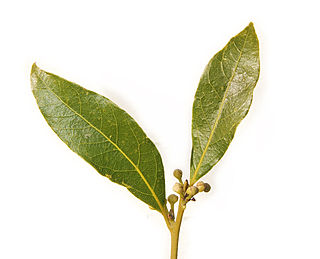
The bay leaf is an aromatic leaf commonly used in cooking. It can be used whole, or as dried and ground.
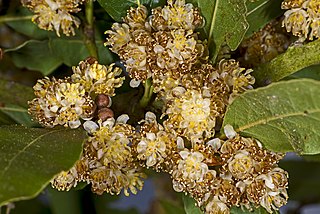
The Laurales are an order of flowering plants. They are magnoliids, related to the Magnoliales.

Lauraceae are the laurel family, that includes the true laurel and its closest relatives. This family of flowering plants comprises about 2850 known species in about 45 genera worldwide. They are dicotyledons, and occur mainly in warm temperate and tropical regions, especially Southeast Asia and South America. Many are aromatic evergreen trees or shrubs, but some, such as Sassafras, are deciduous, or include both deciduous and evergreen trees and shrubs, especially in tropical and temperate climates. Cassytha is a genus unique to the Lauraceae in that it is a genus of parasitic vines.

Umbellularia californica is a large hardwood tree native to coastal forests of California, as well as to coastal forests extending into Oregon. It is endemic to the California Floristic Province. It is the sole species in the genus Umbellularia.

Prunus laurocerasus, also known as cherry laurel, common laurel and sometimes English laurel in North America, is an evergreen species of cherry (Prunus), native to regions bordering the Black Sea in southwestern Asia and southeastern Europe, from Albania and Bulgaria east through Turkey to the Caucasus Mountains and northern Iran.
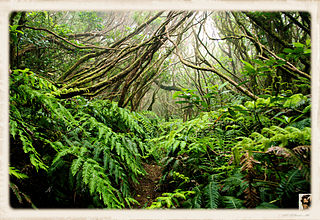
Laurel forest, also called laurisilva or laurissilva, is a type of subtropical forest found in areas with high humidity and relatively stable, mild temperatures. The forest is characterized by broadleaf tree species with evergreen, glossy and elongated leaves, known as "laurophyll" or "lauroid". Plants from the laurel family (Lauraceae) may or may not be present, depending on the location.

Ocotea is a genus of flowering plants belonging to the family Lauraceae. Many are evergreen trees with lauroid leaves.

Cinnamomum tamala, Indian bay leaf', also known as ತಮಾಲ (Tamaala) in Kannada(ಕನ್ನಡ), மரப்பட்டை இலை in தமிழ்(Tamizh), tejpat, tejapatta, Malabar leaf, Indian bark, Indian cassia, or malabathrum, is a tree in the Lauraceae family that is native to India, Bangladesh, Nepal, Bhutan, and China. It can grow up to 20 m (66 ft) tall. Its leaves have a clove-like aroma with a hint of peppery taste, they are used for culinary and medicinal purposes. It is thought to have been one of the major sources of the medicinal plant leaves known in classic and medieval times as malabathrum.
An evergreen forest is a forest made up of evergreen trees. They occur across a wide range of climatic zones, and include trees such as conifers, live oak, and holly in cold climates, eucalypts, acacias and banksias in more temperate zones, and rainforest trees in tropical zones.

Beilschmiedia is a genus of trees and shrubs in family Lauraceae. Most of its species grow in tropical climates, but a few of them are native to temperate regions, and they are widespread in tropical Asia, Africa, Madagascar, Australia, New Zealand, North America, Central America, the Caribbean, and South America. The best-known species to gardeners in temperate areas are B. berteroana and B. miersii because of their frost tolerance. Seeds of B. bancroftii were used as a source of food by Australian Aborigines. Timbers of some species are very valuable.

Persea indica is a species of plant in the Lauraceae family. It belongs to the evergreen tree genus Persea of about 150 species, of which the avocado, P. americana, is the best known.
Povedadaphne is a genus of plants in the family Lauraceae, with a single species, Povedadaphne quadriporata. They are evergreen "lauroid" trees belonging to the tropical laurel forest habitat, a type of cloud forest in Costa Rica, in Central America.
Xyleborus glabratus is a type of ambrosia beetle invasive to the United States. It has been documented as carrying the fungus that causes laurel wilt, a disease that can kill several tree species in the Lauraceae family, including redbay and avocado.

Cinnamomum verum, called true cinnamon tree or Ceylon cinnamon tree is a small evergreen tree belonging to the family Lauraceae, native to Sri Lanka. Among other species, its inner bark is used to make cinnamon.
Hypodaphnis is a monotypic genus of flowering plants belonging to the Lauraceae family. Its only extant species, Hypodaphnis zenkeri, is native to Gabon. Although only one living species is known, fossils of some species of this genus are present in North America, especially in Northern Mexico. In most phylogenetic analysis, Hypodaphnis appears as the basal branch, the sister group of the rest of the Lauraceae family.
Potoxylon is a monotypic genus of evergreen trees belonging to the Laurel family, Lauraceae. Its only species, Potoxylon melagangai, is native to Borneo.

Cassytha filiformis, common name love-vine, is a species of obligate parasitic vine in the family Lauraceae. The species has a native pantropical distribution encompassing the Americas, Indomalaya, Australasia, Polynesia and tropical Africa In the Caribbean region, it is one of several plants known as "Love vine" because it has a reputation as an aphrodisiac.