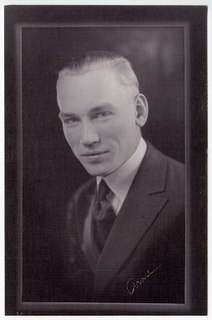
Arnold Orville Beckman was an American chemist, inventor, investor, and philanthropist. While a professor at California Institute of Technology, he founded Beckman Instruments based on his 1934 invention of the pH meter, a device for measuring acidity, later considered to have "revolutionized the study of chemistry and biology". He also developed the DU spectrophotometer, "probably the most important instrument ever developed towards the advancement of bioscience". Beckman funded the first transistor company, thus giving rise to Silicon Valley. After retirement, he and his wife Mabel (1900-1989) were numbered among the top philanthropists in the United States.
Stanford University School of Medicine is the medical school of Stanford University and is located in Stanford, California. It predates the rest of the university and can trace its roots to the Medical Department of the University of the Pacific, founded in San Francisco in 1858. This medical institution, by then called Cooper Medical College, was acquired by Stanford in 1908. The medical school moved to the Stanford campus near Palo Alto, California in 1959.

The Beckman Institute for Advanced Science and Technology is a unit of the University of Illinois at Urbana–Champaign dedicated to interdisciplinary research. A gift from scientist, businessman, and philanthropist Arnold O. Beckman (1900–2004) and his wife Mabel (1900–1989) led to the building of the Institute which opened in 1989. It is one of five institutions which receive support from the Arnold and Mabel Beckman Foundation on an ongoing basis. Current research at Beckman involves the areas of molecular engineering, intelligent systems, and imaging science. Researchers in these areas work across traditional academic boundaries in scientific projects that can lead to the development of real-world applications in medicine, industry, electronics, and human health across the lifespan.
Robert Duncan Luce was an American mathematician and social scientist, and one of the most preeminent figures in the field of mathematical psychology. At the end of his life, he held the position of Distinguished Research Professor of Cognitive Science at the University of California, Irvine.
The Presidential Early Career Award for Scientists and Engineers (PECASE) is the highest honor bestowed by the United States government on outstanding scientists and engineers in the early stages of their independent research careers. The White House, following recommendations from participating agencies, confers the awards annually. To be eligible for a Presidential Award, an individual must be a US citizen, national or permanent resident. Some of the winning scientists and engineers receive up to a five-year research grant.
Bruce J. Tromberg is an American photochemist and a leading researcher in the field of biophotonics. He is the director of the National Institute of Biomedical Imaging and Bioengineering (NIBIB) within the National Institutes of Health (NIH). Before joining NIH, he was Professor of Biomedical Engineering at The Henry Samueli School of Engineering and of Surgery at the School of Medicine, University of California, Irvine. He was the principal investigator of the Laser Microbeam and Medical Program (LAMMP), and the Director of the Beckman Laser Institute and Medical Clinic at Irvine. He was a co-leader of the Onco-imaging and Biotechnology Program of the NCI Chao Family Comprehensive Cancer Center at Irvine.
The Institute of Transportation Studies (ITS) at the University of California's Berkeley, Davis, Irvine, and Los Angeles campuses are centers for research, education, and scholarship in the fields of transportation planning and engineering. Faculty members, staff researchers, and graduate students comprise this multidisciplinary institute network of more than 400 people, which administers an average of $20 million in research funds each year. ITS Berkeley is an organized research unit with nine affiliated organizations and an eight-member advisory council.
The Kavli Foundation, based in Los Angeles, California, is a foundation that supports the advancement of science and the increase of public understanding and support for scientists and their work.

The Henry Samueli School of Engineering (HSSoE) is the academic unit of the University of California, Irvine that oversees academic research and teaching in disciplines of the field of engineering. Established when the campus opened in 1965, the school consists of five departments, each of which is involved in academic research in its specific field, as well as several interdisciplinary fields. The school confers Bachelor of Science, Master of Science, and Doctor of Philosophy degrees.
The Joint Center for Artificial Photosynthesis (JCAP), founded in 2010, is a (DOE) Energy Innovation Hub whose primary mission is to find a cost-effective method to produce fuels using only sunlight, water, and carbon-dioxide (Artificial Photosynthesis. The program has a budget of $122M over five years, subject to Congressional appropriation.
The Tolman Medal is awarded each year by the Southern California Section of the American Chemical Society (SCALACS) for outstanding contributions to chemistry which include contributions in areas of fundamental studies, chemical technology, and significant contributions to chemical education or outstanding leadership in science on a national level. To be eligible for the Medal, the recipient must have accomplished the majority of his or her work while resident in Southern California.
A Beckman Fellow receives funding, usually via an intermediary institution, from the Arnold and Mabel Beckman Foundation, founded by Arnold Orville Beckman and his wife Mabel. The Foundation supports programs at several institutions to encourage research, particularly the work of young researchers who might not be eligible for other sources of funding. People from a variety of different programs at different institutions may therefore be referred to as Beckman Fellows. Though most often designating postdoctoral awards in science, the exact significance of the term will vary depending on the institution involved and the type(s) of Beckman Fellowship awarded at that institution.
The Beckman Center for Molecular and Genetic Medicine is an interdisciplinary center, part of Stanford School of Medicine at Stanford University, Stanford, California. Considered a "unique facility", it was one of the first research centers to take a translational medicine approach to molecular and medical genetics.
The Beckman Laser Institute is an interdisciplinary research center for the development of optical technologies and their use in biology and medicine. Located on the campus of the University of California, Irvine in Irvine, California, an independent nonprofit corporation was created in 1982, under the leadership of Michael W. Berns, and the actual facility opened on June 4, 1986. It is one of a number of institutions focused on translational research, connecting research and medical applications. Researchers at the institute have developed laser techniques for the manipulation of structures within a living cell, and applied them medically in treatment of skin conditions, stroke, and cancer, among others.
Petra Elfrida Erna Beate Wilder-Smith is a professor and director of dentistry at the Beckman Laser Institute at the University of California, Irvine, and a fellow of the Chao Family Comprehensive Cancer Center at the University of California, Irvine. She is a visiting professor at Aachen University (Germany); and a visiting lecturer at Loma Linda University. Wilder-Smith specializes in the use of light and optics in tracking and treating oral cancer. She has developed innovative noninvasive laser technology used to examine and treat mouth lesions.

The Beckman Institute at Caltech is a multi-disciplinary center for research in the chemical and biological sciences, located at and partnering with the California Institute of Technology (Caltech) in Pasadena, California, United States.
Michael W. Berns is a professor of surgery and cell biology at the University of California, Irvine (UCI) and the University of California, San Diego. Berns is a founder of the first Laser Microbeam Program (LAMP), the Beckman Laser Institute, the UCI Center for Biomedical Engineering, and the UCI Photonics Incubator.
Alexandria Boehm is an American scientist whose field of study is civil and environmental engineering. She researches water quality of ocean coastal zones in tandem with finding the best solutions to prevent and clean up these polluted waters. Boehm is a Senior Fellow at Stanford University's Woods Institute for the Environment and an Associate Professor in Stanford University's Department of Civil and Environmental Engineering.
