Alexander Graham Bell was a Scottish-born scientist, inventor, engineer, and innovator who is credited with inventing and patenting the first practical telephone. He also founded the American Telephone and Telegraph Company (AT&T) in 1885.
TAT-6 was the sixth transatlantic telephone cable. It was in operation from 1976 to 1994, with a bandwidth of 12MHz between Green Hill and Saint-Hilaire-de-Riez, Vendée, (France).

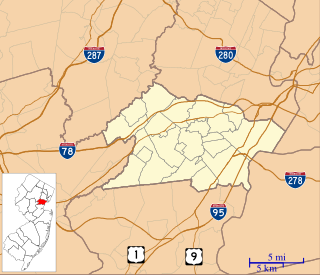
Holmdel Township, often referred to as simply Holmdel, is a township in Monmouth County, New Jersey, United States. As of the 2010 United States Census, the township's population was 16,773, reflecting an increase of 992 (+6.3%) from the 15,781 counted in the 2000 Census, which had in turn increased by 4,249 (+36.8%) from the 11,532 counted in the 1990 Census.

Karl Guthe Jansky was an American physicist and radio engineer who in August 1931 first discovered radio waves emanating from the Milky Way. He is considered one of the founding figures of radio astronomy.

Robert Woodrow Wilson is an American astronomer who, along with Arno Allan Penzias, discovered cosmic microwave background radiation (CMB) in 1964. The pair won the 1978 Nobel laureate in physics for their discovery.
This timeline of the telephone covers landline, radio, and cellular telephony technologies and provides many important dates in the history of the telephone.

The Holmdel Horn Antenna is a large microwave horn antenna that was used as a satellite communication antenna and radio telescope during the 1960s at Bell Telephone Laboratories in Holmdel Township, New Jersey, United States. It was designated a National Historic Landmark in 1988 because of its association with the research work of two radio astronomers, Arno Penzias and Robert Wilson. In 1965 while using this antenna, Penzias and Wilson discovered the cosmic microwave background radiation (CMBR) that permeates the universe. This was one of the most important discoveries in physical cosmology since Edwin Hubble demonstrated in the 1920s that the universe was expanding. It provided the evidence that confirmed George Gamow's and Georges Lemaître's "Big Bang" theory of the creation of the universe. This helped change the science of cosmology, the study of the history of the universe, from a field for unlimited theoretical speculation into a discipline of direct observation. In 1978 Penzias and Wilson received the Nobel Prize for Physics for their discovery.

John Robinson Pierce, was an American engineer and author. He worked extensively in the fields of radio communication, microwave technology, computer music, psychoacoustics, and science fiction. As a sideline to his professional career he wrote science fiction for many years under various names: John Pierce, John R. Pierce, and J. J. Coupling. Born in Des Moines, Iowa, he earned his PhD from Caltech, and died in Palo Alto, California from complications of Parkinson's Disease.

William Rae Young, Jr. was one of the Bell Labs engineers that invented the cell phone.
Gerald R. Ash is a retired electrical engineer who worked at Bell Labs. His research has focused on routing problems; he is known for the development of Dynamic Non-Hierarchical Routing (DNHR).
Alexander Graham Bell honors and tributes include honours bestowed upon him and awards named for him.
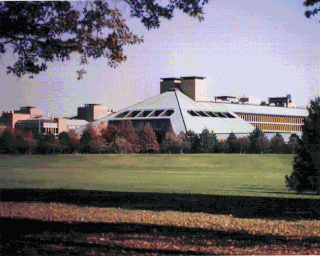
The Bell Labs Holmdel Complex, in Holmdel Township, New Jersey, United States, functioned for forty-four years as a research and development facility, initially for the Bell System and later Bell Labs.
The centerpiece of the campus is an Eero Saarinen designed structure that served as the home to over 6,000 engineers and researchers. This modernist building, dubbed "The Biggest Mirror Ever" by Architectural Forum, due to its mirror box exterior, was the site of at least one Nobel Prize discovery, the laser cooling work of Steven Chu. The building has undergone renovations into a multi-purpose living and working space, dubbed Bell Works by its redevelopers. Since 2013 it has been operated by Somerset Development, who redeveloped the building into a mixed-use office for high-tech startup companies. The complex was listed on the National Register of Historic Places in 2017.
Raymond Waibel Ketchledge was an American engineer, known for his contributions to the first computerized telephone switching control systems.
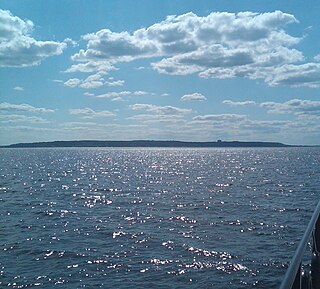
The Navesink Highlands, sometimes referred to as the Highlands of Navesink and also known as the Atlantic Highlands, are a range of low hills and upland areas located along the United States Atlantic coast in New Jersey. The hills of the Highlands reach over 350 feet (107 m) in elevation, reportedly reaching a maximum elevation of 391 feet at Crawford Hill, which is the highest point in Monmouth County. The seaward front of the Navesink Highlands constitute the highest headlands along the United States east coast south of Maine, with the highest point of the headlands reaching an elevation of 266 feet at Mount Mitchill.
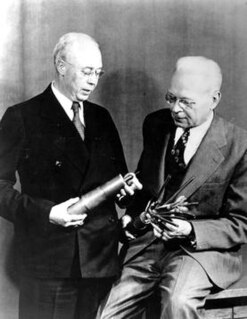
Lloyd Espenschied was an American electrical engineer who invented the modern coaxial cable with Herman Andrew Affel.
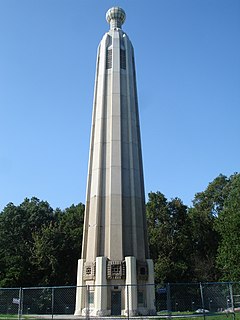
The Edison State Park is located in the Menlo Park section of Edison, New Jersey. It is located on Christie Street, the first street in the world to be lit up by lightbulb, just off Lincoln Highway, near the Metropark Train Station. It covers a total area of 37 acres (0.15 km2). The park commemorates the site where the famous inventor Thomas Alva Edison had his Menlo Park laboratory. In his laboratory, Edison invented over 600 inventions such as the incandescent electric light and the phonograph, the latter being the first object to record and play sound.
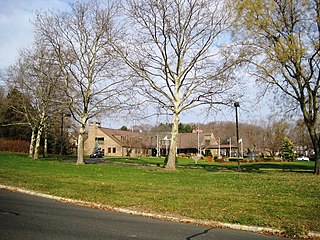
Crawford Corners or Crawfords Corner is an unincorporated community located within Holmdel Township in Monmouth County, New Jersey, United States. The settlement is located at the intersection of Holmdel Road and Crawfords Corners Road in the hilly northern portion of the township. The settlement is located about one-half mile (0.80 km) from Crawford Hill, the highest point in Monmouth County. The area also includes the township's town hall, police department, and high school in addition to a New Jersey State Police barracks and the PNC Bank Arts Center off the Garden State Parkway. These buildings and landmarks comprise the eastern section of the settlement, homes and heavily treed lands are located on the west side of Holmdel Road, and Holmdel Park makes up the southern portion of the area.