Biggar is a town and former burgh in South Lanarkshire, Scotland, in the Southern Uplands near the River Clyde on the A702. The closest towns are Lanark and Peebles.

Broughton is a village in Tweeddale in the historical county of Peeblesshire in the Scottish Borders council area, in the south of Scotland, in the civil parish of Broughton, Glenholm and Kilbucho and Upper Tweed Community Council. Broughton is on the Biggar Water, near where it flows into the River Tweed. It is about 7 km east of Biggar, and 15 km west of Peebles.
The Symington, Biggar and Broughton Railway was a railway company in southern Scotland. It built a line connecting Biggar, and later Peebles, to the main line railway at Symington. It was taken over by the Caledonian Railway in 1861, and was completed in 1864.

Broughton Cross railway station was situated on the Cockermouth and Workington Railway and served the village of Broughton Cross, Cumbria, England.

Camerton railway station was situated next to the River Derwent on the Cockermouth and Workington Railway. It served the village of Camerton, Cumberland, England.
Great Broughton railway station briefly served the village of Great Broughton, near Cockermouth in Cumberland, England.

Broughton Astley railway station was a railway station serving Broughton Astley in Leicestershire, England.

Broughton-in-Furness railway station served the market town of Broughton-in-Furness, in Lancashire, England. It was on the branch line to Coniston.

Stobo railway station was a railway station in the Borders east of Biggar, serving the hamlet of Stobo; a rural community within the Parish of Stobo.

Dearham Bridge was a railway station on the Maryport and Carlisle Railway (M&CR) serving the village and rural district of Dearham in Cumberland, England. The station was opened by the M&CR in 1842 as Dearham, but was renamed Dearham Bridge in 1867 when the M&CR opened a station in the village of Dearham, to which it gave that name. Dearham Bridge station lay in the Parish of Crosscanonby.
Eskmeals is a former railway station in the Eskmeals area of the Cumbrian coast, England. It was located on the Cumbrian Coast Line, south of Ravenglass and near to the estuary of the River Esk. It was situated at the southern end of Eskmeals Viaduct. It served a scattered farming community.
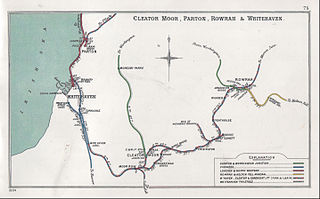
The original Cleator Moor railway station was built by the Whitehaven, Cleator and Egremont Railway. It served the rapidly urbanising town of Cleator Moor, Cumbria, England.
Linefoot railway station, sometimes referred to as Linefoot Junction and sometimes as Linefoot Goods, briefly served the scattered community around the crossroads at Linefoot, near Cockermouth in Cumberland, England.
Camerton Colliery Halt railway station was an unadvertised halt for workers at one or both of the collieries at Camerton, near Cockermouth in Cumberland, England.
Buckhill Colliery Halt railway station was an unadvertised halt for workers at Buckhill Colliery north east of Camerton, near Cockermouth in Cumberland, England.

Lyne railway station served the village of Lyne, Scottish Borders, Scotland from 1864 to 1950 on the Symington, Biggar and Broughton Railway.

Peebles (West) railway station was one of two railway stations that served the burgh of Peebles, Peeblesshire, Scotland from 1864 to 1950 on the Symington, Biggar and Broughton Railway and Peebles Railway.
Broughton railway station served the village of Broughton, Scottish Borders, Scotland from 1860 to 1950 on the Symington, Biggar and Broughton Railway and Talla Railway.
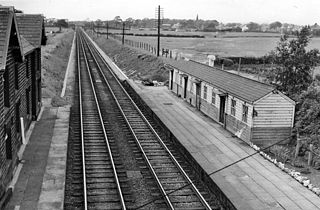
Barton and Broughton railway station served the villages of Barton and Broughton in Lancashire, England, from 1840 to 1965 on the Lancaster and Preston Junction Railway.
This page is based on this
Wikipedia article Text is available under the
CC BY-SA 4.0 license; additional terms may apply.
Images, videos and audio are available under their respective licenses.
