Bute Street may refer to:
 | This disambiguation page lists articles about roads and streets with the same name. If an internal link led you here, you may wish to change the link to point directly to the intended article. |
Bute Street may refer to:
| | This disambiguation page lists articles about roads and streets with the same name. If an internal link led you here, you may wish to change the link to point directly to the intended article. |

John Stuart, 3rd Earl of Bute, was a British nobleman who served as Prime Minister of Great Britain from 1762 to 1763 under George III. He was arguably the last important favourite in British politics. He was the first Prime Minister from Scotland following the Acts of Union in 1707 and the first Tory to have held the post. He was also elected as the first President of the Society of Antiquaries of Scotland when it was founded in 1780.

Argyll and Bute is both one of 32 unitary authority council areas and a lieutenancy area in Scotland. The administrative centre for the council area is in Lochgilphead.
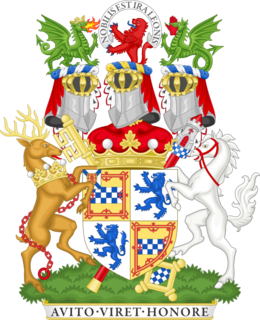
Marquess of the County of Bute, shortened in general usage to Marquess of Bute, is a title in the Peerage of Great Britain. It was created in 1796 for John Stuart, 4th Earl of Bute.
Neil N. LaBute is an American playwright, film director, screenwriter, and actor. He is best-known for a play that he wrote and later adapted for film, In the Company of Men (1997), which won awards from the Sundance Film Festival, the Independent Spirit Awards, and the New York Film Critics Circle. He wrote and directed the films Your Friends & Neighbors (1998), Possession (2002), The Shape of Things (2003), The Wicker Man (2006), Some Velvet Morning (2013), and Dirty Weekend (2015). He directed the films Nurse Betty (2000), Lakeview Terrace (2008), and the American adaptation of Death at a Funeral (2010). LaBute created the TV series Billy & Billie, writing and directing all of the episodes and is also creator of the TV series Van Helsing. He also directed several episodes for shows such as Hell on Wheels and Billions.

The Isle of Bute, known as Bute, is an island in the Firth of Clyde in Scotland, United Kingdom. It is divided into highland and lowland areas by the Highland Boundary Fault. Formerly a constituent island of the larger County of Bute, it is now part of the council area of Argyll and Bute. Bute's resident population was 6,498 in 2011, a decline of just over 10% from the figure of 7,228 recorded in 2001 against a background of Scottish island populations as a whole growing by 4% to 103,702 for the same period.

Butetown is a district and community in the south of the city of Cardiff, the capital of Wales. It was originally a model housing estate built in the early 19th century by John Crichton-Stuart, 2nd Marquess of Bute, for whose title the area was named. Commonly known as "Tiger Bay", this area became one of the UK's first multicultural communities with people from over 50 countries settled here by the outbreak of the First World War, working in the docks and allied industries. Some of the largest communities included the Somalis, Yemenis and Greeks, whose influence still lives on today. A Greek Orthodox church still stands at the top of Bute Street. It is known as one of the "five towns of Cardiff", the others being Crockherbtown, Grangetown, Newtown and Temperance Town. The population of the ward taken at the 2011 census was 10,125.

Bute House is the official residence of the First Minister of Scotland located within Charlotte Square in Edinburgh, the capital city of Scotland. Alongside two other offices at Holyrood and at St. Andrew's House, Bute House also has a smaller office used by the First Minister when in official residence.

Argyll and Bute is a county constituency of the House of Commons of the Parliament of the United Kingdom. It was created for the 1983 general election, merging most of Argyll with some of Bute and Northern Ayrshire. A similar constituency, also called Argyll and Bute, is used by the Scottish Parliament.

Bute Park is a major park in the city of Cardiff, capital of Wales. It comprises 130 acres (53 ha) of landscaped gardens and parkland that once formed the grounds of Cardiff Castle. The park is named after the 3rd Marquess of Bute, whose family owned the castle.

Cardiff Bay railway station, formerly Cardiff Bute Road, is a station serving the Cardiff Bay and Butetown areas of Cardiff, Wales. It is the southern terminus of the Butetown Branch Line 1 mile (1.5 km) south of Cardiff Queen Street.

Bute Inlet is one of the principal inlets of the British Columbia Coast. It is 80 km long from the estuaries of the Homathko and Southgate Rivers at the head of the inlet, to the mouth, where it is nearly blocked by Stuart Island, and it averages about 4 km in width. Bute Inlet is in a spectacular wilderness setting and is one of the most scenic waterways in the world. In the upper reaches of the inlet mountains rise 9000 feet above sea level. Bute Inlet is a spectacular wilderness that is visited by very few people. In more recent years tourists are travelling from around the world to view grizzly bears in a natural setting and explore the wilderness of Bute Inlet.

Treherbert is a village and community situated at the head of the Rhondda Fawr valley in the county borough of Rhondda Cynon Taf, Wales. Historically part of Glamorgan, Treherbert is a former industrial coal mining village which was at its economic peak between 1850 and 1920. Treherbert is the upper most community of the Rhondda Fawr and encompasses the districts of Blaencwm, Blaenrhondda, Tynewydd and Pen-yr-englyn.
Bute or BUTE may refer to:

Bute Street is a street in Cardiff, Wales. It links Cardiff Bay and Butetown with Cardiff city centre. It now has no road number. It runs from the dockside of the Mermaid Quay complex in the south, which is now a pedestrian zone, to the junction of Bute Terrace (A4160) in the north.

The Animal Wall is a sculptured wall depicting 15 animals in the Castle Quarter of the city centre of Cardiff, Wales. It is a Grade I listed structure.

The A4160 was the road that connected Penarth with Cardiff in Wales; now the A4055 and A4232 have become the main route from Penarth to Cardiff city centre and Cardiff Bay
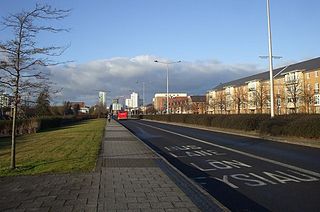
Lloyd George Avenue, originally known as Bute Avenue, is an avenue in Cardiff, Wales. Roughly one mile long, the road links the Inner Harbour of Cardiff Bay to Cardiff city centre and forms part of the A470 road. It runs parallel to Bute Street and the Butetown Branch Line. Landscaping on the route was completed in 2000 was renamed after Liberal prime minister David Lloyd George. The site of the avenue had been known as Collingdon Road, which was described as a "grimy industrial area of small factories and workshops, employing hundreds of people".
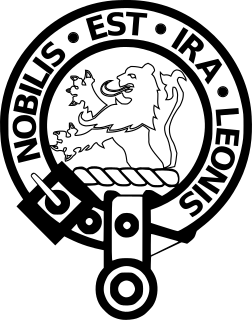
Clan Stuart of Bute is a Highland Scottish clan and is a branch of the larger Clan Stewart.

The James Bute Company Warehouse, located at 711 William Street in Houston, Texas, was listed on the National Register of Historic Places on July 7, 1994. The Bute Paint Company, founded by James Bute, operated from 1867 until 1990. Its warehouse building on William Street was built in 1909. Abandoned after 1990, the property was converted to loft apartments in 1993.

The Zetland Arms is a pub in South Kensington, London, on the corner of Old Brompton Road and Bute Street.