
Creedence Clearwater Revival was an American rock band active in the late 1960s and early 1970s which consisted of lead vocalist, lead guitarist, and primary songwriter John Fogerty; his brother, rhythm guitarist Tom Fogerty; bassist Stu Cook; and drummer Doug Clifford. These members had played together since 1959, first as The Blue Velvets and later as The Golliwogs. Their musical style encompassed roots rock, swamp rock, and blues rock. They played in a Southern rock style, despite their San Francisco Bay Area origin, with lyrics about bayous, catfish, the Mississippi River, and other popular elements of Southern United States iconography, as well as political and socially conscious lyrics about topics including the Vietnam War. The band performed at the 1969 Woodstock Festival in Upstate New York.

C-C chemokine receptor type 5, also known as CCR5 or CD195, is a protein on the surface of white blood cells that is involved in the immune system as it acts as a receptor for chemokines.

Buchanan Field Airport is a public airport in Contra Costa County, California, a mile west of the center of Concord and east of Pacheco. The airport's street address is 550 Sally Ride Drive, Concord.

Chemokine receptors are cytokine receptors found on the surface of certain cells that interact with a type of cytokine called a chemokine. There have been 20 distinct chemokine receptors discovered in humans. Each has a rhodopsin-like 7-transmembrane (7TM) structure and couples to G-protein for signal transduction within a cell, making them members of a large protein family of G protein-coupled receptors. Following interaction with their specific chemokine ligands, chemokine receptors trigger a flux in intracellular calcium (Ca2+) ions (calcium signaling). This causes cell responses, including the onset of a process known as chemotaxis that traffics the cell to a desired location within the organism. Chemokine receptors are divided into different families, CXC chemokine receptors, CC chemokine receptors, CX3C chemokine receptors and XC chemokine receptors that correspond to the 4 distinct subfamilies of chemokines they bind. Four families of chemokine receptors differ in spacing of cysteine residues near N-terminal of the receptor.
CCR, formerly Companhia de Concessões Rodoviárias, is a transportation company with interests in private interstate highway concessions, airport operations, metro system in Brazil and other countries. The Company controls 9 subsidiary concession holders, through which it works a public-private business model for the operation of toll-roads, aiming to centralize the management of a portfolio of toll concessions and service companies.
CC chemokine receptors are integral membrane proteins that specifically bind and respond to cytokines of the CC chemokine family. They represent one subfamily of chemokine receptors, a large family of G protein-linked receptors that are known as seven transmembrane (7-TM) proteins since they span the cell membrane seven times. To date, ten true members of the CC chemokine receptor subfamily have been described. These are named CCR1 to CCR10 according to the IUIS/WHO Subcommittee on Chemokine Nomenclature.
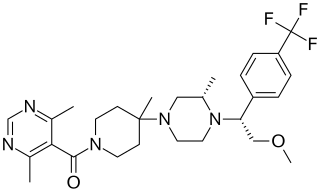
Vicriviroc, previously named SCH 417690 and SCH-D, is a pyrimidine CCR5 entry inhibitor of HIV-1. It was developed by the pharmaceutical company Schering-Plough. Merck decided to not pursue regulatory approval for use in treatment-experienced patients because the drug did not meet primary efficacy endpoints in late stage trials. Clinical trials continue in patients previously untreated for HIV.

C-C chemokine receptor type 2 (CCR2 or CD192 is a protein that in humans is encoded by the CCR2 gene. CCR2 is a chemokine receptor.

C-C chemokine receptor type 7 is a protein that in humans is encoded by the CCR7 gene. Two ligands have been identified for this receptor: the chemokines ligand 19 (CCL19/ELC) and ligand 21 (CCL21).

C-C chemokine receptor type 1 is a protein that in humans is encoded by the CCR1 gene.
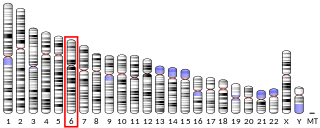
Chemokine receptor 6 also known as CCR6 is a CC chemokine receptor protein which in humans is encoded by the CCR6 gene. CCR6 has also recently been designated CD196.
C-C chemokine receptor type 4 is a protein that in humans is encoded by the CCR4 gene. CCR4 has also recently been designated CD194.
C-C chemokine receptor type 3 is a protein that in humans is encoded by the CCR3 gene.
Chemokine receptor 8, also known as CCR8, is a protein which in humans is encoded by the CCR8 gene. CCR8 has also recently been designated CDw198.
C-C chemokine receptor type 9 is a protein that in humans is encoded by the CCR9 gene.
Chemokine-binding protein 2 is a protein that in humans is encoded by the CCBP2 gene.
CCR5 receptor antagonists are a class of small molecules that antagonize the CCR5 receptor. The C-C motif chemokine receptor CCR5 is involved in the process by which HIV, the virus that causes AIDS, enters cells. Hence antagonists of this receptor are entry inhibitors and have potential therapeutic applications in the treatment of HIV infections.
Mogamulizumab is a humanized, afucosylated monoclonal antibody targeting CC chemokine receptor 4 (CCR4). The US FDA approved it in August 2018 for treatment of relapsed or refractory mycosis fungoides and Sézary disease. It was approved in Japan in 2012 for the treatment of relapsed or refractory CCR4+ adult T-cell leukemia/lymphoma (ATCLL) and in 2014 for relapsed or refractory CCR4+ cutaneous T cell lymphoma (CTCL). The latter approval was based on study with 28 subjects.
Meteorological Service Singapore (MSS) is a division of the National Environment Agency, Singapore. MSS's mission is to observe and understand the weather and climate affecting Singapore and to provide services in support of national needs and international co-operation. It collects and maintain reliable long-term national weather records, provides reliable weather and climate services. It also conducts research to advance understanding and prediction of the weather and climate of Singapore and the region. It does risk and impact assessment of natural environmental hazards.
ViaMobilidade is a company in Brazil belonging to Companhia de Concessões Rodoviárias, being responsible for the operation, maintenance and investments in Line 5–Lilac of São Paulo Metro for 20 years (2018–2038), through a public-private concession contract, in partnership with the Government of the State of São Paulo.
