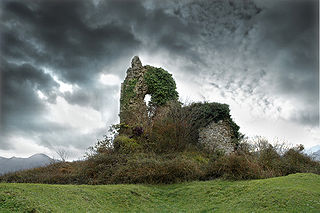
Alfonso III, called the Great, was the king of León, Galicia and Asturias from 866 until his death. He was the son and successor of Ordoño I. In later sources he is the earliest to be called "Emperor of Spain." He was also titled "Prince of all Galicia".
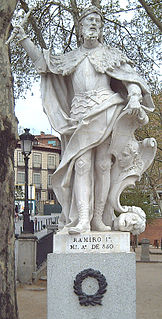
Ramiro I was King of Asturias from 842 until his death. He was son of King Bermudo I, and became king after a struggle for succession that followed the death of Alfonso II without issue. He was a contemporary of Abd ar-Rahman II, Umayyad Emir of Córdoba. During his turbulent reign, the chronicles relate that he had to fend off attacks from both Vikings and Moors. Numerous important structures, such as his recreational palace Santa María del Naranco, were built during his reign in the estilo ramirense that prefigured Romanesque architecture.
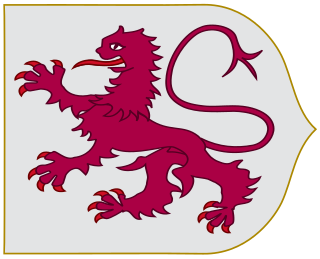
The Kingdom of León was an independent kingdom situated in the northwest region of the Iberian Peninsula. It was founded in AD 910 when the Christian princes of Asturias along the northern coast of the peninsula shifted their capital from Oviedo to the city of León. The County of Castile separated in 931, the County of Portugal separated to become the independent Kingdom of Portugal in 1139 and the eastern, inland part of León was joined to the Kingdom of Castile in 1230.
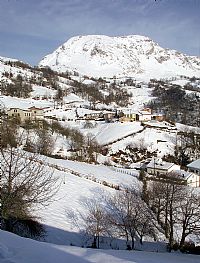
Laviana is a municipality in the Autonomous Community of the Principality of Asturias, located in Spain. It is bordered on the north by Bimenes and Nava, on the south by Aller, on the east by Piloña and Sobrescobio, and on the west by San Martín del Rey Aurelio and Mieres.

The Archdiocese of Oviedo is an Archdiocese of the Roman Catholic Church in Spain. The archdiocese encompasses roughly the current autonomous community of Asturias or Principality of Asturias. Erected in the 9th century, the diocese was elevated to an archdiocese in 1954. The diocesan see is in the city of Oviedo, where the Catedral de San Salvador is located.
Asturias de Oviedo is one of the historical comarcas in the Kingdom of Asturias. It extended from the Eo River in the west to the Deva River in the east, and from the Bay of Biscay in the north to the Cordillera Cantábrica in the south. Its capital and chief city was Oviedo. To its east lay the comarca of Asturias de Santillana.
Fernando Núñez de Lara was a count of the House of Lara. He spent most of career in the service of the Kingdom of Castile, but at times served the neighbouring Kingdom of León as well. He was a courtier, almost permanently present at court late in the reign of Alfonso VIII (1158–1214), whom he twice served as alférez, the highest military post in the kingdom, also fighting, with his brothers Álvaro and Gonzalo in the Battle of Las Navas de Tolosa in 1212.
Pedro Alfonso or Alfónsez was an Asturian magnate, dominating the region from 1139 until his death. He had vast landholdings in the Asturias, the region of León, and "kingdom" of Toledo, including in the cities of León and Toledo themselves, the most important cities of the realm. His commercial dealings were extensive, a sign of his economic power, and he loyally served Alfonso VII and his son Ferdinand II as a military commander and diplomat from 1128 until his death.

Vela Jiménez who appears also as Vigila Scemeniz, is documented on two occasions as Count of Álava between 882 and 883 in the Codex Vigilanus, compiled in 881 with two large paragraphs added subsequently describing the events that took place in 882 and 883.
Urraca Alfonso, also known as Urraca the Asturian, illegitimate daughter of Alfonso VII of León, was Queen Consort of Navarre by her marriage to García Ramírez. After becoming a widow, she returned to her homeland and was the regent of Asturias from 1153 to 1165. Urraca was involved in a rebellion against her half-brother, King Ferdinand II of León and with her second husband, Álvaro Rodríguez de Castro attempted to secure the independence of Asturias.
Bernaldode Quirós (1675–1710), also known as Francisco Bernardo de Quirós y Benavides, is the only Asturian writer from the 17th century besides Antón de Marirreguera whose work has been preserved.
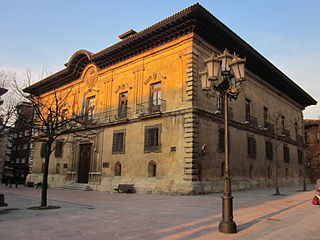
Camposagrado Palace is a baroque and Neo-classical palace located in the town of Oviedo, in Asturias, Spain. The building dates back to the eighteenth century and was built for the Marquis de Camposagrado, José Manuel Bernaldo de Quirós.

The Asturian bowling is the variation of bowling mainly played in Asturias, and the most important traditional sport in this Spanish Autonomous Community.
Gonzalo Téllez was a nobleman who was Count of Lantarón and Cerezo and is also mentioned in a document dated 903 as Count of Castile. He and his wife were the founders of the Monastery of San Pedro de Arlanza.

The Battle of Las Babias occurred in the year 795 when the Emir of Cordoba, Hisham I of Córdoba sought to avenge his previous military incursions in 794 against the Kingdom of Asturias under the command of the brothers Abd al-Karim ibn Abd al-Walid ibn Mugaith and Abd al-Malik ibn Abd al-Walid ibn Mugaith. The previous battles resulted in devastating losses for the Emirate, most importantly at the Battle of Lutos where one of the Emir's generals was killed in action. The battle resulted in a Córdoban victory.
The following is a timeline of the history of the city of Oviedo, Spain.

María Salud Bernaldo de Quirós was the first woman in Spain to earn a pilot's licence, passing her test in early October 1928 and receiving the licence from the Escuela Nacional Aeronáutica on the following 24 November. The first Spanish male pilot, Benito Loygorri, had made his first flight in Spain seven years earlier.

Olloniego is a parish of the municipality of Oviedo, Asturias, Spain.