
A genetic disorder is a health problem caused by one or more abnormalities in the genome. It can be caused by a mutation in a single gene (monogenic) or multiple genes (polygenic) or by a chromosomal abnormality. Although polygenic disorders are the most common, the term is mostly used when discussing disorders with a single genetic cause, either in a gene or chromosome. The mutation responsible can occur spontaneously before embryonic development, or it can be inherited from two parents who are carriers of a faulty gene or from a parent with the disorder. When the genetic disorder is inherited from one or both parents, it is also classified as a hereditary disease. Some disorders are caused by a mutation on the X chromosome and have X-linked inheritance. Very few disorders are inherited on the Y chromosome or mitochondrial DNA.

Ehlers–Danlos syndromes (EDS) are a group of thirteen genetic connective-tissue disorders that are in the current classification, with a fourteenth type discovered in 2018. Symptoms may include loose joints, joint pain, stretchy velvety skin, and abnormal scar formation. These may be noticed at birth or in early childhood. Complications may include aortic dissection, joint dislocations, scoliosis, chronic pain, or early osteoarthritis.
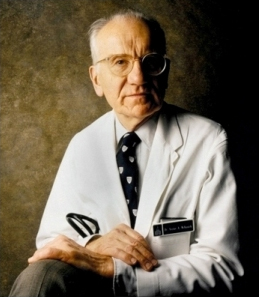
Victor Almon McKusick was an American internist and medical geneticist, and Professor of Medicine at the Johns Hopkins Hospital, Baltimore. He was a proponent of the mapping of the human genome due to its use for studying congenital diseases. He is well known for his studies of the Amish. He was the original author and, until his death, remained chief editor of Mendelian Inheritance in Man (MIM) and its online counterpart Online Mendelian Inheritance in Man (OMIM). He is widely known as the "father of medical genetics".

Kabuki syndrome is a congenital disorder of genetic origin. It affects multiple parts of the body, with varying symptoms and severity, although the most common is the characteristic facial appearance.
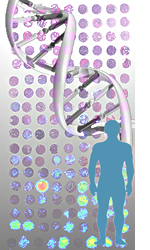
Human genetics is the study of inheritance as it occurs in human beings. Human genetics encompasses a variety of overlapping fields including: classical genetics, cytogenetics, molecular genetics, biochemical genetics, genomics, population genetics, developmental genetics, clinical genetics, and genetic counseling.
Imaging genetics refers to the use of anatomical or physiological imaging technologies as phenotypic assays to evaluate genetic variation. Scientists that first used the term imaging genetics were interested in how genes influence psychopathology and used functional neuroimaging to investigate genes that are expressed in the brain.
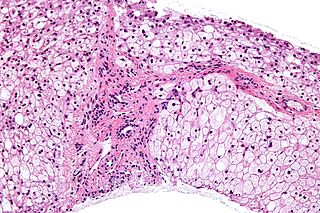
Glycogen storage disease type III is an autosomal recessive metabolic disorder and inborn error of metabolism characterized by a deficiency in glycogen debranching enzymes. It is also known as Cori's disease in honor of the 1947 Nobel laureates Carl Cori and Gerty Cori. Other names include Forbes disease in honor of clinician Gilbert Burnett Forbes (1915–2003), an American physician who further described the features of the disorder, or limit dextrinosis, due to the limit dextrin-like structures in cytosol. Limit dextrin is the remaining polymer produced after hydrolysis of glycogen. Without glycogen debranching enzymes to further convert these branched glycogen polymers to glucose, limit dextrinosis abnormally accumulates in the cytoplasm.
A medical specialty is a branch of medical practice that is focused on a defined group of patients, diseases, skills, or philosophy. Examples include children (paediatrics), cancer (oncology), laboratory medicine (pathology), or primary care. After completing medical school, physicians or surgeons usually further their medical education in a specific specialty of medicine by completing a multiple-year residency to become a specialist.

Medical genetics is the branch of medicine that involves the diagnosis and management of hereditary disorders. Medical genetics differs from human genetics in that human genetics is a field of scientific research that may or may not apply to medicine, while medical genetics refers to the application of genetics to medical care. For example, research on the causes and inheritance of genetic disorders would be considered within both human genetics and medical genetics, while the diagnosis, management, and counselling people with genetic disorders would be considered part of medical genetics.
Psychiatric genetics is a subfield of behavioral neurogenetics and behavioral genetics which studies the role of genetics in the development of mental disorders. The basic principle behind psychiatric genetics is that genetic polymorphisms are part of the causation of psychiatric disorders.

Dolichyl pyrophosphate Man9GlcNAc2 alpha-1,3-glucosyltransferase is an enzyme that in humans is encoded by the ALG6 gene.

PHD finger protein 8 is a protein that in humans is encoded by the PHF8 gene.

CSIR Institute of Genomics and Integrative Biology (CSIR-IGIB) is a scientific research institute devoted primarily to biological research. It is a part of Council of Scientific and Industrial Research (CSIR), India.
Brentuximab vedotin is an antibody-drug conjugate medication used to treat relapsed or refractory Hodgkin lymphoma (HL) and systemic anaplastic large cell lymphoma (ALCL), a type of T cell non-Hodgkin lymphoma. It selectively targets tumor cells expressing the CD30 antigen, a defining marker of Hodgkin lymphoma and ALCL. The drug is being jointly marketed by Millennium Pharmaceuticals outside the US and by Seattle Genetics in the US.
DECIPHER is a web-based resource and database of genomic variation data from analysis of patient DNA. It documents submicroscopic chromosome abnormalities and pathogenic sequence variants, from over 25000 patients and maps them to the human genome using Ensembl or UCSC Genome Browser. In addition it catalogues the clinical characteristics from each patient and maintains a database of microdeletion/duplication syndromes, together with links to relevant scientific reports and support groups.
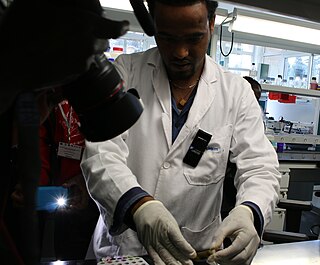
A geneticist is a biologist who studies genetics, the science of genes, heredity, and variation of organisms. A geneticist can be employed as a scientist or a lecturer. Geneticists may perform general research on genetic processes or develop genetic technologies to aid in the pharmaceutical or and agriculture industries. Some geneticists perform experiments in model organisms such as Drosophila, C. elegans, zebrafish, rodents or humans and analyze data to interpret the inheritance of biological traits. A geneticist can be a scientist who has earned a PhD in genetics or a physician who has been trained in genetics as a specialization. They evaluate, diagnose, and manage patients with hereditary conditions or congenital malformations, genetic risk calculations, and mutation analysis, as well as refer patients to other medical specialists. The geneticist carries out studies, tests and counsels patients with genetic disorders.
Seagen Inc. is an American biotechnology company focused on developing and commercializing innovative, empowered monoclonal antibody-based therapies for the treatment of cancer. The company, headquartered in Bothell, Washington, is the industry leader in antibody-drug conjugates or ADCs, a technology designed to harness the targeting ability of monoclonal antibodies to deliver cell-killing agents directly to cancer cells. Antibody-drug Conjugates are intended to spare non-targeted cells and thus reduce many of the toxic effects of traditional chemotherapy, while potentially enhancing antitumor activity.

The Edinburgh Cancer Research Centre (ECRC), also known as the Cancer Research UK Edinburgh Centre and the University of Edinburgh Cancer Research Centre, is a center for basic, translational and clinical cancer research located in Edinburgh, Scotland. ECRC constitutes a part of the Institute of Genetics & Molecular Medicine (IGMM) and is positioned in direct proximity of the Western General Hospital, where most of its clinical activities take place.
Denintuzumab mafodotin is a humanized monoclonal antibody-drug conjugate designed for the treatment of CD19-positive acute lymphoblastic leukemia and B-cell non-Hodgkin lymphoma. It consists of an anti-CD19 mAb linked to monomethyl auristatin F (MMAF), a cytotoxic agent. This drug was developed by Seattle Genetics.
