
Port Glasgow is the second largest town in the Inverclyde council area of Scotland. The population according to the 1991 census for Port Glasgow was 19,426 persons and in the 2001 census was 16,617 persons. The most recent census in 2011 states that the population has declined to 15,414. It is located immediately to the east of Greenock and was previously a burgh in the former county of Renfrew.

Clyde is a suburb in Melbourne, Victoria, Australia, 48 km south-east from Melbourne's central business district. Its local government area is the City of Casey. At the 2016 Census, Clyde had a population of 2,117.

The Inverclyde Line is a railway line running from Glasgow Central station through Paisley and a series of stations to the south of the River Clyde and the Firth of Clyde, terminating at Gourock and Wemyss Bay, where it connects to Caledonian MacBrayne ferry services. The line has been in operation since the 1840s between Glasgow and Greenock and was the first passenger service to follow the River Clyde to the coast. The line was electrified in 1967.

Clyde is a suburb of Sydney, in the state of New South Wales, Australia. Clyde is located 21 kilometres west of the Sydney central business district in the local government area of the City of Parramatta. Clyde is part of the Greater Western Sydney region.

Anniesland railway station is a railway station that serves the Anniesland suburb of Glasgow, Scotland.
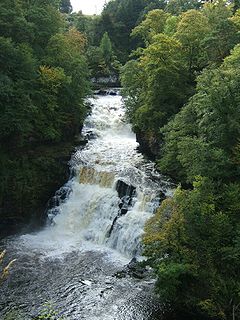
The Clyde Walkway is a foot and mountain bike path which runs from Glasgow, Scotland, to just above the UNESCO World Heritage site of New Lanark. The path runs close to the River Clyde for most of its length. It was completed in 2005, and is now designated as one of Scotland's Great Trails by Scottish Natural Heritage. The route is 65 kilometres (40 mi) long, and combines rural sections on the upper Clyde in South Lanarkshire, including the Clyde Valley Woodlands National Nature Reserve and the Falls of Clyde, with urban walking through the centre of Glasgow. About 155,000 people use the path every year, of whom about 7,750 undertake multi-day journeys.
The Glasgow, Yoker and Clydebank Railway was a railway company that opened in 1882, giving a rail connection to shipyards and other industry that developed in what became Clydebank. At first it was a purely local line, connecting only at Stobcross with the North British Railway, but as industry developed in the area it served it became increasingly important.
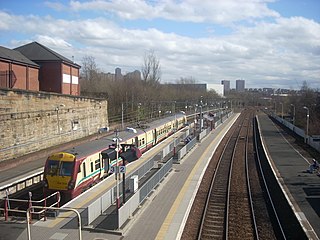
Springburn railway station serves the Springburn district of Glasgow, Scotland. The station is 1 1⁄4 miles (2.0 km) north of Glasgow Queen Street station on the Cumbernauld Line and is a terminus of the Springburn branch, a spur from Bellgrove station, on the North Clyde Line.

Drumry railway station serves the Drumry and Linnvale area of Clydebank, West Dunbartonshire, Scotland. The railway station is managed by Abellio ScotRail and is served by trains on the Argyle Line and North Clyde Line.

Barnhill railway station is in Glasgow, Scotland, 3 miles (5 km) north of Glasgow Queen Street railway station on the Springburn branch of the North Clyde Line. The station is managed by Abellio ScotRail.

This station was once named Alexandra Park: for a guide to the various stations of that name see Alexandra Park railway station (disambiguation).

Duke Street Railway Station is a railway station in Glasgow, Scotland. The station is managed by Abellio ScotRail and is served by trains on the North Clyde Line, 1½ miles (2 km) north east of Glasgow Queen Street.

Easterhouse railway station serves the Easterhouse area of Glasgow, Scotland. It was built by the North British Railway as part of their Coatbridge Branch and opened when the branch opened on 1 February 1871. The station is 5¾ miles (9 km) east of Glasgow Queen Street railway station on the North Clyde Line and is managed by Abellio ScotRail.

The Forth and Clyde canal pathway runs between the Firth of Forth and the Firth of Clyde and is a 106-kilometre (66 mi) long footpath and cycleway that runs across Scotland, between Bowling, west of Glasgow, and Lochrin Basin in Edinburgh. The path runs on the towpaths of the Forth & Clyde and Union Canals and is entirely off road. The path is well maintained and its surface is generally good, although there are some stretches particularly between Falkirk and the outskirts of Edinburgh where wet weather leads to muddy conditions unsuitable for road intended bicycles. It is well used by walkers and cyclists, and designated as one of Scotland's Great Trails by Scottish Natural Heritage. It also forms part of the National Cycle Network, being designated as Route 754. Sustrans advises that the path is best followed from the Clyde to the Forth because the prevailing wind is from the south west. Much of the path is also suitable for experienced horseriders, although in some places low bridges, narrow aqueducts and gates may restrict access for horses.

Bridge Street railway station, now disused, was the original Glasgow terminus of the Glasgow and Paisley Joint Railway; jointly owned by the Glasgow, Paisley and Greenock Railway (GP&G), which later merged with the Caledonian Railway, and the Glasgow, Paisley, Kilmarnock and Ayr Railway (GPK&A), which became part of the Glasgow and South Western Railway.
The Glasgow City and District Railway was a sub-surface railway line in Glasgow, Scotland, built to connect suburban routes east and west of the city, and to relieve congestion at the Queen Street terminus.
The Glasgow, Dumbarton and Helensburgh Railway was independently sponsored to build along the north of the River Clyde. It opened in 1858, joining with an earlier local line serving Balloch. Both were taken over by the powerful North British Railway in 1865, and for some time the line was the main route in the area. As industry developed other lines were opened to serve it, and the line formed the core of a network in the area.

Balfron railway station was a railway station that served the village of Balfron in Scotland. The station was served by trains on the Strathendrick and Aberfoyle Railway and the Forth and Clyde Junction Railway, both of which closed in the 1950s.
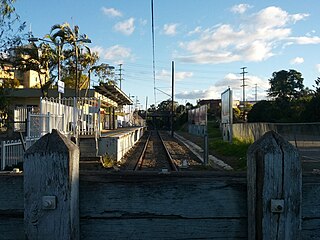
The Carlingford railway line is a branch railway line in Sydney, Australia. It was opened from Clyde to Subiaco in January 1885, then by means of the construction of a bridge across the Parramatta River, to Carlingford in April 1896. The line runs north-south between the suburb of Carlingford and the Main Suburban railway line at Clyde. Passenger services on the line form part of the Sydney Trains commuter rail network and are marketed as the T6 Carlingford Line. The railway line's small catchment, low patronage, short platforms and single track for much of its length mean the T6 generally operates as a shuttle service, with passengers changing at Clyde for T1 North Shore, Northern & Western Line services to the Sydney central business district and Parramatta. Most of the line is planned for conversion to light rail as part of the Parramatta Light Rail network. The remainder of the line will permanently close, apart from a short section which will remain open for use by Sydney Trains.

