Related Research Articles
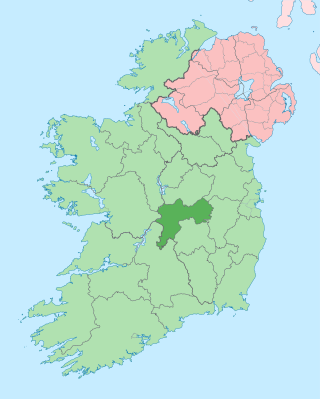
County Offaly is a county in Ireland. It is part of the Eastern and Midland Region and the province of Leinster. It is named after the ancient Kingdom of Uí Failghe. It was formerly known as King's County, in honour of Philip II of Spain. Offaly County Council is the local authority for the county. The county population was 82,668 at the 2022 census.

The Constitution of Ireland vests executive authority in the Government of Ireland, which is headed by the Taoiseach, the head of government. The government – also known as the cabinet – is composed of ministers, each of whom must be a member of the Oireachtas, which consists of Dáil Éireann and Seanad Éireann. Most ministers have a portfolio of specific responsibilities such as departments or policy areas, although ministers without portfolio can be appointed.
Bord na Móna is a semi-state company in Ireland, created in 1946 by the Turf Development Act 1946. The company began developing the peatlands of Ireland with the aim to provide economic benefit for Irish Midland communities and achieve security of energy supply for the recently formed Irish Republic. The development of peatlands involved the mechanised harvesting of peat, which took place primarily in the Midlands of Ireland.
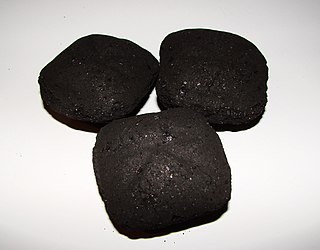
A briquette is a compressed block of coal dust or other combustible biomass material used for fuel and kindling to start a fire. The term derives from the French word brique, meaning brick.

The Bog of Allen is a large raised bog in the centre of Ireland between the rivers Liffey and Shannon.

Shannonbridge is a village located on the River Shannon, at the junction of the R444 and R357 regional roads in County Offaly, Ireland. It lies within the townland of Raghra, at the borders of counties Offaly, Galway and Roscommon, with the majority of the population living east of the bridge in County Offaly. As of the 2016 census, the village had a population of 175. There are two housing estates within the village. Its location along Ireland's largest river and its proximity to Clonmacnoise have contributed to tourism being a key contributor to the local economy. The village is flanked by a Special Area of Conservation – the Shannon Callows. The physical environment consists of the River Shannon, callows, boglands and the Esker Riada. The village has one of the oldest bridges still in use over the River Shannon, completed in 1757.

Laois–Offaly is a parliamentary constituency which is represented in Dáil Éireann, the lower house of the Irish parliament or Oireachtas. The constituency elects 5 deputies on the system of proportional representation by means of the single transferable vote (PR-STV). It was previously a constituency from 1921 to 2016.

Daingean, formerly Philipstown, named after King Philip II of Spain, is a small town in east County Offaly, Ireland. It is situated midway between the towns of Tullamore and Edenderry on the R402 regional road. The town of Daingean had a population, as of the 2022 census, of 1,223. It is the principal town of the Daingean Catholic Parish. The other main poles of this parish are Ballycommon, Kilclonfert and Cappincur.

Kilcormac is a small village in County Offaly, Ireland, located on the N52 at its junction with the R437 regional road, between the towns of Tullamore and Birr. It is a small village of 935 people, many of whom were previously employed by Bord na Móna to work the local peat bogs. The village is located near the Slieve Bloom Mountains. The Silver River flows through the village. The village was more commonly referred to as Frankford prior to Irish independence.
The primary natural resources of the Republic of Ireland include natural gas, petroleum, peat, copper, lead, dolomite, barite, limestone, gypsum, silver and zinc. Key industries based on these and other natural resources include fishing, mining, and various forms of agriculture and fish farming. The Department of Communications, Energy and Natural Resources is charged with the legislative protection of Ireland's natural resources.
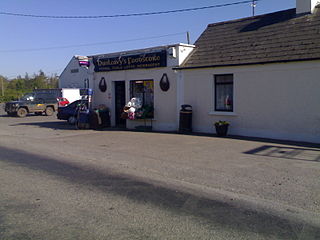
Coole is a village in County Westmeath, Ireland, on the R395 regional road. It is situated on a plateau that overlooks the part of the Bog of Allen, cultivated for peat for fuel consumption purposes by Bórd na Móna, the government-owned peat production industry and for garden plant soil compost products by Harte Peat Ltd., a private enterprise, and Bórd na Móna.

Pollagh, also spelled Pullough, is a village in County Offaly, Ireland, located in the midlands of Ireland. It is a rural village on the Grand Canal and lies between Ferbane and Tullamore. Much of the surrounding area is bogland, and is used to produce fossil fuels such as peat turf. The River Brosna flows close to the village. The Grand Canal was used for transporting peat and bricks produced in the area. Pollagh benefited from the canal in earlier years when it brought investment and employment from Bord na Móna, and it is now a tourist attraction. Pollagh is also known for its church, including its bog oak altar and stained glass windows, designed by the Harry Clarke studios.

Rhode is a village in County Offaly, Ireland. It is situated on the R400 at its junction with the R441 which leads to Edenderry, 12 km to the east. Rhode village is on an "island" of high ground surrounded by an expanse of raised bog which forms part of the Bog of Allen.

The Clonmacnoise and West Offaly Railway was a former tourist attraction based on a narrow-gauge industrial railway in the Midlands of Ireland.

Lullymore is a civil parish in County Kildare in Ireland. It is in the historical barony of Offaly East. The lowest observed 20th century air temperature in Ireland, -18.8 °C was measured at Lullymore on 2 January 1979.

The West Offaly Power Station was a large peat-fired 135 MW power station in Shannonbridge from 2005 to 2020, in the Republic of Ireland. The station was capable of generating up to 153 MWe of power, thus ranking as the largest peat-fired power station in the country. The power station was constructed adjacent to the ageing 125 MWe peat Shannonbridge Power Station, which operated in stages from 1965 to 2003, and demolished in 2005.
Raheenmore Bog is a raised bog north-west of Daingean, County Offaly, in Ireland. Since the 1980s the greater part of the bog has been maintained as a 162 hectare Nature Reserve, which is currently managed by the National Parks and Wildlife Service. A Special Area of Conservation covers 182 ha, including some land in private ownership.

Ireland is a net energy importer. Ireland's import dependency decreased to 85% in 2014. The cost of all energy imports to Ireland was approximately €5.7 billion, down from €6.5 billion (revised) in 2013 due mainly to falling oil and, to a lesser extent, gas import prices. Consumption of all fuels fell in 2014 with the exception of peat, renewables and non-renewable wastes.
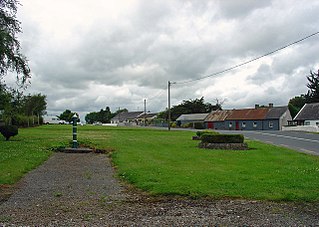
Carrig is a settlement and electoral division in the historical barony of Ormond Lower, County Tipperary, Ireland. It is located on the N52 road between Birr and Borrisokane. The early medieval Christian psalter known as the Faddan More Psalter was discovered near here in July 2006 in a peat bog.
Redwood is a townland in the historical Barony of Ormond Lower, County Tipperary, Ireland. It is also an electoral district in the Dáil constituency of Offaly having previously been part of the Tipperary North Dáil constituency.
References
- ↑ Oireachtas, Houses of the (May 1, 1957). "Committee on Finance. - Turf Development Bill, 1957 —Second Stage. – Dáil Éireann (16th Dáil) – Wednesday, 1 May 1957 – Houses of the Oireachtas". www.oireachtas.ie.
- ↑ "Who Do You Think You Are? - Ryan Tubridy Episode - The Peat Industry in Ireland". rte.ie. RTÉ. Archived from the original on 20 September 2012.
- ↑ "Brief History of the Peat Industry in Ireland". Living History.
- ↑ "Closure of peat briquette factory a blow to Tipperary". Irish Times. May 4, 2017.
- ↑ "Cowen says briquette factory to remain in production until 2024". Offaly Independent. February 15, 2021.
- ↑ "Briquette production in Offaly ends this year - Irish Today". March 8, 2023.
- ↑ "Derrinlough Wind Farm Planning". www.derrinloughwindfarmplanning.ie.
- ↑ "Major windfarm work to start". Offaly Independent. June 10, 2022.
- ↑ Fanning, Derek. "Push to locate new Anaerobic Digester at site of soon to close factory in Offaly". www.offalyexpress.ie.