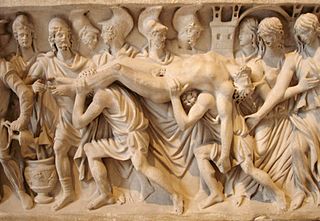
In Greek mythology and Roman mythology, Hector was a Trojan prince and the greatest fighter for Troy in the Trojan War. As the first-born son of King Priam and Queen Hecuba, who was a descendant of Dardanus and Tros, the founder of Troy, he was a prince of the royal house and the heir apparent to his father's throne. He was married to Andromache, with whom he had an infant son, Scamandrius. He acted as leader of the Trojans and their allies in the defence of Troy, "killing 31,000 Greek fighters", offers Hyginus. During the European Middle Ages, Hector figures as one of the Nine Worthies noted by Jacques de Longuyon, known not only for his courage but also for his noble and courtly nature. Indeed, Homer places Hector as peace-loving, thoughtful as well as bold, a good son, husband and father, and without darker motives. James Redfield describes Hector as a "martyr to loyalties, a witness to the things of this world, a hero ready to die for the precious imperfections of ordinary life."
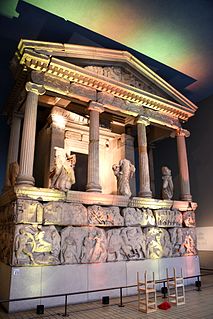
In Greek mythology, the Nereids are sea nymphs, the 50 daughters of Nereus and Doris, sisters to Nerites. They often accompany Poseidon, the god of the sea, and can be friendly and helpful to sailors, like the Argonauts in their search for the Golden Fleece.

In Greek mythology, Priam was the legendary king of Troy during the Trojan War. His many children included notable characters like Hector and Paris.
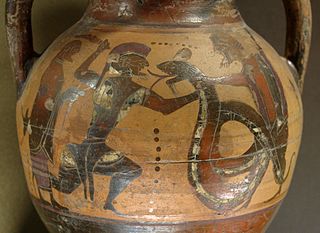
Balius and Xanthus were, according to Greek mythology, two immortal horses, the offspring of the harpy Podarge and the West wind, Zephyrus; following another tradition, their father was Zeus.

In Greek mythology, Chryseis is a Trojan woman, the daughter of Chryses. Chryseis, her apparent name in the Iliad, means simply "Chryses' daughter"; later writers give her real name as Astynome (Ἀστυνόμη). The poet Tzetzes describes her to be "very young and thin, with milky skin; had blond hair and small breasts; nineteen years old and still a virgin".

In Greek mythology, Chryses was a Trojan priest of Apollo at Chryse, near the city of Troy.

In Greek mythology, Andromache was the wife of Hector, daughter of Eetion, and sister to Podes. She was born and raised in the city of Cilician Thebe, over which her father ruled. The name means "man battler" or "fighter of men" or "man's battle", from the Greek stem ἀνδρ- "man" and μάχη "battle".

Scamander, Skamandros Xanthos (Ξάνθος), was the name of a river god in Greek mythology.
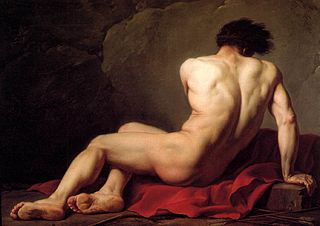
In Greek mythology, as recorded in Homer's Iliad, Patroclus was a close friend and wartime companion of Achilles. He was the son of Menoetius, grandson of Actor, King of Opus.
In Greek mythology and history, there were at least eight men named Medon.
In Greek mythology, King Mygdon of Phrygia, was a son of Acmon and father of Coroebus by his wife Anaximene.

Cilician Thebe, also known as Thebe Hypoplakia was a city in Greek mythology. It was located in or near the Troad, in a region termed Cilicia and received the epithet Cilician to distinguish it from the Boeotian city of Thebes and the Egyptian Thebes. Alternative names include Placia, Hypoplacia and Hypoplacian Thebe(s), referring to the city's position at the foot of Mount Placus.
Pedasus has been identified with several personal and place names in Greek history and mythology.
In Greek mythology, Pyraechmes was, along with Asteropaeus, a leader of the Paeonians in the Trojan War. He came from the city of Amydon. Although Homer mentions Pyraechmes as the leader of the Paeonians early on in the Iliad, in the Trojan Catalogue, Pyraechmes plays a minor role compared to the more illustrious Asteropaeus, a later arrival to the front. Unlike Asteropaeus, Homer does not provide a pedigree for Pyraechmes. Pyraechmes was killed in battle by Patroclus: dressed in Achilles' armor, Patroclus routed the panicked Trojans, and the first person he killed was Pyraechmes.
Podes was the son of Eetion in Greek mythology, and thus the brother of Andromache, wife of Hector, whom he is said to have befriended. He fought on the side of the Trojans in the Trojan War, and was killed by Menelaus. However, in Book 6 of the Iliad Andromache claims that her seven brothers have been killed by Achilles. This contradiction is not resolved.
In Greek mythology, as recorded in Homer's Iliad, Lycaon was a son of Priam and Laothoe, daughter of the Lelegian king Altes.
In Greek mythology, Phorcys was a Phrygian ally of King Priam in the Trojan War. Phorcys appears in The Iliad as the leader of the Phrygians, a son of Phaenops. The Bibliotheca, however, refers to him as a son of Aretaon and brother of Ascanius, another Phrygian leader. Phorcys is mentioned among the Trojan allies whom Hector addresses with a speech in Book 17 of the Iliad. He was killed in battle by the Greek hero Ajax.
In Greek mythology, Imbrius, son of Mentor, was a defender of Troy. According to the Iliad, Imbrius originated from Pedaeum and was married to Medesicaste, an illegitimate daughter of King Priam. When the Greeks landed at Troy, Imbrius moved to the house of his father-in-law, who treated him like his own son. Imbrius fought at the walls of Troy and was killed by Teucer.


