
Terrorism, in its broadest sense, is the use of violence against non-combatants to achieve political or ideological aims. The term is used in this regard primarily to refer to intentional violence during peacetime or in the context of war against non-combatants. There are various different definitions of terrorism, with no universal agreement about it. Different definitions of terrorism emphasize its randomness, its aim to instill fear, and its broader impact beyond its immediate victims.

The September 11 attacks transformed the first term of President George W. Bush and led to what he referred to as the war on terror. The accuracy of describing it as a "war" and its political motivations and consequences are the topic of strenuous debate. The U.S. government increased military operations, economic measures, and political pressure on groups that it accused of being terrorists, as well as increasing pressure on the governments and countries which were accused of sheltering them. October 2001 saw the first military action initiated by the US. Under this policy, NATO invaded Afghanistan to remove the Taliban regime and capture al-Qaeda forces.
Religious terrorism is a type of religious violence where terrorism is used as a strategy to achieve certain religious goals or which are influenced by religious beliefs and/or identity.

The People's Mojahedin Organization of Iran (PMOI), also known as Mojahedin-e-Khalq (MEK) or Mojahedin-e-Khalq Organization (MKO), is an Iranian dissident organization that was previously armed but has now transitioned primarily into a political group. Its headquarters are currently in Albania. The group's ideology is rooted in "Islam with revolutionary Marxism", and offered a revolutionary reinterpretation of Shia Islam influenced by the writings of Ali Shariati. After the Iranian Revolution, the MEK opposed the new theocratic Government of the Islamic Republic of Iran, seeking to replace it with its own government. At one point the MEK was Iran's "largest and most active armed dissident group", and it is still sometimes presented by Western political backers as a major Iranian opposition group, but it is also deeply unpopular today within Iran, largely due to its siding with Iraq in the Iran–Iraq War.

Armenian Secret Army for the Liberation of Armenia (ASALA) was a militant organization active between 1975 and the 1990s whose stated goal was "to compel the Turkish Government to acknowledge publicly its responsibility for the Armenian genocide in 1915, pay reparations, and cede territory for an Armenian homeland." ASALA itself and other sources described it as a guerilla and armed organization. The United States Department of State, the Ministry of Foreign Affairs of Azerbaijan and some other sources listed it as a terrorist organization.

Lashkar-e-Taiba is a terrorist group formed in Pakistan, and a militant and Islamist Salafi jihadist organisation. Described as one of Pakistan's "most powerful jihadi groups", it is most infamous outside Pakistan. The organisation's primary stated objective is to merge the whole of Kashmir with Pakistan. It was founded in 1985–1986 by Hafiz Saeed, Zafar Iqbal Shehbaz Abdullah Azzam and several other Islamist mujahideen with funding from Osama bin Laden during the Soviet–Afghan War. It has been designated a terrorist group by numerous countries.
Cyberterrorism is the use of the Internet to conduct violent acts that result in, or threaten, the loss of life or significant bodily harm, in order to achieve political or ideological gains through threat or intimidation. Emerging alongside the development of information technology, cyberterrorism involves acts of deliberate, large-scale disruption of computer networks, especially of personal computers attached to the Internet by means of tools such as computer viruses, computer worms, phishing, malicious software, hardware methods, and programming scripts can all be forms of internet terrorism. Some authors opt for a very narrow definition of cyberterrorism, relating to deployment by known terrorist organizations of disruption attacks against information systems for the primary purpose of creating alarm, panic, or physical disruption. Other authors prefer a broader definition, which includes cybercrime. Participating in a cyberattack affects the terror threat perception, even if it isn't done with a violent approach. By some definitions, it might be difficult to distinguish which instances of online activities are cyberterrorism or cybercrime.
Terrorism and mass attacks in Canada includes acts of terrorism, as well as mass shootings, vehicle-ramming attacks, mass stabbings, and other such acts committed in Canada that people may associate with terroristic tactics but have not been classified as terrorism by the Canadian legal system.

The Guantanamo military commissions were established by President George W. Bush through a military order on November 13, 2001, to try certain non-citizen terrorism suspects at the Guantanamo Bay prison. To date, there have been a total of eight convictions in the military commissions, six through plea agreements. Several of the eight convictions have been overturned in whole or in part on appeal by U.S. federal courts.
The Saddam–al-Qaeda conspiracy theory was based on false claims by the United States government alleging that a secretive relationship existed between Iraqi president Saddam Hussein and the Sunni pan-Islamist militant organization al-Qaeda between 1992 and 2003. U.S. president George W. Bush used it as a main reason for invading Iraq in 2003.
The Terrorism Research Center (TRC) is a non-profit think tank focused on investigating and researching global terrorism issues through multi-disciplinary collaboration amongst a group of international experts.
The Memorial Institute for the Prevention of Terrorism (MIPT) was a non-profit organization founded in response to the 1995 Oklahoma City bombing. Supported by Department of Homeland Security and other government grant funds, it conducted research into the causes of terrorism and maintained the MIPT Terrorism Knowledge Base — which was an online database of terrorist incidents, groups, and other information. MIPT also worked in conjunction with RAND, for some of its research and analysis. The institute provided training and professional development dedicated to improving the skills of law enforcement officers.
The September 11 attacks, commonly known as 9/11, were four coordinated Islamist terrorist suicide attacks carried out by al-Qaeda against the United States in 2001. On that Tuesday morning, 19 terrorists hijacked four commercial airliners scheduled to travel from the East Coast to California. The first two teams of hijackers crashed the first two planes into the Twin Towers of the World Trade Center in New York City, while the remaining hijackers aimed the next two flights toward targets in or near Washington, D.C., in an attack on the nation's capital. The third team succeeded in striking the Pentagon, the headquarters of the U.S. Department of Defense in Arlington County, Virginia, while the fourth plane hijacked by the fourth team crashed in rural Pennsylvania during a passenger revolt. The September 11 attacks killed 2,977 people, making it the deadliest terrorist attack in history. In response to the attacks, the United States waged the multi-decade global war on terror to eliminate hostile groups deemed terrorist organizations, as well as the foreign governments purported to support them, in Afghanistan, Iraq, Syria, and several other countries.

Sociology of terrorism is a field of sociology that seeks to understand terrorism as a social phenomenon. The field defines terrorism, studies why it occurs and evaluates its impacts on society. The sociology of terrorism draws from the fields of political science, history, economics and psychology. The sociology of terrorism differs from critical terrorism studies, emphasizing the social conditions that enable terrorism. It also studies how individuals as well as states respond to such events.
Since the Iranian Revolution in 1979, the government of the Islamic Republic of Iran has been accused by several countries of training, financing, and providing weapons and safe havens for non-state militant actors, such as Hezbollah in Lebanon, Hamas in Gaza, and other Palestinian groups such as the Islamic Jihad (IJ) and the Popular Front for the Liberation of Palestine (PFLP). These groups are designated terrorist groups by a number of countries and international bodies such as the EU, UN, and NATO, but Iran considers such groups to be "national liberation movements" with a right to self-defense against Israeli military occupation. These proxies are used by Iran across the Middle East and Europe to foment instability, expand the scope of the Islamic Revolution, and carry out terrorist attacks against Western targets in the regions. Its special operations unit, the Quds Force, is known to provide arms, training, and financial support to militias and political movements across the Middle East, including Bahrain, Iraq, Lebanon, Palestine, Syria, and Yemen.

The war on terror, officially the Global War on Terrorism (GWOT), is a global counterterrorist military campaign initiated by the United States following the September 11 attacks of 2001, and is the most recent global conflict spanning multiple wars. Some researchers and political scientists have argued that it replaced the Cold War.
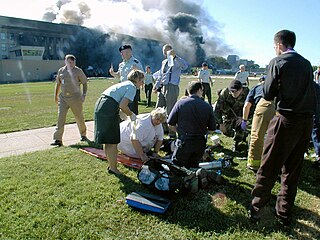
Disaster medicine is the area of medical specialization serving the dual areas of providing health care to disaster survivors and providing medically related disaster preparation, disaster planning, disaster response and disaster recovery leadership throughout the disaster life cycle. Disaster medicine specialists provide insight, guidance and expertise on the principles and practice of medicine both in the disaster impact area and healthcare evacuation receiving facilities to emergency management professionals, hospitals, healthcare facilities, communities and governments. The disaster medicine specialist is the liaison between and partner to the medical contingency planner, the emergency management professional, the incident command system, government and policy makers.

The September 11 attacks were condemned by world leaders and other political and religious representatives and the international media, as well as numerous memorials and services all over the world. The attacks were widely condemned by world governments, including those traditionally considered hostile to the United States, such as Cuba, Iran, Syria, Libya, North Korea, and Afghanistan itself. However, in a few cases celebrations of the attacks were also reported, and some groups and individuals accused the United States in effect of bringing the attacks on itself. These reports have been uncorroborated and many have been linked to unsubstantiated conspiracy theories.
Christian Action Network (CAN) is a Christian activist organization founded by Martin Mawyer in 1990. The organization states that its "primary goals are to protect America's religious and moral heritage through educational efforts."
The UN Counter-Terrorism Implementation Task Force (CTITF) was an instrument designed to roll out the UN Global Counter-Terrorism Strategy.