
Austria-Hungary, often referred to as the Austro-Hungarian Empire or the Dual Monarchy, was a multi-national constitutional monarchy in Central Europe between 1867 and 1918. A military and diplomatic alliance, it consisted of two sovereign states with a single monarch who was titled both emperor of Austria and King of Hungary. Austria-Hungary constituted the last phase in the constitutional evolution of the Habsburg monarchy: it was formed with the Austro-Hungarian Compromise of 1867 in the aftermath of the Austro-Prussian War and was dissolved shortly after Hungary terminated the union with Austria on 31 October 1918.

Franz Joseph I or Francis Joseph I was Emperor of Austria, King of Hungary, and the ruler of the other states of the Habsburg monarchy from 2 December 1848 until his death in 1916. In the early part of his reign, his realms and territories were referred to as the Austrian Empire, but were reconstituted as the dual monarchy of the Austro-Hungarian Empire in 1867. From 1 May 1850 to 24 August 1866, he was also president of the German Confederation.

Charles I was Emperor of Austria, King of Hungary and King of Croatia, King of Bohemia, and the last of the monarchs belonging to the House of Habsburg-Lorraine to rule over Austria-Hungary. The son of Archduke Otto of Austria and Princess Maria Josepha of Saxony, Charles became heir presumptive of Emperor Franz Joseph when his uncle Archduke Franz Ferdinand of Austria was assassinated in 1914. In 1911, he married Princess Zita of Bourbon-Parma. He is venerated in the Catholic Church, was beatified by Pope John Paul II on 3 October 2004, and is known to the Catholic Church as Blessed Karl of Austria.

The Austro-Hungarian Compromise of 1867 established the dual monarchy of Austria-Hungary, which was a military and diplomatic alliance of two sovereign states. The Compromise only partially re-established the former pre-1848 sovereignty and status of the Kingdom of Hungary, being separate from, and no longer subject to, the Austrian Empire. The compromise put an end to the 18-year-long military dictatorship and absolutist rule over Hungary which Emperor Franz Joseph had instituted after the Hungarian Revolution of 1848. The territorial integrity of the Kingdom of Hungary was restored. The agreement also restored the old historic constitution of the Kingdom of Hungary.

Oskar Potiorek was an officer of the Austro-Hungarian Army, who served as Governor of Bosnia and Herzegovina from 1911 to 1914. He was a passenger in the car carrying Archduke Franz Ferdinand of Austria and his wife Duchess Sophie of Hohenberg when they were assassinated in Sarajevo on 28 June 1914. Potiorek had failed to inform the driver of a change of route which led the royal car to take a wrong turn, stalling after trying to turn around, and ending up in front of Gavrilo Princip. In World War I, Potiorek commanded the Austro-Hungarian forces in the failed Serbian campaign of 1914. He was removed from command, retiring from the army shortly afterward.

The University of Zagreb is a public research university in Zagreb, Croatia. It is the largest Croatian university and one of the oldest continuously operating universities in Europe. The University of Zagreb and the University North are the only public universities operating in Northern and Central Croatia.

Svetozar Boroević von Bojna was an Austro-Hungarian field marshal of Croatian Serb descent who was described as one of the finest defensive strategists of the First World War. He commanded Austro-Hungarian forces in the Isonzo front, for which he was nicknamed the "Lion of Isonzo".
Landwehr, or Landeswehr, is a German language term used in referring to certain national armies, or militias found in nineteenth- and early twentieth-century Europe. In different context it refers to large-scale, low-strength fortifications. In German, the word means "defence of the country"; but the term as applied to an insurrectional militia is very ancient, and lantveri are mentioned in Baluzii Capitularia, as quoted in Henry Hallam's Middle Ages, i. 262, 10th edition.
The Austro-Hungarian Army, also known as the Imperial and Royal Army, was the principal ground force of Austria-Hungary from 1867 to 1918. It consisted of three organisations: the Common Army, the Imperial-Royal Landwehr and the Royal Hungarian Honvéd.

The Military Order of Maria Theresa was the highest military honour of the Habsburg monarchy, Austrian Empire and Austro-Hungarian Empire.

Archduke Franz Ferdinand Carl Ludwig Joseph Maria of Austria was the heir presumptive to the throne of Austria-Hungary. His assassination in Sarajevo was the most immediate cause of World War I.

The assassination of Archduke Franz Ferdinand was one of the key events that led to World War I. Archduke Franz Ferdinand of Austria, heir presumptive to the Austro-Hungarian throne, and his wife, Sophie, Duchess of Hohenberg, were assassinated on 28 June 1914 by Bosnian Serb student Gavrilo Princip. They were shot at close range while being driven through Sarajevo, the provincial capital of Bosnia and Herzegovina, formally annexed by Austria-Hungary in 1908.

Baron Josip Šokčević, was a Croatian lieutenant marshal in the Austro-Hungarian Army who served as the ban of Croatia and as the governor of the Voivodeship of Serbia and Temes Banat.

The Order of Saint Stephen is an order of chivalry founded in 1764 by Maria Theresa. In 1938, Miklós Horthy took the rights and activities of Grand Master as Regent of Hungary. The name of the Order changed to the Royal Hungarian Order of Saint Stephen. The Order was terminated at the time of the proclamation of the Second Hungarian Republic in 1946. It was recreated in 2011 as the Hungarian Order of Saint Stephen, and to this day remains the highest order in Hungary.

Milan Emil Uzelac was an Austro-Hungarian military commander who was a leading figure in the air forces of the Austro-Hungarian Empire, Kingdom of Yugoslavia and the Independent State of Croatia.

On the initiative of Croatian ban Károly Khuen-Héderváry, in mid-October 1895 Austro-Hungarian Emperor Franz Joseph visited Zagreb, at the time the capital of the Kingdom of Croatia–Slavonia, in order to attend the opening of the Croatian National Theatre. A group of Croatian students used the visit to protest the rule of the Hungarian Khuen-Héderváry as Croatian ban. They were led by Stjepan Radić, who would later form the influential Croatian People's Peasant Party.
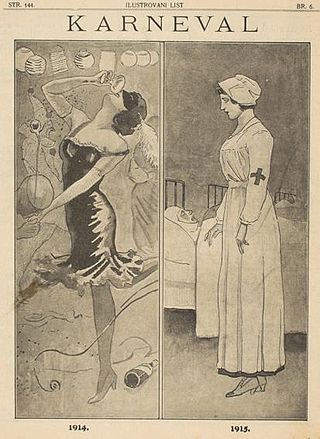
The Triune Kingdom of Croatia, Slavonia and Dalmatia was part of Austria-Hungary during World War I. Its territory was administratively divided between the Austrian and Hungarian parts of the empire; Međimurje and Baranja were in the Hungarian part (Transleithania), the Kingdom of Croatia-Slavonia was a separate entity associated with the Hungarian Kingdom, Dalmatia and Istria were in the Austrian part (Cisleithania), while the town of Rijeka had semi-autonomous status.

SMS Kaiser Franz Joseph I was a protected cruiser built for the Austro-Hungarian Navy. Named for the Austrian emperor and Hungarian king Franz Joseph I, Kaiser Franz Joseph I was the lead ship of her namesake class. Constructed by Stabilimento Tecnico Triestino in Trieste, she was laid down in January 1888 and launched in May 1889. Kaiser Franz Joseph I was commissioned into the Navy in June 1890. As the first protected cruiser constructed by the Austro-Hungarian Navy, she was intended to serve as Austria-Hungary's response to the Italian cruisers Giovanni Bausan and Etna. Her design was heavily influenced by the Jeune École, a naval strategy which had gained prominence in the 1880s as a means to combat a larger and more heavily armored navy of battleships through the use of torpedo flotillas.

During its existence, Austria-Hungary did not have a common flag – a "national flag" could not exist since the Dual Monarchy consisted of two sovereign states. However, the black-gold flag of the ruling Habsburg Dynasty was sometimes used as a de facto national flag and a common civil ensign was introduced in 1869 for civilian vessels. Until 1918, the k.u.k. War Fleet continued to carry the Austrian ensign it had used since 1786 and the regiments of the k.u.k. Army carried the double-eagle banners they had used before 1867, as they had a long history in many cases. New ensigns created in 1915 were not implemented due to the ongoing war. At state functions, the Austrian black-gold and the Hungarian red-white-green tricolor were used.

The Austro-Hungarian Bank was the central bank of the Habsburg Monarchy in the 19th and early 20th centuries.
