
Honeysuckles are arching shrubs or twining vines in the genus Lonicera of the family Caprifoliaceae. It includes 158 species native to northern latitudes in North America, Eurasia, and North Africa. Widely known species include Lonicera periclymenum, Lonicera japonica and Lonicera sempervirens. L. japonica is a highly invasive species considered a significant pest in parts of North America, Europe, South America, Australia, and Africa.
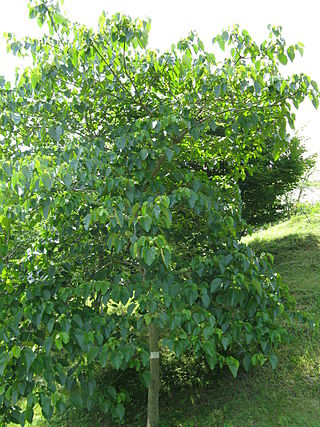
Vernicia fordii is a species of flowering plant in the spurge family Euphorbiaceae. It is native to southern China, Myanmar, and northern Vietnam. It is a small to medium-sized deciduous tree growing to 20 m tall, with a spreading crown. The bark is smooth and thin, and bleeds latex if cut. The leaves are alternate, simple, 4.5–25 cm long and 3.5–22 cm broad, heart-shaped or with three shallow, maple-like lobes, green above and below, red conspicuous glands at the base of the leaf, and with a 5.5–26 cm long petiole. The flowers are 2.5–3.5 cm diameter, with five pale pink to purple petals with streaks of darker red or purple in the throat; it is monoecious with individual flowers either male or female, but produced together in the inflorescences. The flowers appear before or with the leaves in loose, terminal clusters. The fruit is a hard, woody pear-shaped berry 4–6 cm long and 3–5 cm diameter, containing four or five large, oily seeds; it is green initially, becoming dull brown when ripe in autumn.
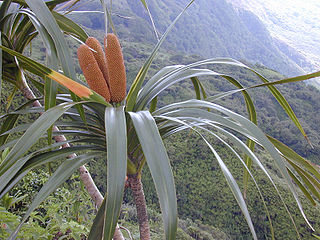
Freycinetia is one of the five extant genera in the flowering plant family Pandanaceae. As of November 2024, the genus comprises approximately 300 species. The type species is Freycinetia arborea.
William Botting Hemsley was an English botanist and 1909 Victoria Medal of Honour recipient. The standard author abbreviation Hemsl. is used to indicate this person as the author when citing a botanical name.

Nepenthes sumatrana is a tropical pitcher plant endemic to the Indonesian island of Sumatra, after which it is named.
Heliotropium pannifolium, the Saint Helena heliotrope, is now extinct but was formerly a hairy-leaved small shrub in the family Boraginaceae. It grew to a height of up to 1 m. It was only seen once, by the explorer W. Burchell in Broad Gut, Saint Helena and has never been seen again. Human impact on the island of Saint Helena was severe and the Saint Helena heliotrope is one of several extinct plants from that island.
Freycinetia arborea, ʻIeʻie, is a densely branched, brittle, woody climber in the family Pandanaceae, endemic to the Pacific Islands. ʻIeʻie is found in moist forest on the Hawaiian, Marquesas, Austral, Society, and Cook Islands. It grows into the forest canopy, attaching itself to a host tree using aerial roots. It may also grow as a sprawling tangle on the forest floor.
Polyscias crassa is a species of plant in the family Araliaceae. It is endemic to Seychelles. It is threatened by habitat loss.

Dalbergia retusa is a plant species in the familyFabaceae . It is found in Pacific regions of Central America, ranging from Panama to southwestern Mexico. It produces the cocobolo wood. It is a fair-sized tree, reported to reach 20–25 m in height. This is probably the species contributing most of the wood in the trade. Because of the wood's great beauty and high value, the trees yielding this wood have been heavily exploited and are now rare outside national parks, reserves, and plantations.

Cornus controversa, syn. Swida controversa, is a species of flowering plant in the dogwood family Cornaceae. It is native to China, Korea, the Himalayas and Japan. It is a deciduous tree growing to 50 ft (15 m), with multiple tiered branches. Flat panicles of white flowers appear in summer, followed by globose black fruit. Ovate dark green leaves are glaucous underneath and turn red-purple in autumn. It is cultivated in gardens and parks in temperate regions.
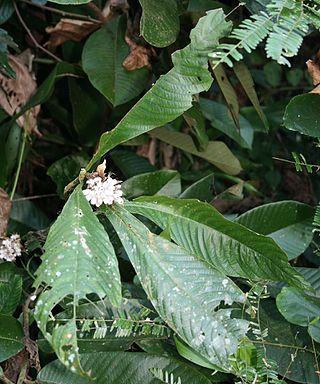
Mycetia is a genus of flowering plants in the family Rubiaceae. It includes 54 species, ranging from the Indian subcontinent through Indochina, southern China, and Malesia to New Guinea.

Lobelia rhynchopetalum, the giant lobelia, is a flowering plant in the family Campanulaceae. It is endemic to Ethiopia. Its habitat is the Afroalpine climate of the Semien Mountains and Bale Mountains National Park. Recent study show that it is under a threat of climate change.

Rhododendron concinnum (秀雅杜鹃) is a species of flowering plant in the family Ericaceae. It is native to Guizhou, Henan, Hubei, Shaanxi, Sichuan, and Yunnan in China, where it grows at altitudes of 2300–3000 meters. It is a shrub that grows to 1.5–3 m in height, with leaves that are oblong, elliptic, ovate, oblong-lanceolate or ovate-lanceolate, 2.5–7.5 by 1.5–3.5 cm in size. Flowers are pale pink to deep purplish red.
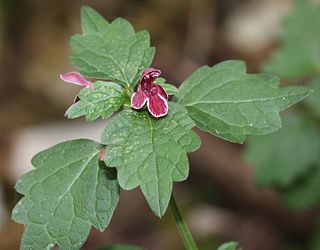
Loxocalyx is a genus of plants in the family Lamiaceae, first described in 1891. It is native to China and Japan.
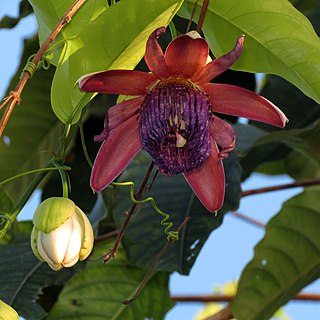
Passiflora ambigua is a species of flowering plant in the family Passifloraceae . It is found in Mexico, Belize, Costa Rica, and Colombia.

Damrongia is a genus of flowering plants in the Gesneriad family, centered in Thailand and found in southern China, Southeast Asia, and Sumatra. Species were reassigned to it in 2016 in a revision of Loxocarpinae.

Cyrtandromoea is a genus of flowering plants belonging to the family Phrymaceae. For a considerable time, the family placement of the genus remained uncertain; it was placed in either Gesneriaceae or Scrophulariaceae. A molecular phylogenetic study published in 2019 showed that it belonged in Phrymaceae.

Freycinetia scandens is a species of climbing plant in the family Pandanaceae. Naturally found growing in Papua New Guinea, Malesia and Queensland.

Freycinetia percostata, commonly known as climbing pandan, is a plant in the family Pandanaceae native to New Guinea, the Solomon Islands and the Northern Territory and Queensland in Australia. It is a root climber with stems up to a maximum of 3 cm (1.2 in) diameter. Leaves are long and narrow with parallel venation, and are arranged in closely packed spirals. Auricles are present at the leaf base and the margins are finely toothed. The species is dioecious, meaning that pistillate and staminate flowers are borne on separate plants. Inflorescences consist of spadices and are surrounded by orange bracts. Fruit are a multiple fruit consisting of numerous red berries about 1 cm (0.39 in) wide.

