
Lincolnshire is a county in the East Midlands of England, with a long coastline on the North Sea to the east. It borders Norfolk to the south-east, Cambridgeshire to the south, Rutland to the south-west, Leicestershire and Nottinghamshire to the west, South Yorkshire to the north-west, and the East Riding of Yorkshire to the north. It also borders Northamptonshire in the south for just 20 yards (19 m), England's shortest county boundary. The county town is the city of Lincoln, where the county council is based.

Lincolnshire is a village in Vernon Township, Lake County, in the U.S. state of Illinois. The village is a northern suburb of Chicago. Per the 2020 census, the population was 7,940. Lincolnshire was incorporated on August 5, 1957, from the unincorporated Half Day area when land was purchased to build a residential subdivision. The community underwent an aggressive era of expansion from 1983 to the 1990s. The Des Plaines River bisects the village, passing from north to south; Illinois Route 22 also divides the village into two parts, crossing the village from east to west.

Brigg (/'brɪg/) is a market town in North Lincolnshire, England, with a population of 5,076 in the, the population increased to 5,626 at the 2011 census. The town lies at the junction of the River Ancholme and east–west transport routes across northern Lincolnshire. As a formerly important local centre, the town's full name of Glanford Brigg is reflected in the surrounding area and local government district of the same name. The town's urban area includes the neighbouring hamlet of Scawby Brook.
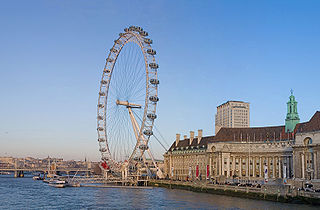
The South Bank is an entertainment and commercial district in central London, next to the River Thames opposite the City of Westminster. It forms a narrow strip of riverside land within the London Borough of Lambeth and the London Borough of Southwark,. As such, the South Bank may be regarded as somewhat akin to the riverside part of an area known previously as Lambeth Marsh and North Lambeth.

Epworth is a town and civil parish in the Isle of Axholme, North Lincolnshire, England. The town lies on the A161, about halfway between Goole and Gainsborough. As the birthplace of John Wesley and Charles Wesley, it has given its name to many institutions associated with Methodism. Their father, Samuel Wesley, was the rector from 1695 to 1735.

Gainsborough is a market town, inland port and civil parish in the West Lindsey district of Lincolnshire, England. The town population was 20,842 at the 2011 census, and estimated at 23,243 in 2019. It lies on the east bank of the River Trent, 18 miles (29 km) north-west of Lincoln, 16 miles (26 km) south-west of Scunthorpe, 20 miles south-east of Doncaster and 39 miles (63 km) east of Sheffield. It is England's furthest inland port at over 55 miles (90 km) from the North Sea.

West Lindsey is a local government district in Lincolnshire, England. Its council is based in Gainsborough.
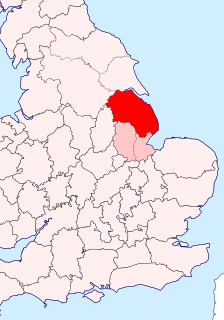
The Parts of Lindsey are a traditional division of Lincolnshire, England, covering the northern part of the county. The Isle of Axholme, which is on the west side of the River Trent, has normally formed part of it. The district's name originated from the Kingdom of Lindsey of Anglo-Saxon times, whose territories were merged with that of Stamford to form Lincolnshire.

Gainsborough is a constituency in Lincolnshire represented in the House of Commons of the UK Parliament since 1983 by Sir Edward Leigh, a Conservative.

Gainsborough Trinity Football Club is a football club based in Gainsborough, Lincolnshire, England. Established in 1873, the club became members of the Football League in 1893 and remained members of the Second Division until 1912, making Gainsborough one of the smallest towns in England to have had a Football League team. They are currently members of the Northern Premier League Premier Division, the seventh tier of English football, and play at the Northolme.

Stagecoach Lincolnshire is a bus company, formerly known as Lincolnshire RoadCar, which runs services throughout Lincolnshire.

Kitchener–Waterloo Oktoberfest is an annual nine-day festival in the twin cities of Kitchener–Waterloo, Ontario, Canada. Based on the original German Oktoberfest, it is billed as Canada's Greatest Bavarian Festival, and is the second-largest Oktoberfest in the world. It is held every October, starting on the Friday before Canadian Thanksgiving and running until the Saturday after. Estimates indicate that the event attracts roughly 700,000 visitors to Waterloo Region, Ontario every year.

The Battle of Gainsborough was a battle in the First English Civil War, fought on 28 July 1643. The strategically important town of Gainsborough was a Royalist base used for harassing the Parliamentarians who were generally dominant in Lincolnshire, but was taken by Parliamentarians in July 1643. An attempt to recapture Gainsborough by Charles Cavendish and the Royalists was foiled in a battle in which Colonel Oliver Cromwell distinguished himself as a cavalry leader.
Lincolnshire is one of the few counties within the UK that still uses the eleven-plus to decide who may attend grammar school, in common with Buckinghamshire and Kent.

Luton International Carnival is a large carnival in Luton, Bedfordshire. The carnival is commissioned by Luton Borough Council and is artistically produced by UK Centre for Carnival Arts, which is based in Luton town centre.
Garthorpe is a village in North Lincolnshire, England. It is situated approximately 8 miles (13 km) south-east from Goole, 1 mile (1.6 km) west from the River Trent, and in the Isle of Axholme. Together with Fockerby, which is contiguous with the village, Garthorpe forms a civil parish of about 500 inhabitants, measured as 418 in the 2011 census.

The A631 is a road running from Sheffield, South Yorkshire to Louth, Lincolnshire in England. It passes through the counties of South Yorkshire, Nottinghamshire and Lincolnshire. The road has many towns on its route including Rotherham, Maltby, Gainsborough and Market Rasen. It is mostly single road throughout its length but has some stretches of dual carriageway as well.

Stamford Riverside Festival was an annual music festival in Stamford, Lincolnshire, England. It has been going for over 25 years, previous event names being 'Rock on the Rec', 'Rock on the Meadows' and 'Music on the Meadows'.

The Trent Aegir, also known as the Eagre, is a tidal bore on the River Trent in England. At certain times of the year, the lower tidal reaches of the Trent experience a moderately large bore. It is said to take its name from Ægir, a personification of the sea in Norse mythology, although this is disputed. A more likely derivation is from Old English ēagor.
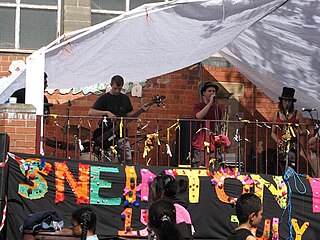
Sneinton Festival is a local cultural event that takes place every July in Sneinton, Nottingham, England. The first festival was held in 1995, and is run by The Festival Group, a volunteer group made up of local residents, representatives of local organisations, community groups, schools, church, youth and play groups, artists, musicians, performers and local project workers. Since 2002, the group has been supported and coordinated by the Sneinton Community Project. Each festival is organised around three individual elements: initial workshops, a week-long festival, and lastly a carnival day.

