This page is based on this
Wikipedia article Text is available under the
CC BY-SA 4.0 license; additional terms may apply.
Images, videos and audio are available under their respective licenses.
A parish is a territorial entity in many Christian denominations, constituting a division within a diocese. A parish is under the pastoral care and clerical jurisdiction of a parish priest, who might be assisted by one or more curates, and who operates from a parish church. Historically, a parish often covered the same geographical area as a manor. Its association with the parish church remains paramount.
Layamon or Laghamon – spelled Laȝamon or Laȝamonn in his time, occasionally written Lawman – was a poet of the late 12th/early 13th century and author of the Brut, a notable work that was the first to present the legends of Arthur and the Knights of the Round Table in English poetry.
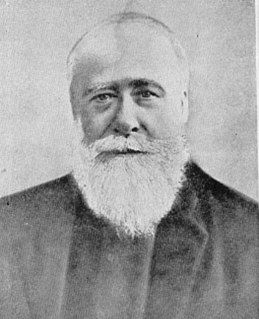
George Uglow Pope or G.U. Pope was an Anglican Christian missionary and Tamil scholar who spent 40 years in Tamil Nadu and translated many Tamil texts into English. His popular translations included those of the Tirukkural and Tiruvachagam. He later took to teaching, running his own school in Ootacamund for while and then moving to head the Bishop Cotton Boys' School in Bangalore and after returning to England worked as a Lecturer at Balliol College, Oxford. A statue on the Chennai beach recognizes him for his contribution to the understanding and promotion of the Tamil language.
Layamon's Brut, also known as The Chronicle of Britain, is a Middle English poem compiled and recast by the English priest Layamon. The Brut is 16,096 lines long and narrates the history of Britain: it is the first historiography written in English since the Anglo-Saxon Chronicle. Named for Britain's mythical founder, Brutus of Troy, the poem is largely based on the Anglo-Norman Roman de Brut by Wace, which is in turn a version of Geoffrey of Monmouth's Latin Historia Regum Britanniae. Layamon's poem, however, is longer than both and includes an enlarged section on the life and exploits of King Arthur. It is written in the alliterative verse style commonly used in Middle English poetry by rhyming chroniclers, the two halves of the alliterative lines being often linked by rhyme as well as by alliteration.
William Cotton may refer to:

Joseph Cotton Wigram was a British churchman, Archdeacon of Winchester and bishop of Rochester.
Henry Maxwell, D.D. (c.1723–1798) was an Anglican clergyman who served in the Church of Ireland as the Dean of Kilmore, then Bishop of Dromore, and finally Bishop of Meath.
Nicholas Synge was an 18th-century Irish Anglican priest.
Edward Young, DD was an English Anglican priest in the Eighteenth Century: his senior posts were in Ireland.
Essex Digby, DD was an English Anglican priest in Ireland in the second half of the Seventeenth Century.
Bartholomew Vigors was an Anglican priest in Ireland in the late seventeenth and early eighteenth centuries.
John Smith, D.D. was an Irish Anglican priest in Ireland in the Seventeenth Century.
The Very Rev. William Gore 921 January 1779 - 6 January 1731) was a Church of Ireland priest in the first quarter of the 18th-century.
The Very Rev. Richard Daniel was a Church of Ireland priest in the first half of the 18th-century.
The Ven. Andrew Hamilton was a long serving Anglican priest in Ireland.
Robert Naylor was a Seventeenth Century priest in Ireland.
Jasper Pheasant was an Anglican priest in Ireland in the Seventeenth Century.
Joseph Teate was an Anglican priest in Ireland during the seventeenth century.
John Wellwood, D.D. was a 17th-century English Anglican priest in Ireland.