This page is based on this
Wikipedia article Text is available under the
CC BY-SA 4.0 license; additional terms may apply.
Images, videos and audio are available under their respective licenses.

General Sir Charles James Napier,, was an officer and veteran of the British Army's Peninsular and 1812 campaigns, and later a Major General of the Bombay Army, during which period he led the military conquest of Sindh, before serving as the Governor of Sindh, and Commander-in-Chief in India.

Field Marshal Robert Cornelius Napier, 1st Baron Napier of Magdala was an Indian Army officer. He fought in the First Anglo-Sikh War and the Second Anglo-Sikh War before seeing action as chief engineer during the second relief of Lucknow in March 1858 during the Indian Rebellion of 1857. He also served in the Second Opium War as commander of the 2nd division of the expeditionary force which took part in the Battle of Taku Forts, the surrender of Peking's Anting Gate and the entry to Peking in 1860. He subsequently led the punitive expedition to Abyssinia July 1867, defeating the Emperor Tewodros II of Ethiopia with minimal loss of life among his own forces and rescuing the hostages of Tewodros.

Baron Napier of Magdala, in Abyssinia and of Caryngton in the County Palatine of Chester, is a title in the Peerage of the United Kingdom. It was created in 1868 for the military commander Sir Robert Napier, in recognition of his part in the 1868 Expedition to Abyssinia when the town of Magdala was captured. Napier was later Commander-in-Chief in India and Governor of Gibraltar and was made a Field Marshal in 1882. He was succeeded by his eldest son, the second Baron. He served as Aide-de-Camp to his father. On his death the title passed to his younger brother, the third Baron. He was a Colonel in the British Army. He was succeeded by his half-brother, the fourth Baron. He worked for the Indian State Railways. His son, the fifth Baron, was a Brigadier in the Royal Engineers. As of 2010 the title is held by the latter's son, the sixth Baron, who succeeded in 1987.
Air Marshal is a three-star air-officer rank which originated in and continues to be used by the Royal Air Force. The rank is also used by the air forces of many countries which have historical British influence, including the Commonwealth, and it is sometimes used as the English translation of an equivalent rank in countries which have a non-English air force-specific rank structure.
General Sir William Francis Patrick Napier KCB was an Irish soldier in the British Army and a military historian.

Admiral Sir Charles John Napier KCB GOTE RN was a British naval officer whose sixty years in the Royal Navy included service in the War of 1812, the Napoleonic Wars, Syrian War and the Crimean War, and a period commanding the Portuguese navy in the Liberal Wars. An innovator concerned with the development of iron ships, and an advocate of humane reform in the Royal Navy, he was also active in politics as a Liberal Member of Parliament and was probably the naval officer most widely known to the public in the early Victorian Era.

The Battle of Miani was a battle between forces of the Bombay Army of the British East India company, under Charles Napier and the Baluch army of Talpur Amirs of Sindh, led by Mir Nasir Khan Talpur. The Battle took place on 17 February 1843 at Miani, Sindh, in what is now Pakistan. This battle eventually led to the capture of parts of Sindh region, first territorial possession by British East India company in what is the modern-day country of Pakistan.
Francis Scott Napier, 8th Lord Napier was a British peer and army officer.

The 125th Napier's Rifles was an infantry regiment of the British Indian Army. At various points in history it was also known as the 1st Extra Battalion Bombay Native Infantry, the 25th Regiment of Bombay Native Infantry (1826–1889) and the 25th Bombay Rifles. Amalgamated with five other regiments in 1922, it is now the 5th Battalion, Rajputana Rifles.
Napier is a surname with an English, Scottish or Polish origin.
Vice Admiral George Napier Tomlin, CMG, MVO was a British naval officer.

Northern Command was a Home Command of the British Army from 1793-1889 and 1905-1972.
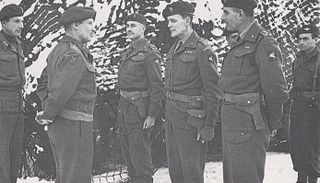
Lieutenant General Sir Napier Crookenden, KCB, DSO, OBE, DL was a British Army General who reached high office in the 1960s.

In the Battle of Campo Maior, or Campo Mayor, on 25 March 1811, Brigadier General Robert Ballard Long with a force of Anglo-Portuguese cavalry, the advance-guard of the army commanded by William Beresford, clashed with a French force commanded by General of Division Marie Victor de Fay, marquis de Latour-Maubourg. Initially successful, some of the Allied horsemen indulged in a reckless pursuit of the French. An erroneous report was given that they had been captured wholesale. In consequence, Beresford halted his forces and the French were able to escape and recover a convoy of artillery pieces.
Major-General William Craig Emilius Napier was a British Army officer who became Governor of the Royal Military College, Sandhurst.

Lieut. Colonel George S. F. Napier was a British Army officer of the 52nd Oxfordshire Light Infantry.

A bronze statue of Charles James Napier by the sculptor George Gammon Adams stands in Trafalgar Square in London, United Kingdom. It occupies one of the four plinths in Trafalgar Square, the one to the southwest of Nelson's Column.