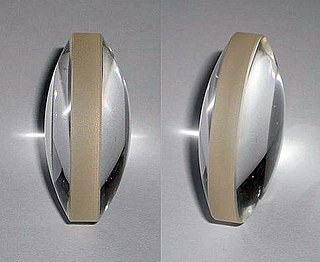
A lens is a transmissive optical device that focuses or disperses a light beam by means of refraction. A simple lens consists of a single piece of transparent material, while a compound lens consists of several simple lenses (elements), usually arranged along a common axis. Lenses are made from materials such as glass or plastic, and are ground and polished or molded to a desired shape. A lens can focus light to form an image, unlike a prism, which refracts light without focusing. Devices that similarly focus or disperse waves and radiation other than visible light are also called lenses, such as microwave lenses, electron lenses, acoustic lenses, or explosive lenses.
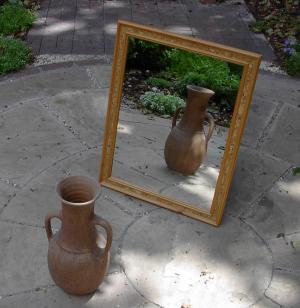
A mirror is an object that reflects light in such a way that, for incident light in some range of wavelengths, the reflected light preserves many or most of the detailed physical characteristics of the original light, called specular reflection. This is different from other light-reflecting objects that do not preserve much of the original wave signal other than color and diffuse reflected light, such as flat-white paint.

In passive solar building design, windows, walls, and floors are made to collect, store, reflect, and distribute solar energy in the form of heat in the winter and reject solar heat in the summer. This is called passive solar design because, unlike active solar heating systems, it does not involve the use of mechanical and electrical devices.

Corrosion is a natural process, which converts a refined metal to a more chemically-stable form, such as its oxide, hydroxide, or sulfide. It is the gradual destruction of materials by chemical and/or electrochemical reaction with their environment. Corrosion engineering is the field dedicated to controlling and stopping corrosion.

Float glass is a sheet of glass made by floating molten glass on a bed of molten metal, typically tin, although lead and various low melting point alloys were used in the past. This method gives the sheet uniform thickness and very flat surfaces.

Vitreous enamel, also called porcelain enamel, is a material made by fusing powdered glass to a substrate by firing, usually between 750 and 850 °C. The powder melts, flows, and then hardens to a smooth, durable vitreous coating. The word comes from the Latin vitreum, meaning "glassy".

A whiteboard is any glossy, usually white surface for nonpermanent markings. Whiteboards are analogous to blackboards, but with a smoother surface allowing rapid marking and erasing of markings on their surface. The popularity of whiteboards increased rapidly in the mid-1990s and they have become a fixture in many offices, meeting rooms, school classrooms, and other work environments.
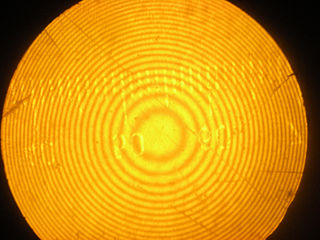
Newton's rings is a phenomenon in which an interference pattern is created by the reflection of light between two surfaces—a spherical surface and an adjacent touching flat surface. It is named for Isaac Newton, who investigated the effect in his 1704 "Opticks". When viewed with monochromatic light, Newton's rings appear as a series of concentric, alternating bright and dark rings centered at the point of contact between the two surfaces. When viewed with white light, it forms a concentric ring pattern of rainbow colors, because the different wavelengths of light interfere at different thicknesses of the air layer between the surfaces.
A hermetic seal is any type of sealing that makes a given object airtight. The term originally applied to airtight glass containers, but as technology advanced it applied to a larger category of materials, including rubber and plastics. Hermetic seals are essential to the correct and safe functionality of many electronic and healthcare products. Used technically, it is stated in conjunction with a specific test method and conditions of use.
Lapping is a machining process in which two surfaces are rubbed together with an abrasive between them, by hand movement or using a machine.
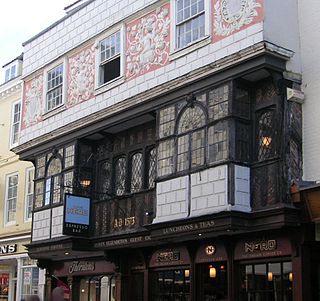
Architectural glass is glass that is used as a building material. It is most typically used as transparent glazing material in the building envelope, including windows in the external walls. Glass is also used for internal partitions and as an architectural feature. When used in buildings, glass is often of a safety type, which include reinforced, toughened and laminated glasses.
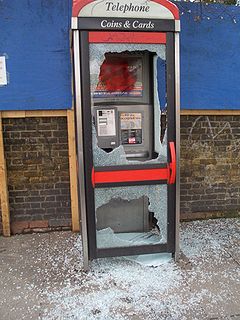
Tempered or toughened glass is a type of safety glass processed by controlled thermal or chemical treatments to increase its strength compared with normal glass. Tempering puts the outer surfaces into compression and the interior into tension. Such stresses cause the glass, when broken, to crumble into small granular chunks instead of splintering into jagged shards as plate glass does. The granular chunks are less likely to cause injury.

Glass etching comprises the techniques of creating art on the surface of glass by applying acidic, caustic, or abrasive substances. Traditionally this is done after the glass is blown or cast, although mold-etching has replaced some forms of surface etching. The removal of minute amounts of glass causes the characteristic rough surface and translucent quality of frosted glass.
A glass cutter is a tool used to make a shallow score in one surface of a piece of glass that is to be broken in two pieces. The scoring makes a split in the surface of the glass which encourages the glass to break along the score. Regular, annealed glass can be broken apart this way but not tempered glass as the latter tends to shatter rather than breaking cleanly into two pieces.
Self-cleaning glass is a specific type of glass with a surface that keeps itself free of dirt and grime.
Chemically strengthened glass is a type of glass that has increased strength as a result of a post-production chemical process. When broken, it still shatters in long pointed splinters similar to float glass. For this reason, it is not considered a safety glass and must be laminated if a safety glass is required. However, chemically strengthened glass is typically six to eight times the strength of float glass.
Dealkalization is a process of surface modification applicable to glasses containing alkali ions, wherein a thin surface layer is created that has a lower concentration of alkali ions than is present in the underlying, bulk glass. This change in surface composition commonly alters the observed properties of the surface, most notably enhancing corrosion resistance.

Plate glass, flat glass or sheet glass is a type of glass, initially produced in plane form, commonly used for windows, glass doors, transparent walls, and windscreens. For modern architectural and automotive applications, the flat glass is sometimes bent after production of the plane sheet. Flat glass stands in contrast to container glass and glass fibre.

Gorilla Glass is a brand of chemically strengthened glass developed and manufactured by Corning, now in its sixth generation, designed to be thin, light and damage-resistant. Gorilla Glass is unique to Corning, but close equivalents exist, including AGC Inc. Dragontrail and Schott AG Xensation.


