
Accordions are a family of box-shaped musical instruments of the bellows-driven free-reed aerophone type, colloquially referred to as a squeezebox. A person who plays the accordion is called an accordionist. The concertina and bandoneón are related; the harmonium and American reed organ are in the same family.
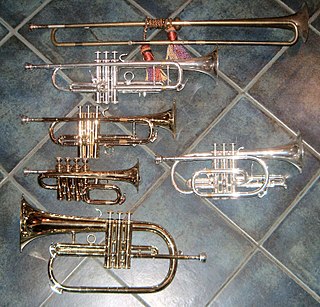
A brass instrument is a musical instrument that produces sound by sympathetic vibration of air in a tubular resonator in sympathy with the vibration of the player's lips. Brass instruments are also called labrosones, literally meaning "lip-vibrated instruments".

The guitar is a fretted musical instrument that usually has six strings. It is typically played with both hands by strumming or plucking the strings with either a guitar pick or the finger(s)/fingernails of one hand, while simultaneously fretting with the fingers of the other hand. The sound of the vibrating strings is projected either acoustically, by means of the hollow chamber of the guitar, or through an electrical amplifier and a speaker.

The piano is an acoustic, stringed musical instrument invented in Italy by Bartolomeo Cristofori around the year 1700, in which the strings are struck by hammers. It is played using a keyboard, which is a row of keys that the performer presses down or strikes with the fingers and thumbs of both hands to cause the hammers to strike the strings.

A percussion instrument is a musical instrument that is sounded by being struck or scraped by a beater ; struck, scraped or rubbed by hand; or struck against another similar instrument. The percussion family is believed to include the oldest musical instruments, following the human voice.

The saxophone is a family of woodwind instruments. Saxophones are usually made of brass and played with a single-reed mouthpiece similar to that of the clarinet. Although most saxophones are made from brass, they are categorized as woodwind instruments, because sound is produced by an oscillating wooden reed rather than lips vibrating in a mouthpiece cup as with the brass instrument family. When the player presses a key, a pad either covers a hole or lifts off a hole, lowering or raising the pitch, respectively.

A trumpet is a brass instrument commonly used in classical and jazz ensembles. The trumpet group contains the instruments with the highest register in the brass family. Trumpet-like instruments have historically been used as signaling devices in battle or hunting, with examples dating back to at least 1500 BC; they began to be used as musical instruments only in the late 14th or early 15th century. Trumpets are used in art music styles, for instance in orchestras, concert bands, and jazz ensembles, as well as in popular music. They are played by blowing air through nearly-closed lips, producing a "buzzing" sound that starts a standing wave vibration in the air column inside the instrument. Since the late 15th century they have primarily been constructed of brass tubing, usually bent twice into a rounded rectangular shape.

The tuba (bass) is the largest and lowest-pitched musical instrument in the brass family. As with all brass instruments, the sound is produced by lip vibration into a large mouthpiece. It first appeared in the mid-19th century, making it one of the newer instruments in the modern orchestra and concert band. The tuba largely replaced the ophicleide. Tuba is Latin for 'trumpet'.

Woodwind instruments are a family of musical instruments within the more general category of wind instruments. There are two main types of woodwind instruments: flutes and reed instruments. What differentiates these instruments from other wind instruments is the way in which they produce their sound. All woodwinds produce sound by splitting an exhaled air stream on a sharp edge, such as a reed or a fipple. A woodwind may be made of any material, not just wood. Common examples include brass, silver, cane, as well as other metals such as gold and platinum. Occasionally woodwinds are made out of earthen materials, especially ocarinas. Common examples include flute, oboe, clarinet, bassoon, and saxophone.

Texas Instruments Inc. (TI) is an American technology company that designs and manufactures semiconductors and various integrated circuits, which it sells to electronics designers and manufacturers globally. Its headquarters are in Dallas, Texas, United States. TI is one of the top ten semiconductor companies worldwide, based on sales volume. Texas Instruments's focus is on developing analog chips and embedded processors, which accounts for more than 80% of their revenue. TI also produces TI digital light processing (DLP) technology and education technology products including calculators, microcontrollers and multi-core processors. To date, TI has more than 43,000 patents worldwide.

A keyboard instrument is a musical instrument played using a keyboard, a row of levers which are pressed by the fingers. The most common of these are the piano, organ, and various electronic keyboards, including synthesizers and digital pianos. Other keyboard instruments include celestas, which are struck idiophones operated by a keyboard, and carillons, which are usually housed in bell towers or belfries of churches or municipal buildings.

String instruments, stringed instruments, or chordophones are musical instruments that produce sound from vibrating strings when the performer plays or sounds the strings in some manner.

Tiglath-Pileser I was a king of Assyria during the Middle Assyrian period. According to Georges Roux, Tiglath-Pileser was "one of the two or three great Assyrian monarchs since the days of Shamshi-Adad I". He was known for his "wide-ranging military campaigns, his enthusiasm for building projects, and his interest in cuneiform tablet collections". Under him, Assyria became the leading power of the Ancient Near East, a position the kingdom largely maintained for the next five hundred years. He expanded Assyrian control into Anatolia and Syria, and to the shores of the Mediterranean Sea. From his surviving inscriptions, he seems to have carefully cultivated a fear of himself in his subjects and in his enemies alike.
Acoustic music is music that solely or primarily uses instruments that produce sound through acoustic means, as opposed to electric or electronic means; typically the phrase refers to that made by acoustic string instruments. While all music was once acoustic, the retronym "acoustic music" appeared after the advent of electric instruments, such as the electric guitar, electric violin, electric organ and synthesizer. Acoustic string instrumentations had long been a subset of popular music, particularly in folk. It stood in contrast to various other types of music in various eras, including big band music in the pre-rock era, and electric music in the rock era.

The Red Sea Riviera, Egypt's eastern coastline along the Red Sea, consists of resort cities on the western shore of the Gulf of Aqaba and along the eastern coast of mainland Egypt, south of the Gulf of Suez. The combination of a favorable climate, warm sea, thousands of kilometers of shoreline and abundant natural and archaeological points of interest makes this stretch of Egypt’s coastline a popular national and international tourist destination. There are numerous National Parks along the Red Sea Riviera, both underwater and on land. Desert and marine life are protected by a number of laws, and visitors may be subject to heavy fines for not abiding.

Classical music is art music produced or rooted in the traditions of Western culture, including both liturgical (religious) and secular music. While a more precise term is also used to refer to the period from 1750 to 1820, this article is about the broad span of time from before the 6th century AD to the present day, which includes the Classical period and various other periods. The central norms of this tradition became codified between 1550 and 1900, which is known as the common-practice period. The major time divisions of Western art music are as follows:
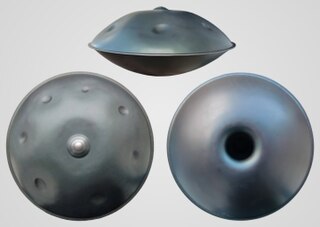
The Hang is a musical instrument in the idiophone class created by Felix Rohner and Sabina Schärer in Bern, Switzerland. The name of their company is PANArt Hangbau AG. The Hang is sometimes referred to as a hang drum, but the inventors consider this a misnomer and strongly discourage its use.

A musical instrument is an instrument created or adapted to make musical sounds. In principle, any object that produces sound can be considered a musical instrument—it is through purpose that the object becomes a musical instrument. The history of musical instruments dates to the beginnings of human culture. Early musical instruments may have been used for ritual, such as a trumpet to signal success on the hunt, or a drum in a religious ceremony. Cultures eventually developed composition and performance of melodies for entertainment. Musical instruments evolved in step with changing applications.


