This page is based on this
Wikipedia article Text is available under the
CC BY-SA 4.0 license; additional terms may apply.
Images, videos and audio are available under their respective licenses.

Stargard (listen) is a city in northwestern Poland, with a population of 71,017 (2005). Situated on the Ina River it is the capital of Stargard County and since 1999 has been in the West Pomeranian Voivodeship; prior to that it was in the Szczecin Voivodeship (1975–1998). Before World War II the town was in Prussia, Germany. The city's name is of Pomeranian (Kashubian) origin and stands for old (stari) town/city. It's one of the biggest towns of Szczecin agglomeration. Stargard is a major railroad junction, where the southwards connection from Szczecin splits into two directions - one towards Poznań and the other towards Gdańsk. There is also another minor line to Pyrzyce from the town.
The Battle of Kay, also referred to as the Battle of Sulechów, Battle of Züllichau, or Battle of Paltzig, was an engagement fought on 23 July 1759 during the Seven Years' War. It occurred near Kay (Kije) in the Neumark, now part of Poland.

Jarlsberg was a former countship that forms a part of today's Vestfold county in Norway.
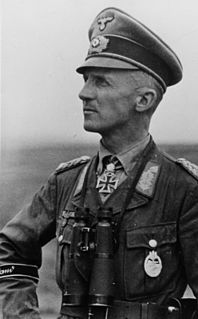
Hasso von Manteuffel was a German general during World War II who commanded the 5th Panzer Army. He was a recipient of the Knight's Cross of the Iron Cross with Oak Leaves, Swords and Diamonds of Nazi Germany.
The 5th Panzer Army was a German armoured formation that operated on the Western Front and North Africa. The remnants of the army surrendered in the Ruhr pocket in 1945.

Signal was a magazine published by the Wehrmacht of Nazi Germany from 1940 through 1945.
There are two notable people who have been known as Baron von Manteuffel:

Drawno is a town in Choszczno County, West Pomeranian Voivodeship, Poland, with 2,425 inhabitants (2004). The headquarters of the Drawa National Park are located here.
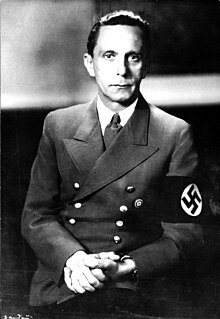
The Reich Ministry of Public Enlightenment and Propaganda was a Nazi government agency to enforce Nazi ideology.
Hasso von Bismarck was a German bobsledder who competed in the early 1930s. He finished seventh and last in the four-man event at the 1932 Winter Olympics in Lake Placid, New York. He was killed in action during World War II.
Royal Saxon Jagdstaffel 24 was a "hunting group" of the Luftstreitkräfte, the air arm of the Imperial German Army during World War I. As one of the original German fighter squadrons, the unit would score 89 verified aerial victories.
Events in the year 1945 in Germany.
Many events took place in 1945. Including the change of the geographical map of Germany

Carl Heinrich von Wedel was a Prussian lieutenant general in the War of Austrian Succession (1740–1748), the Seven Years' War (1756–1763), and the War of Bavarian Succession (1778–1779). He fought most notably in the Battle of Tornow in 1758, and the Battle of Kay in 1759. He was instrumental in Frederick the Great's victory at Leuthen in December 1757.
Royal Prussian Jagdstaffel 75, commonly abbreviated to Jasta 75, was a "hunting group" of the Luftstreitkräfte, the air arm of the Imperial German Army during World War I. The squadron would score four aerial victories during the war, including an observation balloon downed. The unit's victories came at the expense of one wounded in action.
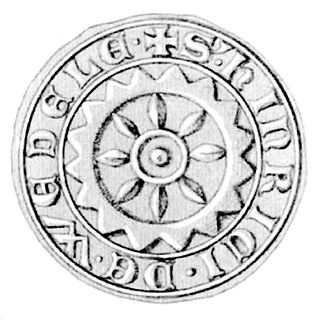
Wedel is an old German noble family, from Stormarn in what is now Schleswig-Holstein.
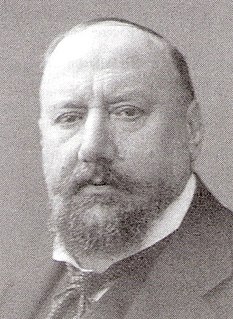
Emil Friedrich Franz Maximilian Graf von Schlitz genannt von Görtz was a German sculptor, Hessian nobleman, cultural policymaker and confidant of Kaiser Wilhelm II.

Wehrmacht Propaganda Troops was a branch of service of the Wehrmacht and the Waffen-SS of Nazi Germany during World War II. Subordinated to the High Command of the Wehrmacht, its function was to produce and disseminate propaganda materials aimed at the German troops and the population.