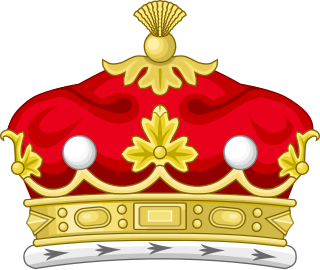
Marquess of Anglesey is a title in the Peerage of the United Kingdom. It was created in 1815 for Henry Paget, 2nd Earl of Uxbridge, a hero of the Battle of Waterloo, second in command to the Duke of Wellington. The Marquess holds the subsidiary titles of Earl of Uxbridge, in the County of Middlesex, in the Peerage of Great Britain (1784), Baron Paget, de Beaudesert, in the Peerage of England (1553), and is also an Irish Baronet, of Plas Newydd in the County of Anglesey and of Mount Bagenall in the County of Louth.
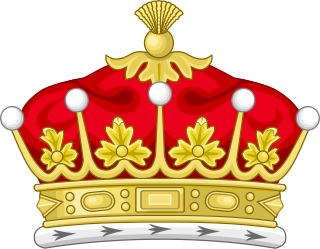
Earl of Lonsdale is a title that has been created twice in British history, firstly in the Peerage of Great Britain in 1784, and then in the Peerage of the United Kingdom in 1807, both times for members of the Lowther family.

Earl of Iddesleigh, in the County of Devon, is a title in the Peerage of the United Kingdom. It was created in 1885 for the Conservative politician Sir Stafford Northcote, 8th Baronet, of Pynes in the parish of Upton Pyne near Exeter in Devon and lord of the manor of Iddesleigh, 28 miles north-west of Pynes. He served as President of the Board of Trade, Secretary of State for India, Chancellor of the Exchequer, First Lord of the Treasury and Foreign Secretary and was Joint Leader of the Conservative Party from 1881 to 1885. Northcote was made Viscount St Cyres, of Newton Saint Cyres in the County of Devon, at the same time he was given the earldom. This title is also in the Peerage of the United Kingdom.
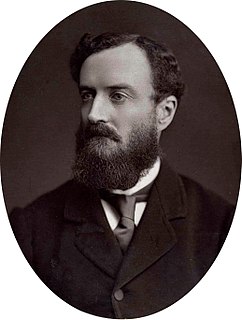
Earl St Aldwyn, of Coln St Aldwyn in the County of Gloucester, is a title in the Peerage of the United Kingdom. It was created in 1915 for the prominent Conservative politician Michael Hicks Beach, 1st Viscount St Aldwyn, known from 1854 to 1907 as Sir Michael Hicks Beach, 9th Baronet, of Beverston. He was Chancellor of the Exchequer from 1885 to 1886 and again from 1895 to 1902. Hicks Beach had already been created Viscount St Aldwyn, of Coln St Aldwyn in the County of Gloucester, in 1906, and was made Viscount Quenington, of Quenington in the County of Gloucester, at the same time he was given the earldom. Both titles are in the Peerage of the United Kingdom. He was succeeded by his grandson, the second Earl, the son of Michael Hicks Beach, Viscount Quenington, Member of Parliament for Tewkesbury, who was killed in action in 1916. Lord St Aldwyn was also a Conservative politician and was Captain of the Honourable Corps of Gentlemen-at-Arms between 1958 and 1964 and 1970 and 1974. As of 2018 the titles are held by his eldest son, the third Earl, who succeeded in 1992.
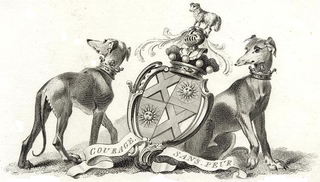
Viscount Gage, of Castle Island in the County of Kerry of the Kingdom of Ireland, is a title in the Peerage of Ireland. It was created in 1720 for Thomas Gage, along with the subsidiary title of Baron Gage, of Castlebar in the County of Mayo, also in the Peerage of Ireland. In 1744 he also succeeded his cousin as eighth Baronet, of Firle Place. The titles remain united. The Gage family descends from John Gage, who was created a baronet, of Firle Place in the County of Sussex, in the Baronetage of England on 26 March 1622. His great-grandson, the seventh Baronet, represented Seaford in Parliament. He was succeeded by his first cousin, Thomas Gage, 1st Viscount Gage, the eighth Baronet. He sat as a Member of Parliament for Minehead and Tewkesbury and also served as Governor of Barbados. In 1720, 24 years before succeeding in the baronetcy, he was raised to the Peerage of Ireland as Baron Gage and Viscount Gage. His second son was the military commander the Hon. Thomas Gage.

Viscount Hardinge, of Lahore and of Kings Newton in the County of Derby, is a title in the Peerage of the United Kingdom. It was created in 1846 for the soldier and Tory politician Sir Henry Hardinge. His son, the second Viscount, represented Downpatrick in Parliament. His great-great-grandson, the sixth Viscount, succeeded a distant relative as eighth Baronet, of Belle Isle in the County of Fermanagh, in 1986. This title had been created in the Baronetage of the United Kingdom 1801 for Richard Hardinge. He was the third son of Nicolas Hardinge, younger brother of Reverend Henry Hardinge and uncle of the latter's third son Henry Hardinge, 1st Viscount Hardinge. The baronetcy was created with special remainder to the heirs male of Richard Hardinge's father.
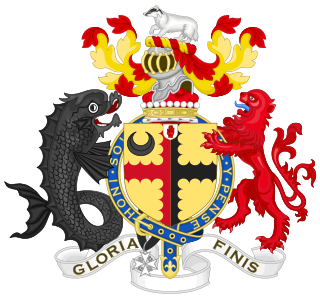
Viscount Brookeborough, of Colebrooke in the County of Fermanagh, is a title in the Peerage of the United Kingdom. It was created in 1952 for the Ulster Unionist politician and Prime Minister of Northern Ireland, Captain The Rt. Hon. Sir Basil Brooke, 5th Bt., P.C. (N.I.), M.P.

Baron Stanley of Alderley, in the County of Chester, is a title in the Peerage of the United Kingdom. It was created in 1839 for the politician and landowner Sir John Stanley, 7th Baronet. Upon his death in 1850, he was succeeded as 2nd Baron Stanley of Alderley and 8th Baronet of Alderley Hall by his son Edward, who was a prominent Liberal politician and notably served as President of the Board of Trade, Postmaster General and had in 1848 been created Baron Eddisbury, of Winnington in the County Palatine of Chester, in his own right. His wife Henrietta was a prominent campaigner for women's education. After his death, the Stanley of Alderley and Eddisbury baronies remained united; most holders have since chosen to be known as Lord Stanley of Alderley. The 3rd Baron Stanley of Alderley had a career in the Diplomatic Service; as he was childless he was succeeded by his younger brother, the 4th Baron. He was Liberal Member of Parliament for Oldham. In 1909, the 4th Baron Stanley of Alderley acquired a further title when he succeeded his first cousin once removed, the Earl of Sheffield, according to a special remainder and thus inherited the title of 4th Baron Sheffield. After his death the titles passed to his son, the 5th Baron Stanley of Alderley. He was Liberal Member of Parliament for Eddisbury and also served as Governor of Victoria. His eldest son, the 6th Baron Stanley of Alderley, sold the family seat of Alderley Hall in 1938. He was married four times, the second time to Sylvia Ashley. On his death the titles passed to his younger brother, who preferred to be known as Lord Sheffield. He only held the titles for three months. As of 2013 the titles are held by the latter's cousin, the 9th Baron Stanley of Alderley, who succeeded his father in that year. He is the grandson of the Hon. Oliver Hugh Stanley, youngest son of the 4th Baron.
Baron Ravensworth, of Ravensworth Castle in the County Palatine of Durham and of Eslington Park in the County of Northumberland, is a title in the Peerage of the United Kingdom.

Baron Hesketh, of Hesketh in the County Palatine of Lancaster, is a title in the Peerage of the United Kingdom. It was created in 1935 for Sir Thomas Fermor-Hesketh, 8th Baronet, who had previously briefly represented Enfield in the House of Commons as a Conservative. As of 2010 the titles are held by his grandson, the third Baron, who succeeded his father in 1955. Lord Hesketh held junior ministerial positions in the Conservative administrations of Margaret Thatcher and John Major. However, he lost his seat in the House of Lords after the House of Lords Act 1999 removed the automatic right of hereditary peers to sit in the upper chamber of Parliament.
Baron Denham, of Weston Underwood in the County of Buckingham, is a title in the Peerage of the United Kingdom. It was created in 1937 for Sir George Bowyer, 1st Baronet, a Conservative politician who had earlier represented Buckingham in the House of Commons. He had already been created a baronet, of Weston Underwood, in 1933. Bowyer was a great-great-great-grandson of Sir William Bowyer, 3rd Baronet, of Denham Court. As of 2017 the titles are held by his second but only surviving son, the second Baron, who succeeded in 1948. In 1950 he also succeeded a distant relative in the Bowyer baronetcy of Denham Court. Like his father Lord Denham is a Conservative politician and one of the ninety elected hereditary peers that remain in the House of Lords after the passing of the House of Lords Act 1999.
Baron Moncreiff, of Tulliebole in the County of Kinross, is a title in the Peerage of the United Kingdom. It was created in 1874 for the lawyer and Liberal politician Sir James Moncreiff, 1st Baronet. He had already been created a Baronet, of Tulliebole in the County of Kinross, in the Baronetage of the United Kingdom in 1871. In 1883 Lord Moncreiff also succeeded his elder brother as 11th Baronet, of Moncreiff in the County of Perth. On his death the titles passed to his eldest son, the second Baron. He was a Judge of the Court of Session from 1888 to 1905 under the title of Lord Wellwood and served as Lord Lieutenant of Kinross-shire between 1901 and 1909. He was succeeded by his younger brother, the third Baron. He was a clergyman. As of 2010 the titles are held by the latter's great-grandson, the sixth Baron, who succeeded his father in 2002.
Baron Congleton, of Congleton in the County Palatine of Chester, is a title in the Peerage of the United Kingdom. It was created in 1841 for the Whig politician and former Secretary at War and Paymaster of the Forces Sir Henry Parnell, 4th Baronet. His eldest son, the second Baron, devoted his life to religious work and was an early member of the Plymouth Brethren. The latter was succeeded by his younger brother, the third Baron. He served in the Royal Navy and fough at the Battle of Navarino in 1827. His eldest surviving son, the fourth Baron, was a major-general in the British Army and served in the Crimean War and in the Anglo-Zulu War. The latter's eldest son, the fifth Baron, was killed in action in Ypres Salient during the First World War and was succeeded by his younger brother, the sixth Baron. As of 2015, the titles are held by the latter's grandson, the ninth Baron, who succeeded his father in 2015.

Baron Roborough, of Maristow in the County of Devon, is a title in the Peerage of the United Kingdom. It was created in 1938 for Sir Henry Lopes, 4th Baronet. He had earlier represented Grantham, Lincolnshire, in Parliament as a Conservative. The Baronetcy, of Maristow in the County of Devon, had been created in the Baronetage of the United Kingdom in 1805 for Manasseh Masseh Lopes, a member of a wealthy family of Portuguese origin, with special remainder to his nephew Ralph Franco, son of his sister Maria. Manasseh Masseh Lopes converted to Christianity in 1802, and later represented Evesham, in Worcestershire, Barnstaple in Devon, and Westbury in Somerset, in Parliament. However, in 1819 he was twice convicted of bribing the voters in both Barnstaple and Grampound in order to be elected to Parliament, and was sentenced to imprisonment and heavy fines. He was also unseated by the House of Commons, but after his release from prison he nonetheless got elected for Westbury, a pocket borough which he controlled to a great extent.
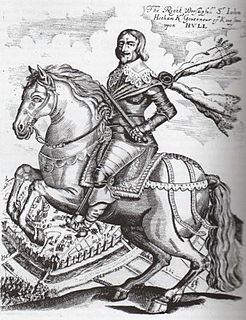
The Sheriff is the oldest secular office under the Crown. Formerly the Sheriff was the principal law enforcement officer in the county but over the centuries most of the responsibilities associated with the post have been transferred elsewhere or are now defunct, so that its functions are now largely ceremonial.
The High Sheriff of Devon is the Queen's representative for the County of Devon, a territory known as his/her bailiwick. Selected from three nominated people, they hold his office over the duration of a year. They have judicial, ceremonial and administrative functions and executes High Court Writs. The office historically was "Sheriff of Devon", changed in 1974 to "High Sheriff of Devon".
This is a list of High Sheriffs of Lincolnshire.
There have been three baronetcies created for persons with the surname O'Neill, two in the Baronetage of Ireland and one in the Baronetage of the United Kingdom.

The Everys are an historic English family from the West Country, traceable to the late 12th century and maternal cousins to the Brice family. They were significant landowners in Devon, particularly in Chardstock and Shepton Beauchamp, and as Lords of the manor of Wootton Abbotts. The family seats were Wycroft Castle, Wootton Abbotts manor house, and Egginton Hall. On 26 May 1641 a branch of the family developed into the Every baronets, and the late 17th-century English pirate Henry Every is believed to have descended from an earlier line.

