Table tennis, also known as ping-pong, is a sport in which two or four players hit a lightweight ball back and forth across a table using small rackets. The game takes place on a hard table divided by a net. Except for the initial serve, the rules are generally as follows: players must allow a ball played toward them to bounce one time on their side of the table, and must return it so that it bounces on the opposite side at least once. A point is scored when a player fails to return the ball within the rules. Play is fast and demands quick reactions. Spinning the ball alters its trajectory and limits an opponent's options, giving the hitter a great advantage.

Para table tennis is a disabled sport which follows the rules set by the International Table Tennis Federation (ITTF). The usual table tennis rules are in effect with slight modifications for wheelchair athletes. Athletes from disability groups can take part. Athletes receive classifications between 1-11. Classes 1-5 are for those in wheelchairs and classes 6-10 for those who have disabilities that allow them to play standing. Within those groups, the higher classification means the more function the athlete has. Class 11 is defined for players with an intellectual disability.
The Table Tennis Federation of Kosovo (TTFK) is the governing body responsible for table tennis in Kosovo.

Natalia Dorota Partyka is a Polish table tennis player. Born without a right hand and forearm, she participates in competitions for able-bodied athletes as well as in competitions for athletes with disabilities. Partyka reached the last 32 of the London 2012 Olympic women's table tennis.
The Table Tennis Association of Wales (TTAW) is the national governing body of table tennis in Wales. It is affiliated to the International Table Tennis Federation (ITTF) and the European Table Tennis Union, and was a founding member of both organisations—in 1926 and 1956 respectively.

The Asian Table Tennis Union (ATTU) is an Asian table tennis governing body formed on May 7, 1972, and recognized by International Table Tennis Federation (ITTF) in 1975. ATTU was founded by 16 member associations, currently, 44 member associations are affiliated to ATTU.

Table Tennis Australia is the National Sporting Organisation for the Sport of Table Tennis in Australia and is affiliated with both the ITTF which oversees the international governance and development of Table Tennis and the OTTF which oversees the sport development at a regional level.
The World Para Table Tennis Championships are the world championships for para table tennis where athletes with a disability compete. They are organised by the International Table Tennis Federation (ITTF) on a four-year rotation with the Paralympic Games.
The Table Tennis Association of the Philippines is the old governing body of table tennis in the Philippines before it changed its name to the Philippine Table Tennis Federation (PTTF). The PTTF is the sporting body that is recognized by the Philippine Olympic Committee, Southeast Asian Table Tennis Association, the Asia Table Tennis Union, and the International Table Tennis Federation.

Table Tennis England, formerly the English Table Tennis Association, is the national governing body for table tennis in England, responsible for representing, coordinating, administering, marketing and developing the sport. Most of its annual income comes from government grants and Sport England funding. Table Tennis England runs three separate national championships every year – for U11, U12, U13 and U14 players; cadets and juniors; and seniors – as well as operating the British League, a Grand Prix series and other irregularly held tournaments, including the English Open.
The Pakistan Table Tennis Federation (PTTF) is the national governing body to develop and promote the sport of Table Tennis in Pakistan. In 1951, Pakistan Table Tennis Federation was formed in Lahore. In the same year, PTTF started its activities for the promotion of Table Tennis in the Country. The first National Table Tennis Championship was held in the Burt Institute, Lahore. The PTTF is the member organization of the International Table Tennis Federation (ITTF).
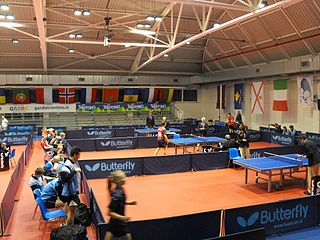
The Jersey Table Tennis Association was established in 1923 and is the governing body responsible for table tennis in Jersey. The organisation has been affiliated to the ITTF since 1935.
Table Tennis Canada, colloquially known as TTCAN, is the non-profit governing body for table tennis in Canada and is responsible for cataloging and sanctioning tournaments within Canada. It was founded in 1929 as the Canadian Table Tennis Association. In addition to processing tournaments, TTCAN maintains a national rating and ranking system. It also oversees the Canadian National Teams. In total, TTCAN has over 9,000 members. The headquarters of Canada Table Tennis is located in Ottawa, Ontario, Canada, which is also home to the Canadian Olympic Training Center.

Barak Mizrachi is an Australian Paralympic table tennis player. After playing competitive table tennis for the first time in 2001, he went on to make his international debut in 2003 at the Maccabiah Games. He has since represented Australia at the Maccabiah Games in 2005, 2007 and 2009, before being selected for the 2016 Summer Paralympics.
Laurens Devos is a Belgian table tennis player who was the Paralympic champion in men's singles class 9. He has also won four European titles and most recently, a world title for his country.

The South African Table Tennis Board (SATTB) is the national governing body responsible for table tennis in South Africa. The organisation has been affiliated to both the ITTF since 1950, and the African Table Tennis Federation. SATTB is based in Pretoria.
The Table Tennis Federation of India (TTFI) is the governing body for table tennis in India. The TTFI was established in 1926, and was a founding member of the International Table Tennis Federation (ITTF). TTFI's membership includes 32 state units and 37 institutions.
European Para Table Tennis Championships are a biennial sport event for para table tennis players who represent a European country. It is one of the first regional para table tennis championships to be held. France have so far earned the most medals in these championships.