
Strategic Air Command (SAC) was both a United States Department of Defense (DoD) Specified Command and a United States Air Force (USAF) Major Command (MAJCOM), responsible for Cold War command and control of two of the three components of the U.S. military's strategic nuclear strike forces, the so-called "nuclear triad," with SAC having control of land-based strategic bomber aircraft and intercontinental ballistic missiles or ICBMs.

The Second Air Force is a USAF numbered air force responsible for conducting basic military and technical training for Air Force enlisted members and non-flying officers. In World War II the CONUS unit defended the Northwestern United States and Upper Great Plains regions and during the Cold War, was Strategic Air Command unit with strategic bombers and missiles. Elements of Second Air Force engaged in combat operations during the Korean War; Vietnam War, as well as Operation Desert Storm.

The Thirteenth Air Force was a numbered air force of the United States Air Force Pacific Air Forces (PACAF). It was last headquartered at Hickam Air Force Base on the island of Oahu, Hawaii. 13 AF has never been stationed in the continental United States. It was one of the oldest continuously active numbered air forces in the United States Air Force.

The Fifteenth Expeditionary Mobility Task Force was one of two ETFs assigned to the United States Air Force Air Mobility Command (AMC) and was headquartered at Travis Air Force Base, California. The 15 ETF was deactivated on 20 March 2012 and its functions and responsibilities assumed by Eighteenth Air Force.

Barksdale Air Force Base is a United States Air Force base in northwest Louisiana, USA, in Bossier Parish. It is contiguous to Bossier City, Louisiana along the base's western and northwestern edge. Barksdale Air Force Base occupies more than 22,000 acres east of Bossier City and along the southern edge of Interstate Highway 20. More than 15,000 active-duty and Air Force Reserve members serve at Barksdale.

General John Charles Meyer was an American World War II flying ace, and later the commander-in-chief of the Strategic Air Command (SAC) and director of the Joint Strategic Target Planning Staff at Offutt Air Force Base, Nebraska. SAC was the United States' major nuclear deterrent force with bombers, tankers and reconnaissance aircraft, and intercontinental ballistic missiles. The Joint Strategic Target Planning Staff coordinated the nation's nuclear war plans and developed the Single Integrated Operations Plan.

Kadena Air Base is a United States Air Force base in the towns of Kadena and Chatan and the city of Okinawa, in Okinawa Prefecture, Japan. It is often referred to as the “Keystone of the Pacific”. Kadena Air Base is home to the USAF's 18th Wing, the 353d Special Operations Group, reconnaissance units, 1st Battalion, 1st Air Defense Artillery, and a variety of associated units. Over 20,000 American servicemembers, family members, and Japanese employees live or work aboard Kadena Air Base. It is the largest and most active US Air Force base in the Far East.

Pacific Air Forces (PACAF) is a Major Command (MAJCOM) of the United States Air Force and is also the air component command of the United States Indo-Pacific Command (USINDOPACOM). PACAF is headquartered at Joint Base Pearl Harbor–Hickam, Hawaii, and is one of two USAF MAJCOMs assigned outside the Continental United States, the other being the United States Air Forces in Europe - Air Forces Africa. Over the past sixty-five plus years, PACAF has been engaged in combat during the Korean and Vietnam Wars and Operations Desert Storm, Southern Watch, Northern Watch, Enduring Freedom and Iraqi Freedom.
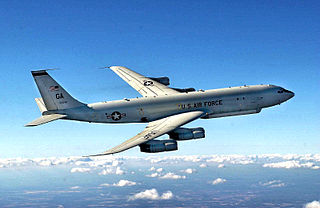
The 116th Air Control Wing is a Wing of the Georgia Air National Guard/United States Air Force, stationed at Robins Air Force Base, Georgia. If activated for federal service, the wing is gained by Air Combat Command.

The Twentieth Air Force is a numbered air force of the United States Air Force Global Strike Command (AFGSC). It is headquartered at Francis E. Warren Air Force Base, Wyoming.

The 19th Airlift Wing is a United States Air Force unit assigned to the Air Mobility Command's Eighteenth Air Force. It is stationed at Little Rock Air Force Base, Arkansas. The wing is also the host unit at Little Rock.
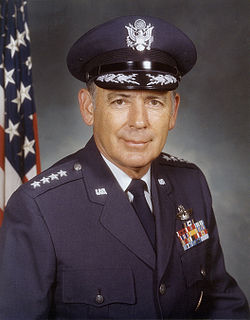
General Russell Elliott Dougherty was commander in chief of the Strategic Air Command and director of strategic target planning, at Offutt Air Force Base, Nebraska.

Richard Hastings Ellis was a United States Air Force general who served as the commander in chief of the Strategic Air Command and director of the Joint Strategic Target Planning Staff with headquarters at Offutt Air Force Base, Nebraska. He was also director of the Joint Strategic Connectivity Staff.

The 111th Attack Wing is a unit of the Pennsylvania Air National Guard, stationed at Horsham Air National Guard Station, Willow Grove, Pennsylvania. If activated to federal service, the Wing is gained by the United States Air Force Air Combat Command. It provides protection of life, property, and the preservation of peace and order when tasked to do so by state or federal authorities. The Wing also provides operational and support units, as well as qualified personnel, to support wartime tasking and contingency commitments of any nature.
The United States Air Force became a separate military service on 18 September 1947 with the implementation of the National Security Act of 1947. The Act created the National Military Establishment, later renamed the United States Department of Defense, which was composed of four of the five branches, the Army, Marine Corps, Navy, and a newly created Air Force. Prior to 1947, the responsibility for military aviation was divided between the Army for land-based operations and the Navy and Marine Corps for sea-based operations from aircraft carrier and amphibious aircraft. The Army created the first antecedent of the Air Force on 1 August 1907, which through a succession of changes of organization, titles, and missions advanced toward eventual separation 40 years later. The predecessor organizations leading up to today's U.S. Air Force are:
Expeditionary warfare is the deployment of a state's military to fight abroad, especially away from established bases. Expeditionary forces were in part the antecedent of the modern concept of rapid deployment forces. Traditionally, expeditionary forces were essentially self-sustaining with an organic logistics capability and with a full array of supporting arms.

The 502d Air Operations Group in an inactive United States Air Force unit. It was last active in October 2006 at Hickam Air Force Base, Hawaii, where it had served as the umbrella for intelligence and operational support units under Pacific Air Forces

The 93d Operations Group is an inactive United States Air Force unit. Its last assignment was with the 93d Air Control Wing, stationed at Robins Air Force Base, Georgia. The unit was inactivated on 1 October 2002.
The 91st Operations Group is the operational component of the 91st Missile Wing, assigned to the Air Force Global Strike Command Twentieth Air Force. It is stationed at Minot Air Force Base, North Dakota.


