
Khanty-Mansi Autonomous Okrug – Yugra or Khanty-Mansiysk Autonomous Okrug – Yugra, is a federal subject of Russia. Population: 1,532,243.

Nizhnevartovsk is a city in Khanty-Mansi Autonomous Okrug, Russia. Since the 1960s, the Western Siberian oil boom led to Nizhnevartovsk's rapid growth from a small settlement to a city due to its location beside the Samotlor oil field along the right bank of the Ob River, 30 kilometers (19 mi) from the border with Tomsk Oblast, and the presence of the petroleum industry has made it one of the wealthiest cities in Russia.

The Mansi are an indigenous people living in Khanty–Mansia, an autonomous okrug within Tyumen Oblast in Russia. In Khanty–Mansia, the Khanty and Mansi languages have co-official status with Russian. The Mansi language is one of the postulated Ugric languages of the Uralic family. The Mansi people were formerly known as the Voguls.

Surgut is a city in Khanty-Mansi Autonomous Okrug, Russia, located on the Ob River near its junction with the Irtysh River. It is one of the few cities in Russia to be larger than the capital or the administrative center of its federal subject in terms of population, economic activity, and tourist traffic. Population: 348,643 (2016); 306,675 (2010 Census); 285,027 (2002 Census); 247,823 (1989 Census).

Sovetsky is a town and the administrative center of Sovetsky District in Khanty-Mansi Autonomous Okrug, Russia, located 470 kilometers (290 mi) west of Khanty-Mansiysk, the administrative center of the autonomous okrug. Population: 26,495 (2010 Census); 23,230 (2002 Census); 21,123 (1989 Census).
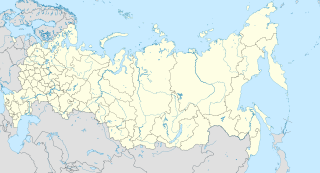
Beloyarsky is a town and the administrative center of Beloyarsky District in Khanty-Mansi Autonomous Okrug, Russia, located on the Kazim River, northwest of Khanty-Mansiysk, the administrative center of the autonomous okrug. Population: 20,283 (2010 Census); 18,721 (2002 Census); 20,534 (1989 Census).

Raduzhny is a town in Khanty-Mansi Autonomous Okrug, Russia, located on the Agan River, 475 kilometers (295 mi) northeast of Khanty-Mansiysk and 975 kilometers (606 mi) northeast of Tyumen. Population: 43,399 (2010 Census); 47,060 ; 43,726.

Pyt-Yakh is a town in Khanty–Mansi Autonomous Okrug, Russia, located on the east bank of the Bolshoy Balyk River, southeast of Khanty-Mansiysk. Population: 41,488 (2010 Census); 41,813 (2002 Census); 17,101 (1989 Census).
The indigenous small-numbered peoples of the North, Siberia and the Far East is a Russian census classification of indigenous peoples, assigned to groups with fewer than 50,000 members, living in the Russian Far North, Siberia or Russian Far East. They are frequently referred as indigenous small-numbered peoples of the North or indigenous peoples of the North.
Ostyak is a name formerly used to refer to several indigenous peoples in Siberia.

Nefteyugansky District is an administrative and municipal district (raion), one of the nine in Khanty-Mansi Autonomous Okrug, Russia. It is located in the south of the autonomous okrug. The area of the district is 24,550 square kilometers (9,480 sq mi). Its administrative center is the city of Nefteyugansk. Population: 44,815 ; 45,354 (2002 Census); 61,161 (1989 Census).

Nizhnevartovsky District is an administrative and municipal district (raion), one of the nine in Khanty-Mansi Autonomous Okrug, Russia. The area of the district is 118,500 square kilometers (45,800 sq mi). Its administrative center is the city of Nizhnevartovsk. Population: 35,745 ; 33,508 (2002 Census); 28,288 (1989 Census).

Surgutsky District is an administrative and municipal district (raion), one of the nine in Khanty-Mansi Autonomous Okrug, Russia. It is located in the center of the autonomous okrug. The area of the district is 105,190 square kilometers (40,610 sq mi). Its administrative center is the city of Surgut. Population: 113,515 ; 106,624 (2002 Census); 74,685 (1989 Census).
Khanty-Mansiysky (masculine), Khanty-Mansiyskaya (feminine), or Khanty-Mansiyskoye (neuter) may refer to:

Uray is a town in Khanty–Mansi Autonomous Okrug, located on the Konda River 350 kilometers (220 mi) from Khanty-Mansiysk. Population: 39,457 (2010 Census); 38,872 (2002 Census); 37,198 (1989 Census).
The Anthem of the Khanty-Mansi autonomous okrug is the anthem of the Khanty-Mansi Autonomous Okrug, a federal subject of Russia. It is one of the national symbols of the Khanty-Mansi Autonomous Okrug along with its flag and coat of arms. It was written by Alexander Padchenko with music by Alexander Padchenko and Viktor Khudoley and was officially adopted in 2004.


