This page is based on this
Wikipedia article Text is available under the
CC BY-SA 4.0 license; additional terms may apply.
Images, videos and audio are available under their respective licenses.

Year 887 (DCCCLXXXVII) was a common year starting on Sunday of the Julian calendar.
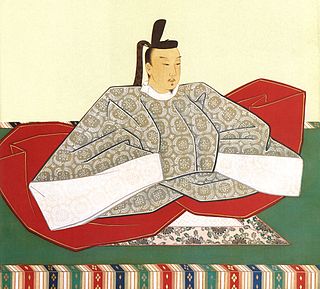
Emperor Go-Komatsu was the 100th emperor of Japan, according to the traditional order of succession, and the sixth and final Emperor of the Northern Court.
Guugu Yimithirr, also rendered Guugu Yimidhirr, Guguyimidjir, and many other spellings, is an Australian Aboriginal language, the traditional language of the Guugu Yimithirr people of Far North Queensland. It belongs to the Pama-Nyungan language family. Most of the speakers today live at the community of Hopevale, about 46 km from Cooktown. Guugu Yimithirr is one of the more famous Australian Aboriginal languages because it is the source language of the word "kangaroo."
Koko or KOKO may refer to:

Ninna (仁和) was a Japanese era name after Gangyō and before Kanpyō. This period spanned the years from February 885 through April 889. The reigning emperors were Kōkō-tennō (光孝天皇) and Uda-tennō (宇多天皇).
Kuku-Thaypan is an extinct Paman language spoken on the southwestern part of the Cape York Peninsula, Queensland in Australia, by the Kuku-Thaypan people. The language was sometimes called Alaya or Awu Alaya. Koko-Rarmul may have been a dialect, though Bowern (2012) lists Gugu-Rarmul and Kuku-Thaypan as separate languages. The last native speaker, Tommy George, died 29 July 2016 in Cooktown Hospital.

Doraemon: Nobita and the Legend of the Sun King , also known as Doraemon And The Empire of the Sun, is a feature-length Doraemon film which premiered on March 4, 2000 in Japan. It's the 21st Doraemon film. Its story is an alteration of the story The Prince and the Pauper by Mark Twain and Snow White by the Brothers Grimm as the two main characters switch places. It was premiered together with the Doraemon short film Doki Doki Wildcat Engine and Doraemon: A Grandmother's Recollections. It was a successful film at the box office, grossing around ¥3.42 billion, becoming the highest grossing Doraemon film of the original series.

Koko Guyot is a 48.1-million-year-old guyot, a type of underwater volcano with a flat top, which lies near the southern end of the Emperor seamounts, about 200 km (124 mi) north of the "bend" in the volcanic Hawaiian-Emperor seamount chain. Pillow lava has been sampled on the north west flank of Koko Seamount, and the oldest dated lava is 40 million years old. Seismic studies indicate that it is built on a 9 km (6 mi) thick portion of the Pacific Plate. The oldest rock from the north side of Koko Seamount is dated at 52.6 and the south side of Koko at 50.4 million years ago. To the southeast of the bend is Kimmei Seamount at 47.9 million years ago and southeast of it, Daikakuji at 46.7.
Kazune Kawahara is a Japanese manga artist who is best known for creating the romantic comedy shōjo manga High School Debut .
Kawahara has also published and authored several other manga series, most notably Ai no Tame ni and Aozora Yell, and mostly specialises in the genre of romance.
Yuya Takaki is a Japanese idol, songwriter, actor, dancer and member of Hey! Say! JUMP. He is currently under the management of Johnny & Associates. He was born in Ibaraki, Osaka and resides in the Tokyo Metropolitan Area.
Mina Oba is a Japanese singer and actress of the Japanese idol girl group SKE48 of which she is captain of Team KII. She is a former member of Team B in AKB48.
The Pakadji people, also known by the southern tribal exonym as the Koko Yao, were an Indigenous Australian group of Cape York Peninsula in northern Queensland. The ethnonym Koko Ya'o is said literally to mean 'talk, speech' (koko/kuku) 'this way' (ya'o), though this has been questioned.
The Kokokulunggur are an indigenous Australian people of North Queensland.
The Wulpura were an indigenous Australian people of the state of Queensland.
Their language, Kuku Waldja, has been listed as a dialect of Kuku Yalanji, but there does not appear to be any data available.
The Laia were an indigenous Australian people of the state of Queensland.


