The lira was the currency of Italy between 1861 and 2002 and of the Albanian Kingdom between 1941 and 1943. Between 1999 and 2002, the Italian lira was officially a national subunit of the euro. However, cash payments could be made in lira only, as euro coins or notes were not yet available. The lira was also the currency of the Napoleonic Kingdom of Italy between 1807 and 1814.
Lira is the unit of currency of various countries.
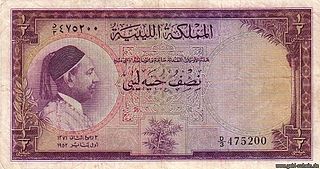
The Libyan pound was the currency of Libya between 1951 and 1971. The pound was divided into 100 piastres and 1000 milliemes (مليم).

The scudo was the name for a number of coins used in various states in the Italian peninsula until the 19th century. The name, like that of the French écu and the Spanish and Portuguese escudo, was derived from the Latin scutum ("shield"). From the 16th century, the name was used in Italy for large silver coins. Sizes varied depending on the issuing country.

The lira was the currency of the Vatican City between 1929 and 2002.

The lira was the currency of San Marino from the 1860s until it was replaced by the Italian Lira in September 17, 2002. It was equivalent and pegged to the Italian lira. Italian coins and banknotes and Vatican City coins were legal tender in San Marino, while Sammarinese coins, minted in Rome, were legal tender throughout Italy, as well as in the Vatican City.

The lira was the currency of the Kingdom of Sardinia between August 6, 1816 and March 17, 1861. It was subdivided into 100 centesimi and was equal in value to the French franc, which had replaced the Piedmontese shield by 1801. Being no more than the Savoyard version of the franc, it could circulate also in France, as the French coins could circulate in Piedmont. It was replaced at par by the Italian lira. As the great part of the 19th century currencies, it was not affected by significant episodes of inflation during all its existence.
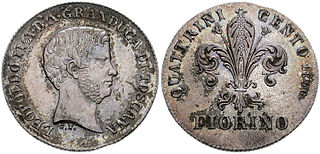
The Tuscan florin was the currency of Tuscany between 1826 and 1859. It was subdivided into 100 quattrini, a local currency made by four pennies. There was an additional denomination called the paolo, worth 40 quattrini, in circulation.
The Papal lira was the currency of the Papal States between 1866 and 1870.
The lira AOI was a special banknote circulating in Italian East Africa between 1938 and 1941.
The lira was the distinct currency of Venice until 1807. It was subdivided into 20 soldi, each of 12 denari. The ducato was equal to 124 soldi, whilst the tallero was equal to 7 lire. The lira of Napoleon's Kingdom of Italy replaced the Venetian lira in 1807.
The scudo was the currency of the Duchy of Milan until 1796. It was subdivided into 6 lire, each of 20 soldi or 240 denari. It was equal to the Conventionsthaler. It was replaced by the lira of the Cispadane Republic, with Cispadanian lira equal to the Milanese. This in turn was replaced in 1797 by the lira of the Cisalpine Republic, followed by the French franc in 1802. In 1816, the Lombardy-Venetia scudo was introduced, also equal to the Conventionsthaler.

The Italian Somaliland lira also called the Somali lira, was a special version of the Italian lira minted in Italian Somaliland between 1925 and 1926.
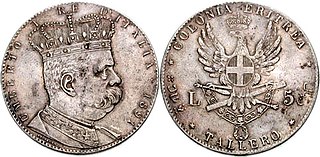
The tallero was the currency of Eritrea between 1890 and 1921. It was subdivided into 5 lire, each of 100 centesimi. The lira was equivalent to the Italian lira.
The lira was the currency of the mainland part of the Kingdom of the Sicily, known as the Kingdom of Naples, between 1812 and 1813. The currency was issued by Joachim Murat, who claimed the title of "King of the Two Sicilies" but only controlled the mainland part of the kingdom. Consequently, the currency is referred to as the "Neapolitan lira". It was subdivided into 100 centesimi and was equal to the Italian lira and French franc. It replaced the piastra, which circulated again following the restoration of Bourbon rule.
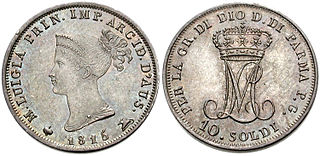
The lira was the distinct currency of Parma before 1802 and again from 1815 to 1859.
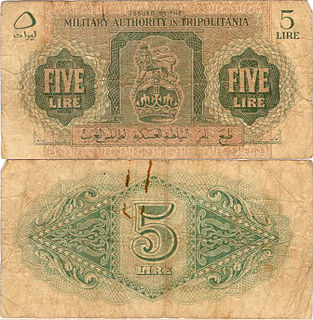
The Tripolitanian lira, also known as the Military Authority Lira, was the currency of the British zone of occupation in Libya between 1943 and 1951, and of the province of Tripolitania until early 1952. It was issued by the "Military Authority in Tripolitania", known popularly as "MAL" and circulated together with the Italian lira at par. This situation reflected that of Italy, where the AM-lira was minted by the United States. The Tripolitanian and the Italian lira were replaced in early 1952 by the Libyan pound at a rate of 1 pound = 480 lire.
The AM-lira was the currency issued in Italy by AMGOT after the invasion of Sicily in 1943. 100 AM-lire were worth 1 US dollar.
Italy has a long history of different coinage types, which spans thousands of years. Italy has been influential at a coinage point of view: the florin, one of the most used coinage types in European history, was struck in Florence in the 13th century. Since Italy has been for centuries divided into many city-states, they all had different coinage systems, but when the country became unified in 1861, the Italian lira came into place, and was used until 2002. Today, Italy uses the Euro.