Mary Tudor

Last updated

Mary Tudor may refer to:

Mary Tudor, Queen of France Queen of France

Mary Tudor was an English princess who was briefly Queen of France, the progenitor of a family that eventually claimed the English throne. She was the younger surviving daughter of King Henry VII of England and Elizabeth of York, and the third wife of Louis XII of France who was more than 30 years older than she. Following his death, she married Charles Brandon, 1st Duke of Suffolk. The marriage was performed secretly in France during the reign of her brother Henry VIII and without his consent. This necessitated the intervention of Thomas Wolsey; Henry eventually pardoned the couple, but they were forced to pay a large fine.

Mary I of England Queen of England and Ireland

Mary I, also known as Mary Tudor, was the Queen of England and Ireland from July 1553 until her death. She is best known for her aggressive attempt to reverse the English Reformation, which had begun during the reign of her father, Henry VIII. The executions that marked her pursuit of the restoration of Roman Catholicism in England and Ireland led to her denunciation as "Bloody Mary" by her Protestant opponents.

Lady Mary Tudor was an actress and natural daughter of King Charles II of England by his mistress, Mary "Moll" Davies, an actress and singer.

Related Research Articles

Catherine of Aragon first wife of Henry VIII of England

Catherine of Aragon was Queen of England from June 1509 until May 1533 as the first wife of King Henry VIII; she was previously Princess of Wales as the wife of Henry's elder brother Arthur.

House of Tudor English royal house of Welsh origin

The House of Tudor was an English royal house of Welsh origin, descended in the female line from the Tudors of Penmynydd. Tudor monarchs ruled the Kingdom of England and its realms, including their ancestral Wales and the Lordship of Ireland from 1485 until 1603, with five monarchs in that period: Henry VII, Henry VIII, Edward VI, Mary I and Elizabeth I. The Tudors succeeded the House of Plantagenet as rulers of the Kingdom of England, and were succeeded by the House of Stuart. The first Tudor monarch, Henry VII of England, descended through his mother from a legitimised branch of the English royal House of Lancaster. The Tudor family rose to power in the wake of the Wars of the Roses (1455-1487), which left the House of Lancaster, to which the Tudors were aligned, extinct in the male line.

Jane Seymour Third wife of Henry VIII of England

Jane Seymour was Queen of England from 1536 to 1537 as the third wife of King Henry VIII. She succeeded Anne Boleyn as queen consort following the latter's execution in May 1536. She died of postnatal complications less than two weeks after the birth of her only child, a son who became King Edward VI. She was the only one of Henry's wives to receive a queen's funeral, and his only consort to be buried beside him in St George's Chapel, Windsor Castle.

Catherine of Valois 15th-century French princess and queen of England

Catherine of Valois was the queen consort of England from 1420 until 1422. A daughter of Charles VI of France, she married Henry V of England, and gave birth to his heir Henry VI of England. Her liaison with Owen Tudor proved the springboard of that family's fortunes, eventually leading to their grandson's elevation as Henry VII of England. Catherine's older sister Isabella was queen of England from 1396 until 1399, as the child bride of Richard II.

Elizabeth of York Queen of England

Elizabeth of York was the wife of Henry VII, and thus the first Tudor queen. She was the daughter of Edward IV and his wife, Elizabeth Woodville, and niece of Richard III. She married Henry VII in 1486, after being detained by him the previous year following the latter's victory at the Battle of Bosworth Field, which started the last phase of the Wars of the Roses. Together, Elizabeth and Henry had a total of four sons, three of whom died before their father, leaving their brother, Henry VIII, to succeed his father as king.

Queen Mary, Queen Marie, or Queen Maria may refer to:

Margaret Douglas Daughter of Archibald Douglas, 6th Earl of Angus, and Margaret Tudor, Queen Dowager of Scotland

Margaret Douglas, Countess of Lennox, was the daughter of the Scottish queen dowager Margaret Tudor and her second husband Archibald Douglas, 6th Earl of Angus. In her youth she was high in the favour of her uncle, Henry VIII of England, but twice incurred the King's anger, first for her unauthorised engagement to Lord Thomas Howard, who died in the Tower of London in 1537 because of his misalliance with her, and again in 1540 for an affair with Thomas Howard's nephew Sir Charles Howard, the brother of Henry's wife Catherine Howard. On 6 July 1544, she married Matthew Stewart, 4th Earl of Lennox, one of Scotland's leading noblemen. Her son Henry Stuart, Lord Darnley, married Mary, Queen of Scots, and was the father of James VI and I.

House of Stuart European royal house

The House of Stuart, originally Stewart, was a European royal house of Scotland with Breton origin. They had held the office of High Steward of Scotland since Walter FitzAlan in around 1150. The royal Stewart line was founded by Robert II whose descendants were kings and queens of Scotland from 1371 until the union with England in 1707. Mary, Queen of Scots was brought up in France where she adopted the French spelling of the name Stuart.

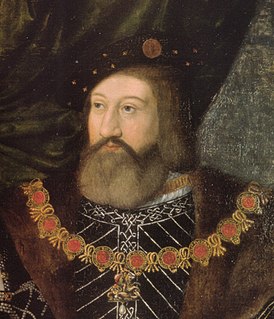
Charles Brandon, 1st Duke of Suffolk English diplomat

Charles Brandon, 1st Duke of Suffolk, 1st Viscount Lisle, was the son of Sir William Brandon and Elizabeth Bruyn. Through his third wife, Mary Tudor, he was brother-in-law to Henry VIII, King of England. His father was the standard-bearer of Henry Tudor, Earl of Richmond who seized the throne as Henry VII. Suffolk died of unknown causes at Guildford.

Mary Stuart or Mary Stewart may refer to:

A queen dowager, dowager queen or queen mother is a title or status generally held by the widow of a king. In the case of the widow of an emperor, the title of empress dowager is used. Its full meaning is clear from the two words from which it is composed: queen indicates someone who served as queen consort, while dowager indicates a woman who holds the title from her deceased husband.

Matthew Stewart, 4th Earl of Lennox Scots earl closely allied with the royal family

Matthew Stewart, 4th Earl of Lennox, was the fourth Earl of Lennox, and a leader of the Catholic nobility in Scotland. He was the son of John Stewart, 3rd Earl of Lennox and Lady Elizabeth Stewart, daughter of John Stewart, 1st Earl of Atholl. His grandson was King James VI of Scotland and I of England.

<i>The Other Boleyn Girl</i> book by Philippa Gregory

The Other Boleyn Girl (2001) is a historical novel written by British author Philippa Gregory, loosely based on the life of 16th-century aristocrat Mary Boleyn of whom little is known. Inspired by Mary's life story, Gregory depicts the annulment of one of the most significant royal marriages in English history and conveys the urgency of the need for a male heir to the throne. Much of the history is highly distorted in her account.

Mary of France may refer to:

Eleanor Brandon, Countess of Cumberland English countess

Lady Eleanor Brandon was the third child and second daughter of Charles Brandon, 1st Duke of Suffolk and Princess Mary Tudor, the Dowager Queen consort of France. She was a younger sister of Lady Frances Brandon and an elder sister of Henry Brandon, 1st Earl of Lincoln. She was also a younger paternal half-sister of Lady Anne Brandon and Lady Mary Brandon from her father's second marriage. After her mother's death in 1533, her father remarried to Catherine Willoughby and Eleanor became an elder half-sister of Henry Brandon, 2nd Duke of Suffolk and Charles Brandon, 3rd Duke of Suffolk.

Stewart of Darnley was a notable Scots family, a branch of the Clan Stewart, who provided the English Stuart monarchs with their male-line Stuart descent, after the reunion of their branch with the royal Scottish branch, which led to the ultimate union of the two main kingdoms of Great Britain: England and Scotland.

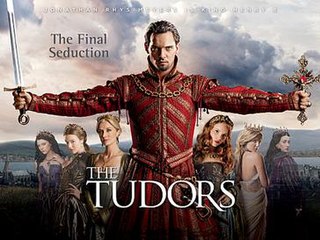
<i>The Tudors</i> historical fiction television series

The Tudors is a historical fiction television series set primarily in 16th-century England created and written by Michael Hirst, produced for the American premium cable television channel Showtime. The series was a collaboration among American, British, and Canadian producers, and was filmed mostly in Ireland. It is named after the Tudor dynasty as a whole, although it is based specifically upon the reign of King Henry VIII.

Mary I of England has been depicted in popular culture a number of times.

Mary of England may refer to: