In chemistry, concentration is the abundance of a constituent divided by the total volume of a mixture. Several types of mathematical description can be distinguished: mass concentration, molar concentration, number concentration, and volume concentration. A concentration can be any kind of chemical mixture, but most frequently solutes and solvents in solutions. The molar (amount) concentration has variants such as normal concentration and osmotic concentration.
In chemistry, the mole fraction or molar fraction (xi) is defined as the amount of a constituent, ni, divided by the total amount of all constituents in a mixture, ntot:

A single-stage-to-orbit vehicle reaches orbit from the surface of a body without jettisoning hardware, expending only propellants and fluids. The term usually, but not exclusively, refers to reusable vehicles. No Earth-launched SSTO launch vehicles have ever been constructed. To date, orbital launches have been performed either by multi-stage fully or partially expendable rockets, the Space Shuttle having both attributes.
Payload is the carrying capacity of an aircraft or launch vehicle, usually measured in terms of weight. Depending on the nature of the flight or mission, the payload of a vehicle may include cargo, passengers, flight crew, munitions, scientific instruments or experiments, or other equipment. Extra fuel, when optionally carried, is also considered part of the payload. In a commercial context, payload may refer only to revenue-generating cargo or paying passengers.

In mathematics, a ratio is a relationship between two numbers indicating how many times the first number contains the second. For example, if a bowl of fruit contains eight oranges and six lemons, then the ratio of oranges to lemons is eight to six. Similarly, the ratio of lemons to oranges is 6:8 and the ratio of oranges to the total amount of fruit is 8:14.
Thrust-specific fuel consumption (TSFC) is the fuel efficiency of an engine design with respect to thrust output.
TSFC may also be thought of as fuel consumption (grams/second) per unit of thrust. It is thus thrust-specific, meaning that the fuel consumption is divided by the thrust.

A scramjet is a variant of a ramjet airbreathing jet engine in which combustion takes place in supersonic airflow. As in ramjets, a scramjet relies on high vehicle speed to compress the incoming air forcefully before combustion, but whereas a ramjet decelerates the air to subsonic velocities before combustion, the airflow in a scramjet is supersonic throughout the entire engine. That allows the scramjet to operate efficiently at extremely high speeds.

In aerospace engineering, payload fraction is a common term used to characterize the efficiency of a particular design. Payload fraction is calculated by dividing the weight of the payload by the takeoff weight of aircraft.
Fuel represents a considerable amount of the overall takeoff weight, and for shorter trips it is quite common to load less fuel in order to carry a lighter load. For this reason the useful load fraction calculates a similar number, but based on the combined weight of the payload and fuel together.
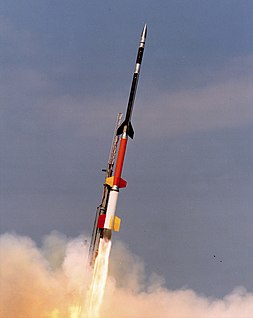
A multistage rocket, or step rocket, is a launch vehicle that uses two or more rocket stages, each of which contains its own engines and propellant. A tandem or serial stage is mounted on top of another stage; a parallel stage is attached alongside another stage. The result is effectively two or more rockets stacked on top of or attached next to each other. Two-stage rockets are quite common, but rockets with as many as five separate stages have been successfully launched.

The Tsiolkovsky rocket equation, classical rocket equation, or ideal rocket equation is a mathematical equation that describes the motion of vehicles that follow the basic principle of a rocket: a device that can apply acceleration to itself using thrust by expelling part of its mass with high velocity and thereby move due to the conservation of momentum.
Air–fuel ratio (AFR) is the mass ratio of air to a solid, liquid, or gaseous fuel present in a combustion process. The combustion may take place in a controlled manner such as in an internal combustion engine or industrial furnace, or may result in an explosion.
In aerospace engineering, mass ratio is a measure of the efficiency of a rocket. It describes how much more massive the vehicle is with propellant than without; that is, the ratio of the rocket's wet mass to its dry mass. A more efficient rocket design requires less propellant to achieve a given goal, and would therefore have a lower mass ratio; however, for any given efficiency a higher mass ratio typically permits the vehicle to achieve higher delta-v.

In aerospace engineering, an aircraft's fuel fraction, fuel weight fraction, or a spacecraft's propellant fraction, is the weight of the fuel or propellant divided by the gross take-off weight of the craft :
In astrophysics, the nuclear timescale is an estimate of the lifetime of a star based solely on its rate of fuel consumption. Along with the thermal and free-fall time scales, it is used to estimate the length of time a particular star will remain in a certain phase of its life and its lifespan if hypothetical conditions are met. In reality, the lifespan of a star is greater than what is estimated by the nuclear time scale because as one fuel becomes scarce, another will generally take its place—hydrogen burning gives way to helium burning, etc. However, all the phases after hydrogen burning combined typically add up to less than 10% of the duration of hydrogen burning.

Air launch to orbit is the method of launching rockets at altitude from a conventional horizontal-takeoff
aircraft, to carry satellites to low Earth orbit. It is a follow-on development of air launches of experimental aircraft that began in the late 1940s. This method, when employed for orbital payload insertion, presents significant advantages over conventional vertical rocket launches, particularly because of the reduced mass, thrust and cost of the rocket.
Rocket propellant is a material used either directly by a rocket as the reaction mass, or indirectly to produce the reaction mass in a chemical reaction. The reaction mass is that which is ejected, typically with very high speed, from a rocket engine to produce thrust.
Space Engine Systems Inc. (SES) is a Canadian aerospace company led by Pradeep Dass and is located in Edmonton, Alberta, Canada. The main focus of the company is the development of a light multi-fuel propulsion system to power a reusable single-stage-to-orbit (SSTO) and hypersonic cruise vehicle. Pumps, compressors, gear boxes, and other related technologies being developed are integrated into SES's major R&D projects. SES is collaborating with the University of Calgary to study and develop technologies in key technical areas of nanotechnology and high-speed aerodynamics.
