This page is based on this
Wikipedia article Text is available under the
CC BY-SA 4.0 license; additional terms may apply.
Images, videos and audio are available under their respective licenses.
MacLeod and McLeod are surnames in the English language.
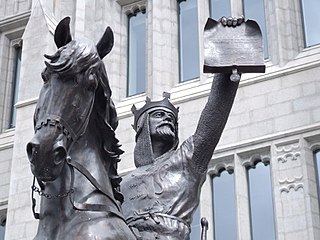
The English language name Bruce arrived in Scotland with the Normans, from the place name Brix, Manche in Normandy, France, meaning "the willowlands". Initially promulgated via the descendants of king Robert the Bruce (1274−1329), it has been a Scottish surname since medieval times; it is now a common given name.

McMahon or MacMahon is an Irish surname. The surname arose separately in two areas: in west County Clare and in County Monaghan. The County Monaghan (Airgíalla) MacMahons are not related to the County Clare (Thomond) MacMahons.
M(a)cLaughlin is the most common English form of Mac Lochlainn, a masculine surname of Irish origin. The feminine form of the surname is Nic Lochlainn. The literal meaning of the name is "son of Lochlann". Note that Mc is simply a contraction of Mac, which is also truncated to M' . Thus, MacLaughlin, McLaughlin and M'Laughlin are the same Anglicism, the latter two merely contractions of the first.
Neil is a masculine given name of Gaelic origin. The name is an Anglicisation of the Irish Niall which is of disputed derivation. The Irish name may be derived from words meaning "cloud", "passionate", or "champion". As a surname, Neil is traced back to Niall of the Nine Hostages who was an Irish king and eponymous ancestor of the Uí Néill and MacNeil kindred. Most authorities cite the meaning of Neil in the context of a surname as meaning champion.
MacDonald, Macdonald, and McDonald are Scottish and Irish surnames.
Brian is a male given name of Irish and Breton origin, as well as a surname of Occitan origin. It is common in the English-speaking world. It is possible that the name is derived from an Old Celtic word meaning "high" or "noble". For example, the element bre means "hill"; which could be transferred to mean "eminence" or "exalted one". The name is quite popular in Ireland, on account of Brian Boru, a 10th-century High King of Ireland. The name was also quite popular in East Anglia during the Middle Ages. This is because the name was introduced to England by Bretons following the Norman Conquest. Bretons also settled in Ireland along with the Normans in the 12th century, and 'their' name was mingled with the 'Irish' version. Also, in the north-west of England, the 'Irish' name was introduced by Scandinavian settlers from Ireland. Within the Gaelic speaking areas of Scotland, the name was at first only used by professional families of Irish origin. It was the fourth most popular male name in England and Wales in 1934, but a sharp decline followed over the remainder of the 20th century and by 1994 it had fallen out of the top 100. It retained its popularity in the United States for longer; its most popular period there was from 1968–1979 when it consistently ranked between eighth and tenth. The name has become increasingly popular in South America - particularly Argentina and Uruguay since the early 1990s.
McCann is an Irish surname derived from the Gaelic Mac Cana, meaning "son of Cana". The Cana particle is a personal name meaning 'wolf cub'.
The surname McArdle or MacArdle was the twelfth most numerous in its homeland of County Monaghan in 1970. The surname in Irish is MacArdghail, from ardghal, meaning 'high valour' or from the Irish "ardghail" meaning "tall foreigner" with roots "ard" meaning "tall" and "gail" meaning "foreigner" indicative of their original ancestor being a Viking or from Viking stock. The surname is also common in County Armagh and County Louth.
McManus is an Irish surname. It is derived from the Gaelic ‘Mac Mághnais’ which means ‘Son of Magnus.’ The given name Magnus comes from the Latin word meaning “great” and it became popular in Ireland during the time of the Vikings. Notable people with the surname include:
McCaffrey, sometimes spelled Caffrey, is an Irish surname. It is found mostly in the Counties Fermanagh, Monaghan, Cavan and Tyrone in the north west of Ireland. Ballymccaffrey is a townland outside Tempo in county Fermanagh. The surname is an Anglicised form of the Gaelic names Mac Gafraidh, Mac Gofraidh, which mean "son of Gafraidh", "son of Gofraidh". The Gaelic names are forms of the Old Norse Lothbrök . Notable people with the surname include:
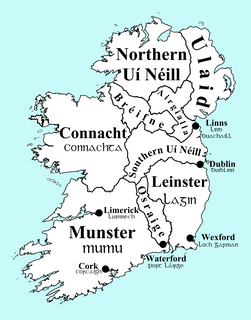
McGowan is a surname. It is an Anglicization of the Irish and Scottish surname Mac Gabhann. Belonging to the Uí Echach Cobo, located in modern-day County Down, Northern Ireland, they produced several over-kings of Ulaid. By the late 12th century, the English had expelled the McGowans to Tír Chonaill in modern-day County Donegal, Republic of Ireland.
McAuliffe or MacAuliffe is a surname of Norse Irish origin. The name is an Anglicisation of the Gaelic Mac Amhlaoibh, meaning "son of Amhlaoibh". The Gaelic name, Amhlaoibh, was derived from the Old Norse personal name Olaf. The surname occurs frequently in Munster, especially northern County Cork, western County Limerick, and eastern County Kerry. The McAuliffes were a sept, related to the McCarthys.
McElwain or McElwaine is a surname of Celtic origin. It can be derived from either Scottish or Irish. The Scottish translation being the anglicized form of Gaelic Mac Gille Bheathain, meaning ‘son of the servant of (Saint) Beathan’ and also a personal name representing a diminutive of beatha ‘life’. The Irish form being the anglicised form of Gaelic Mac Giolla Bháin, meaning ‘son of the white-haired lad’. In Ulster this surname can be derived to be the Scottish form as opposed to the Irish form which would be more common in the Republic of Ireland. Another anglicised version of the Irish "Mac Giolla Bháin" is the surname Kilbane.

The McPhillips surname may be of Scottish or Irish origin, the surname is found predominantly in Ireland, in Cavan, Fermanagh and Monaghan counties.
McMenamin is an Irish surname. In ancient Gaelic it was shorter, Meanma, a word meaning courageous or high spirited. It originated in Co. Donegal in the 13th Century and the Meanma’s were a warrior branch of the O'Donnells of Tyrconnell (Donegal), who were the "chieftains of Fanad" a large territory in Donegal. Notable people with the surname include:

