
The Moro Islamic Liberation Front is a group based in Mindanao, Philippines seeking an autonomous region of the Moro people from the central government. The group has a presence in the Bangsamoro region of Mindanao, the Sulu Archipelago, Palawan, Basilan, and other neighbouring islands.
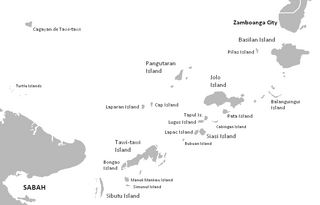
The Sulu Archipelago is a chain of islands in the Pacific Ocean, in the southwestern Philippines. The archipelago forms the northern limit of the Celebes Sea and southern limit of the Sulu Sea. The Sulu Archipelago islands are within the Mindanao island group, consisting of the provinces of Basilan, Sulu, and Tawi-Tawi.
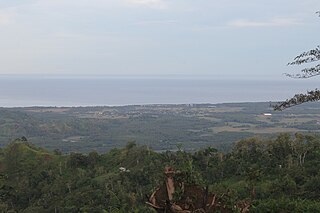
The Moro Gulf is the largest gulf in the Philippines. It located off the coast of Mindanao Island, and is part of the Celebes Sea. The gulf is one of the country's tuna fishing grounds.

The Autonomous Region in Muslim Mindanao was an autonomous region of the Philippines, located in the Mindanao island group of the Philippines, that consisted of five predominantly Muslim provinces: Basilan, Lanao del Sur, Maguindanao, Sulu, and Tawi-Tawi. It was the only region that had its own government. The region's de facto seat of government was Cotabato City, although this self-governing city was outside its jurisdiction.

The Moro Rebellion (1899–1913) was an armed conflict between the Moro people and the United States military during the Philippine-American War.
Islam is the oldest recorded monotheistic religion in the Philippines. Islam reached the Philippines in the 13th century with the arrival of Muslim traders from the Persian Gulf, Southern India, and their followers from several sultanate governments in the Malay Archipelago. The Muslim population of the Philippines has been reported as about 6% of the total population as of a census in 2000. According to a 2015 report of Philippine Statistics Authority, 6% of Filipinos are Muslims. While the majority of the population are Roman Catholic, some ethnic groups are Protestant, Hindu, Buddhist, Animist, Sikh, or non-religious.

Jolo is a volcanic island in the southwest Philippines and is the primary island of the province of Sulu wherein its capital of the same name is situated. It is located in the Sulu Archipelago, between Borneo and Mindanao, and has a population of approximately 500,000 people.

The collective term Bangsamoro people or Moro people refers to the 13 Islamized ethnolinguistic groups of Mindanao, Sulu and Palawan. As Muslim-majority ethnic groups, they form largest non-Christian majority population in the country, and comprise about 5% of the total Philippine population, or 5 million people. Most Moros are followers of Sunni Islam of the Shafi'i madh'hab.
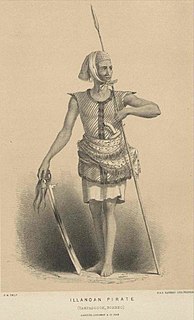
The Iranun are a Moro ethnic group native to Mindanao, Philippines, and the west coast of Sabah.
Abdurajak Abubakar Janjalani was the Moro chief founder and leader of the Abu Sayyaf organization until his death in 1998 by Filipino police. Upon his death his brother, Khadaffy Janjalani, took control of the organization.

The Moro conflict was an insurgency in the Mindanao region of the Philippines, which lasted between 1969 and 2019.
The Ilaga is a Christian extremist paramilitary group based in southern Philippines. The group is predominantly composed of Visayans, embracing a form of Folk Catholicism that utilizes amulets and violence. The group complemented the Philippine Constabulary as a militia force during the 1970s in southern Mindanao while fighting against Moro guerrillas during the Moro insurgency in the Philippines.
Piracy in the Sulu Sea occurred in the vicinity of Mindanao, where frequent acts of piracy were committed against the Spanish. Because of the continual wars between Spain and the Moro people, the areas in and around the Sulu Sea became a haven for piracy which was not suppressed until the beginning of the 20th century. The pirates should not be confused with the naval forces or privateers of the various Moro tribes. However, many of the pirates operated under government sanction during time of war.

During the Japanese occupation of the islands in World War II, there was an extensive Philippine resistance movement, which opposed the Japanese and their collaborators with active underground and guerrilla activity that increased over the years. Fighting the guerrillas – apart from the Japanese regular forces – were a Japanese-formed Bureau of Constabulary, the Kenpeitai, and the Makapili. Postwar studies estimate that around 260,000 persons were organized under guerrilla groups and that members of anti-Japanese underground organizations were more numerous. Such was their effectiveness that by the end of World War II, Japan controlled only twelve of the forty-eight provinces.

Bangsamoro, officially the Bangsamoro Autonomous Region in Muslim Mindanao, or BARMM, is an autonomous region within the southern Philippines.
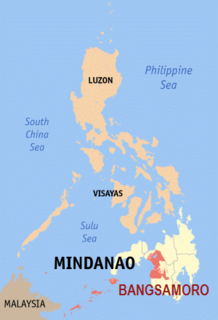
The Framework Agreement on the Bangsamoro is a preliminary peace agreement signed in the Malacañan Palace in Manila, Philippines on 15 October 2012. The agreement calls for the creation of an autonomous political entity named Bangsamoro, replacing the Autonomous Region of Muslim Mindanao (ARMM) which was described by Former President Benigno Aquino III as "a failed experiment".
The Bangsamoro Islamic Freedom Fighters (BIFF), also known as the Bangsamoro Islamic Freedom Movement, is an Islamist militant organization based in Mindanao, the Philippines. It is a smaller player in the overall Moro insurgency in the Philippines and is mostly active in Maguindanao and other places in central Mindanao. It is a breakaway group from the Moro Islamic Liberation Front founded by Ameril Umbra Kato. Following Kato's death, the group split into three factions, one of which has aligned with the Islamic State of Iraq and the Levant (ISIL), while the other two are less radical.
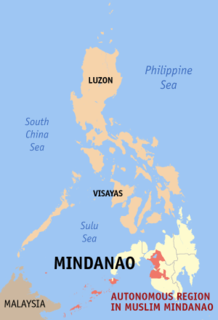
The 2000 Philippine campaign against the Moro Islamic Liberation Front was a military campaign conducted by the Armed Forces of the Philippines (AFP) against a Muslim secessionist group that took place during the presidency of Joseph Estrada in the Autonomous Region in Muslim Mindanao in the Philippines. The campaign was waged "to weaken the Moro Islamic Liberation Front's capability to undermine the territorial integrity of the Philippines and inflict harm on both government personnel and civilians".

