
The Wadiyar dynasty was a Hindu dynasty in Indian subcontinent that ruled the Kingdom of Mysore from 1399 to 1950, with a brief interruption in the late 1700s. The kingdom was incorporated into the Dominion of India after its independence from British rule.
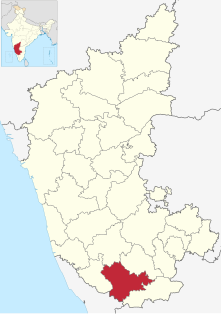
Mysore officially known as Mysuru District is an administrative district located in the southern part of the state of Karnataka, India. The district is bounded by Mandya district to the east and northeast, Chamrajanagar district to the southeast, Kerala state to the south, Kodagu district to the west, and Hassan district to the north. It features many tourist destinations, from Mysore Palace to Nagarhole National Park. This district has a prominent place in the history of Karnataka; Mysore was ruled by the Wodeyars from the year 1399 till the independence of India in the year 1947. Mysore's prominence can be gauged from the fact that the Karnataka state was known previously as Mysore state.

Karnataka produces 9,000 metric tons of mulberry silk of a total of 20,000 metric tons of mulberry silk produced in the country, thus contributing to nearly 45% of the country's total mulberry silk. In Karnataka, silk is mainly grown in the Mysore district. It's a patent registered product under KSIC. KSIC is an owner of the all Mysore Silk brand.

Yuvaraja Sri Sir Kanteerava Narasimharaja Wadiyar, GCIE, was the heir apparent of the princely state of Mysore from 1895 until his death in 1940.

Maharaja of Mysore was the principal title of the ruler of the Kingdom of Mysore in India until the abolition of the monarchy in 1950; the head of the royal family from 1950 to 1971; and, unofficially, the head of the erstwhile royal family following the removal of titles and privileges in 1971.

Cheluvanarayana Swamy Temple ಚೆಲುವನಾರಾಯಣ ಸ್ವಾಮಿ ದೇವಸ್ಥಾನ is located in Melkote in the Mandya District, Karnataka, India. The place is also known as Thirunarayanapura. It is built on rocky hills known as Yadavagiri or Yadugiri overlooking the Cauvery valley. It is about 30 miles (48 km) from Mysore and 97 miles (156 km) from Bangalore.

The Sritattvanidhi is a treatise written in the 19th century in Karnataka on the iconography and iconometry of divine figures in South India. One of its sections, includes instructions for and illustrations of 122 hatha yoga postures.
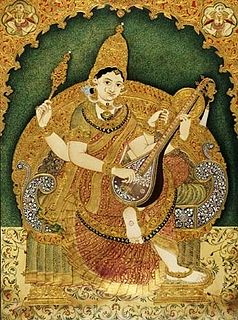
Mysore painting is an important form of classical South Indian painting that originated in and around the town of Mysore in Karnataka encouraged and nurtured by the Mysore rulers. Painting in Karnataka has a long and illustrious history, tracing its origins back to the Ajanta times The distinct school of Mysore painting evolved from the paintings of Vijayanagar times during the reign of the Vijayanagar Kings The rulers of Vijayanagar and their feudatories encouraged literature, art, architecture, religious and philosophical discussions. With the fall of the Vijayanagar empire after the Battle of Talikota the artists who were till then under royal patronage migrated to various other places like Mysore, Tanjore, Surpur, etc. Absorbing the local artistic traditions and customs, the erstwhile Vijayanagar School of Painting gradually evolved into the many styles of painting in South India, including the Mysore and Tanjore schools of painting.
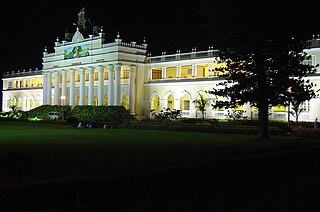
Mysore is a city in the state of Karnataka, India. It is known as the cultural capital of Karnataka. Mysore was the capital of the Wodeyar kings who ruled over the Mysore Kingdom for many centuries. Wodeyars were great patrons of art and music and have contributed significantly to make Mysore a cultural centre. Mysore is well known for its palaces, museums and art galleries and the festivities that take place here during the period of Dasara attract a worldwide audience. Mysore has also lent its name to popular dishes like Mysore Masala Dosa and Mysore Pak. Mysore is also the origin of the popular silk sari known as Mysore silk sari and has also given rise to a popular form of painting known as Mysore painting.

St. Philomena’s Cathedral is a Catholic church that is the cathedral of the Diocese of Mysore, India. The full name is the Cathedral of St. Joseph and St. Philomena. It is also known as St. Joseph's Cathedral. It was constructed in 1936 using a Neo Gothic style and its architecture was inspired by the Cologne Cathedral in Germany. This is one of the tallest churches in Asia.
Krishnaraja Wadiyar II, was the eighteenth maharaja of the Kingdom of Mysore from 1734 to 1766. He ruled only as puppet monarch during his entire rule, first under the dalvoys, and then, for the last five years, under Hyder Ali.

The Kingdom of Mysore (1399–1950) was founded by Yaduraya in 1399 as a feudatory of the Vijayanagara Empire and became an independent kingdom in the early 17th century, after the decline of the Vijayanagara Empire. Many musicians and composers have presumably adorned the courts of the Mysore kings from Yaduraya's time, furthering the Dakshinadi school of music that had developed in earlier centuries. However, records are only available from the time of King Ranadheera Kanteerava Narasaraja Wodeyar (1638). Musical treatises surviving from this time, though, provide ample information on the music, musical instruments, the types of compositions, the raga (melodies) and the tala (rhythms) used. Though all the Mysore kings patronised music, the golden age of Carnatic music was considered to be during the reigns of Kings Krishnaraja Wodeyar III (1794–1868), Chamaraja Wodeyar IX (1862–1894), Krishnaraja Wodeyar IV (1884–1940) and Jaya Chamaraja Wodeyar (1919–1974). The reign of Krishnaraja Wodeyar IV is regarded as particularly important in musical terms.
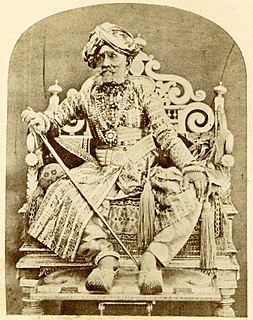
Maharaja Krishnaraja Wadiyar III was the twenty-second maharaja of the Kingdom of Mysore. Also known as Mummadi Krishnaraja Wadiyar, the maharaja belonged to the Wadiyar dynasty and ruled the kingdom for nearly seventy years, from 30 June 1799 to 27 March 1868. He is known for his contribution and patronage to different arts and music during his reign. He was succeeded by his adopted son, Chamarajendra Wadiyar X.

Purnaiah (Purniya), aka Krishnacharya Purniya or Mir Miran Purniya was the Dewan of Mysore. He served under Hyder Ali, Tipu Sultan, the English, and Maharaja Mummadi Krishnaraja Wodeyar. He was known for his skill with accounts, prodigious memory, proficiency in several languages and sheer hard work. He was also a wartime military commander while serving under Tipu Sultan. After Tipu Sultan's defeat, Mummadi Krishnaraja Wodeyar was educated and trained by Purniah. From 1799 till 1810, he governed the Kingdom of Mysore together with the English resident of the East India Company.
Mysore Paper Mill or the MPM is situated at Bhadravathi in the Shimoga district of Karnataka state, India. It was established in the year 1937 by Nalvadi Krishnaraja Wodeyar, the then Maharaja of Mysore state. In 1977, the company became a government company. The company obtained ISO certification in the year 2004.

The group of temples at the Amba Vilas Palace in Mysore were constructed during various periods by the kings of the Wodeyar dynasty who ruled the Kingdom of Mysore from about 1399 to 1947 A.D. These temples are protected monuments under the Karnataka state division of the Archaeological Survey of India.
Chamaraja Wodeyar IX was the twenty-first maharaja of the Kingdom of Mysore from 1776 for two decades until 1796.
Chamaraja Wodeyar VII was the seventeenth maharaja of the Kingdom of Mysore. He ruled only for two years, from 1732 to 1734.

Manasagangotri is a suburb of Mysore city in Mysore district of Karnataka state, India. Mysore University and its various departments are located in this area.


