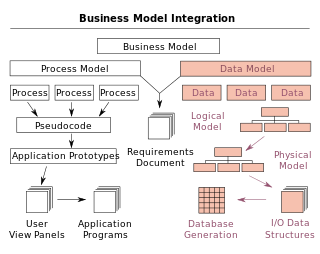
A data model is an abstract model that organizes elements of data and standardizes how they relate to one another and to properties of the real world entities. For instance, a data model may specify that the data element representing a car be composed of a number of other elements which, in turn, represent the color and size of the car and define its owner.
In computing, directory service or name service maps the names of network resources to their respective network addresses. It is a shared information infrastructure for locating, managing, administering and organizing everyday items and network resources, which can include volumes, folders, files, printers, users, groups, devices, telephone numbers and other objects. A directory service is a critical component of a network operating system. A directory server or name server is a server which provides such a service. Each resource on the network is considered an object by the directory server. Information about a particular resource is stored as a collection of attributes associated with that resource or object.
The database schema of a database system is its structure described in a formal language supported by the database management system (DBMS). The term "schema" refers to the organization of data as a blueprint of how the database is constructed. The formal definition of a database schema is a set of formulas (sentences) called integrity constraints imposed on a database. These integrity constraints ensure compatibility between parts of the schema. All constraints are expressible in the same language. A database can be considered a structure in realization of the database language. The states of a created conceptual schema are transformed into an explicit mapping, the database schema. This describes how real-world entities are modeled in the database.
A library (*LIB) on the AS/400 is an object that is used as a system directory to keep track of other objects.

WinFS was the code name for a canceled data storage and management system project based on relational databases, developed by Microsoft and first demonstrated in 2003 as an advanced storage subsystem for the Microsoft Windows operating system, designed for persistence and management of structured, semi-structured and unstructured data.
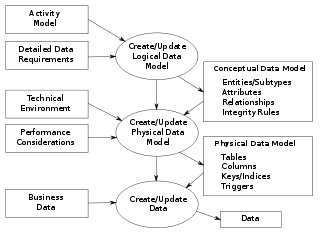
Data modeling in software engineering is the process of creating a data model for an information system by applying certain formal techniques.
A distributed data store is a computer network where information is stored on more than one node, often in a replicated fashion. It is usually specifically used to refer to either a distributed database where users store information on a number of nodes, or a computer network in which users store information on a number of peer network nodes.
A Windows domain is a form of a computer network in which all user accounts, computers, printers and other security principals, are registered with a central database located on one or more clusters of central computers known as domain controllers. Ju Authentication takes place on domain controllers. Each person who uses computers within a domain receives a unique user account that can then be assigned access to resources within the domain. Starting with Windows Server 2003, Active Directory is the Windows component in charge of maintaining that central database. The concept of Windows domain is in contrast with that of a workgroup in which each computer maintains its own database of security principals.
On Microsoft Servers, a domain controller (DC) is a server computer that responds to security authentication requests within a Windows domain. A domain is a concept introduced in Windows NT whereby a user may be granted access to a number of computer resources with the use of a single username and password combination.
Flexible Single Master Operations, or just single master operation or operations master, is a feature of Microsoft's Active Directory (AD). As of 2005, the term FSMO has been deprecated in favour of operations masters.

The Windows Registry is a hierarchical database that stores low-level settings for the Microsoft Windows operating system and for applications that opt to use the registry. The kernel, device drivers, services, Security Accounts Manager, and user interface can all use the registry. The registry also allows access to counters for profiling system performance.

Group Policy is a feature of the Microsoft Windows NT family of operating systems that controls the working environment of user accounts and computer accounts. Group Policy provides centralized management and configuration of operating systems, applications, and users' settings in an Active Directory environment. A set of Group Policy configurations is called a Group Policy Object (GPO). A version of Group Policy called Local Group Policy allows Group Policy Object management without Active Directory on standalone computers.
Administrative Templates are a feature of Group Policy, a Microsoft technology for centralized management of machines and users in an Active Directory environment.
A white pages schema is a data model, specifically a logical schema, for organizing the data contained in entries in a directory service, database, or application, such as an address book. In a white pages directory, each entry typically represents an individual person that makes use of network resources, such as by receiving email or having an account to log into a system. In some environments, the schema may also include the representation of organizational divisions, roles, groups, and devices. The term is derived from the white pages, the listing of individuals in a telephone directory, typically sorted by the individual's home location and then by their name.
Distributed File System (DFS) is a set of client and server services that allow an organization using Microsoft Windows servers to organize many distributed SMB file shares into a distributed file system. DFS has two components to its service: Location transparency and Redundancy. Together, these components improve data availability in the case of failure or heavy load by allowing shares in multiple different locations to be logically grouped under one folder, the "DFS root".
eDirectory is an X.500-compatible directory service software product from NetIQ. Previously owned by Novell, the product has also been known as Novell Directory Services (NDS) and sometimes referred to as NetWare Directory Services. NDS was initially released by Novell in 1993 for Netware 4, replacing the Netware bindery mechanism used in previous versions, for centrally managing access to resources on multiple servers and computers within a given network. eDirectory is a hierarchical, object oriented database used to represent certain assets in an organization in a logical tree, including organizations, organizational units, people, positions, servers, volumes, workstations, applications, printers, services, and groups to name just a few.
Apple Open Directory is the LDAP directory service model implementation from Apple Inc. A directory service is software which stores and organizes information about a computer network's users and network resources and which allows network administrators to manage users' access to the resources.
The following outline is provided as an overview of and topical guide to databases:
CIM Schema is a computer specification, part of Common Information Model standard, and created by the Distributed Management Task Force.
