 | Look up nasar in Wiktionary, the free dictionary. |
Nasar is 9th-century Byzantine admiral.
Contents
Nasar may also refer to:
- Nasar (Pashtun tribe), Pashtun tribe
| Look up nasar in Wiktionary, the free dictionary. |
Nasar is 9th-century Byzantine admiral.
Nasar may also refer to:
Abu Musab al-Suri, born Mustafa bin Abd al-Qadir Setmariam Nasar, is a suspected Al-Qaeda member and writer best known for his 1600-page book The Global Islamic Resistance Call. He has held Spanish citizenship since the late 1980s following marriage to a Spanish woman. He is wanted in Spain for the 1985 El Descanso bombing, which killed eighteen people in a restaurant in Madrid, and in connection with the 2004 Madrid train bombings. He is considered by many as 'the most articulate exponent of the modern jihad and its most sophisticated strategies'.
Syed Abu Nasar was a James R. Boyd Professor of Electrical Engineering (Emeritus) at the University of Kentucky. He was born in India and got his doctorate in electrical engineering at the University of California, Berkeley in 1963. His research concerned electric motors. He served as the chair of the Electrical Engineering department at the University of Kentucky from 1989 to 1997. He was a Life Fellow of the IEEE and the recipient of the 2000 IEEE Nikola Tesla Award.

Sylvia Nasar is an Uzbek German-born American journalist, best known for her biography of John Forbes Nash, Jr., A Beautiful Mind. She received the National Book Critics Circle Award for biography.

Nasar is a small city in Pain Rokh Rural District, Jolgeh Rokh District, Torbat-e Heydarieh County, Razavi Khorasan Province, Iran. At the 2016 census, its population was 3,633, in 1,088 families.
Nasar Rural District is a rural district (dehestan) in Arvandkenar District, Abadan County, Khuzestan Province, Iran. At the 2006 census, its population was 5,275, in 1,067 families. The rural district has 28 villages.
Hajar an-Nasar is an ancient fortress located in northern Morocco. It was constructed in the 10th-century by the Idrisid dynasty. The archaeological site is situated on a rocky crest overlooking the headwaters of a tributary of the Loukkos River around 40 km almost due east of the modern city of Larache.
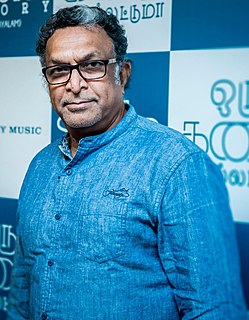
M. Nassar is a multilingual Indian film actor, director, producer, dubbing artist and playback singer who mainly works in the South Indian film industry. He is the incumbent president of the Nadigar Sangam.
 | This disambiguation page lists articles associated with the title Nasar. If an internal link led you here, you may wish to change the link to point directly to the intended article. |
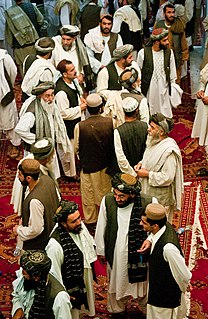
The Pashtuns, historically known as ethnic Afghans and Pathans, are an Iranian ethnic group who mainly live in Pakistan and Afghanistan in South-Central Asia. They speak the Pashto language and adhere to Pashtunwali, which is a traditional set of ethics guiding individual and communal conduct. The ethnogenesis of the Pashtun ethnic group is unclear but historians have come across references to various ancient peoples called Pakthas (Pactyans) between the 2nd and the 1st millennium BC, who may be their early ancestors. Their history is mostly spread amongst the present-day countries of Afghanistan and Pakistan, centred on their traditional seat of power in that region.

Pashtūnistān is the geographic historical region inhabited by the indigenous Pashtun people of modern-day Afghanistan and Pakistan, wherein Pashtun culture, language, and national identity have been based. Alternative names historically used for the region include "Pashtūnkhwā" (پښتونخوا), "Rōh" (روه) [citation needed] and "Afghānistān" (افغانستان), since at least the 3rd century CE onward. Pashtunistan borders Punjab to the east, Persian and Turkic speaking regions to the west and north, Kashmir to the northeast, and Balochistan to the south.
Pashto is an Eastern Iranian language, spoken natively by the Pashtun tribes in Pakistan and Afghanistan.
Kharoti is a Pashtun tribe, of Ghilji origin, based in parts of Afghanistan and Pakistan. In Quetta there is Kharotabad there people live 3275 houses and they live here from 1945 Many of the Kharoti have business in gulf countries and Pakistan. They have an estimated population of about 5.5 million, making it one of the larger, if not the largest, tribes in Afghanistan, Pakistan with significant territory throughout eastern and south-eastern Afghanistan. There are major Kharoti populations in the Paktika districts of Urgun, Barmal, Sar Hawza, Zarghun Shahr, Omna, Surobi, and Ghazni, Zabul, Paktia, Khost, Logar, Wardak, Kabul, Nangarhar, Helmand and Gomal. The Kharoti also have a strong presence in the Pakistani province of Balochistan, as well as the port city of Karachi in southern Pakistan. Bordering Tadjikistan is the largest harbour city of Afghanistan Sher Khan Bandar, named after Sher Khan Nashir, Khan of the Kharoti. Members of the Kharoti also live in the Iranian cities of Zahidan and Karimabad, where around 2000 families of the tribe reside; they typically speak Persian and Balochi. In Pakistan, people of the Kharoti tribe live in the Chaghi district of Balochistan of Pakistan, and typically speak Balochi. They also live in Noushki, Balochistan. Kharoti people also live in Chamalang near to Loralai and call themselves Kharotani but speak Balochi. In KPK province in Dera Ismail Khan many of these tribes' people live. In Punjab as well at Mianwali Road there two towns of the Kharoti tribe. In Rawalpind city of Punjab there are approximately 300 families of Kharoti origine.
The Shalmani, or Shilmani is a Pashtun tribe who is primarily concentrated in the Shalman Valley in Khyber Agency near Peshawar, Khyber Pakhtunkhwa, Pakistan. Shalmani is also known as Sulemani in Abbottabad, Mansehra and Haripur. The tribe is present in different parts of Pakistan. In Pakistan, the tribe lives in Swat, Upper Dir, Lower Dir, Bajour, Buner, Shangla, Malakand District, Dargai, Sakha Koat,Shodag, Charsadda (Hashtnagar).
(Tarakai : ترہ کئ Taraki )
Pashtun diaspora refers to ethnic Pashtuns who live outside their traditional homeland of Pashtunistan, which is south of the Amu River in Afghanistan and west of the Indus River in Pakistan. Pashtunistan is home to the majority of the Pashtun community. However, there are significant Pashtun diaspora communities in the Sindh and Punjab provinces of Pakistan, in particular in the cities of Karachi and Lahore. A recent Pashtun diaspora has also developed in the Arab states of the Persian Gulf, primarily in the United Arab Emirates. Smaller populations of Pashtuns are found in the European Union, North America, Australia and other parts of the world. They may also be found in Iran, Oman, Saudi Arabia, Kuwait, Qatar and Bahrain. In Northern India, there are communities of Indians who trace their origins to the traditional Pashtun homeland.
Sardar Muhammad Yaqoob Khan Nasar is a Pakistani politician and current Member of the Senate of Pakistan. He was the Interim president of the Pakistan Muslim League (N) in 2017. He succeeded Nawaz Sharif after his disqualification by the Supreme Court of Pakistan.

Shīnḍanḍ District is one of the 16 districts of Herat Province, in western Afghanistan, and is situated in the southern part of that province. It borders Adraskan District to the north, Ghor Province to the east and Farah Province to the south and west. The population was 173,800. The district center is the town of Shindand, which boasts a very active market area. Shindand Air Base is located near the town. The main Herat-Kandahar road passes through the district. The Zerkoh Valley is in the district.
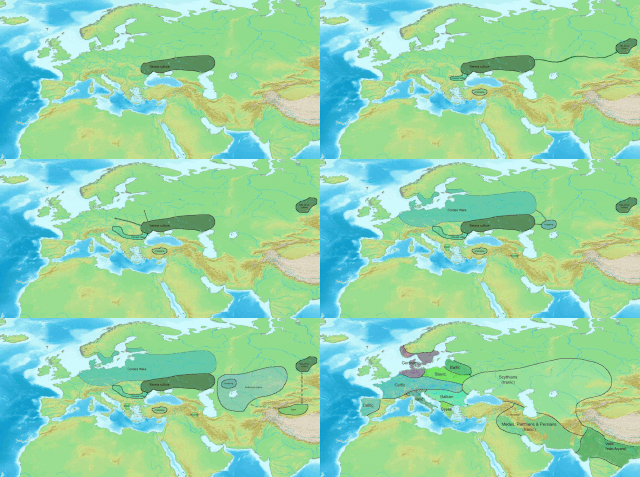
The Pashtun tribes, or Afghan tribes, are the tribes of the Pashtun people, a large Eastern Iranian ethnic group who use the Pashto language and follow Pashtunwali code of conduct. They are found primarily in Afghanistan and Pakistan and form the world's largest tribal society, comprising over 49 million people and between 350 and 400 tribes and clans. They are traditionally divided into four tribal confederacies: the Sarbani (سړبني), the Bettani (بېټني), the Gharghashti (غرغښتي) and the Karlani (کرلاڼي).
The Nasar tribe is an ethnic Pashtun tribe mainly living in Afghanistan and Pakistan. It has mostly remained a nomadic tribe throughout history due to which it spread in the provinces of Kunar, Paktia, Laghman, Nangarhar and Ghazni province. In addition, Nasars have been living in Balochistan, Pakistan prior to partition. In Pakistan, Nasar tribe has been mainly residing in district Loralai, Zhob and Dukki. The recently designated distric of Dukki is the hub of Nasar tribe- the members of which are mainly attached with coal business. Rumours are that he owns more than two hundred coal mines. As they belong to nanomadic tribe so their livelihood is also very simple and due to which they are very kind hearted and benouvelent. With the passage of time and after the industrial revolution in the 19th century their land proved like a game changer for them in the shape of coal the so called black diamond. According to some of the historians they are the ancestors of the great sultan of delhi Ala ud din khilji. many of the nasari men are well educated. Saidal Khan Nasari was one of the prominent rulers of afghanistan and many nasar people feel proud of being the ancestors of khilji and they are proud of their fore fathers because of their bravery and love to their nation.The Nasar tribe is an ethnic Pashtun Ghilzai tribe living in Afghanistan in Qalat now known is Zabal, Kunar, Laghman, Ghazani and Kandahar province and also living in Pakistan in Baluchistan province. NASAR people are also living in Khyber Pakhtunkhwa(Dera Ismail Khan, Draban Kalan).The main and famous section of NASAR tribe naming TOOR NASAR, mostly live in Khyber Pakhtunkhwa.Famous AFGHAN military commander SAIDAL KHAN NASAR, who fought against SAFAWIS of IRAN belonged to TOOR NASAR family. Some mentionable population of NASAR also live in D.G khan(punjab). Nasar tribesmen strictly follow PUSHTOONWALI rules. They are famous for their unique life style and traditions.It is one of the tribes in PUSHTOONs still avoiding Globalisation. NASAR controversy against SULEMAN KHEL tribe (GHILZAI) is famous in PUSHTOON history. this dispute remained for hundred years and hundreds of people of both side murdered.In this dispute nasar's subtribe with name Zangikhial had played a major role.most of the martyrs belong to zangikhail tribe.sulamankhail tribe had well known of their bravery.and also Barkhail had played a very good role in that dispute. In present NASAR tribe has well known politicians and parliament members in PAKISTAN,these politicians play a vital role in Pakistani politics. One of the politicians name MOULANA FAZAL-UR-RAHMAN(son of MUFTI MEHMOOD, former chief minister of NWFP) leading his own party JUI-F. JUI-F is main stream religious party of PAKISTAN and DEOBAND school of thought. Other parliamentarians include MOULANA ATTA-UR-RAHMAN and SARDAR YAQOOB NASAR. The governor of ZABUL province in AFGHANISTAN is ASHRAF KHAN NASARI.
Pashtun names are names used among the Pashtun people.
Daur or Dahur may refer to:
Azad is a Persian word meaning "free". It may also refer to:
Deh Nasar is a village in Sepiddasht Rural District, Papi District, Khorramabad County, Lorestan Province, Iran. At the 2006 census, its population was 179, in 34 families.
Kugan Nasar is a village in Miyankuh-e Sharqi Rural District, Mamulan District, Pol-e Dokhtar County, Lorestan Province, Iran. At the 2006 census, its population was 37, in 7 families.
Chah Nasar is a village in Eshqabad Rural District, Miyan Jolgeh District, Nishapur County, Razavi Khorasan Province, Iran. At the 2006 census, its population was 975, in 241 families.
Miana is a village in Banaft Rural District, Dodangeh District, Sari County, Mazandaran Province, Iran. At the 2006 census, its population was 287, in 89 families. Miana
Shirani, or Sherani, may refer to: