This page is based on this
Wikipedia article Text is available under the
CC BY-SA 4.0 license; additional terms may apply.
Images, videos and audio are available under their respective licenses.
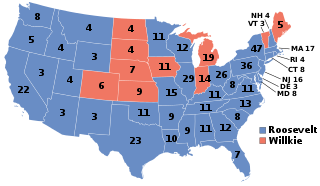
The 1940 United States presidential election was the 39th quadrennial presidential election. It was held on Tuesday, November 5, 1940. The election was contested in the shadow of World War II in Europe, as the United States was emerging from the Great Depression. Incumbent Democratic President Franklin D. Roosevelt defeated Republican businessman Wendell Willkie to be reelected for an unprecedented third term in office.

The 1940 Summer Olympics, officially known as the Games of the XII Olympiad, were originally scheduled to be held from September 21 to October 6, 1940, in Tokyo, Japan. They were rescheduled for Helsinki, Finland, to be held from July 20 to August 4, 1940, but were ultimately cancelled due to the outbreak of World War II. Helsinki eventually hosted the 1952 Summer Olympics and Tokyo the 1964 Summer Olympics.
This is a list of timelines of events over the period of World War II, as well as the prelude to the war.

The North African Campaign of the Second World War took place in North Africa from 10 June 1940 to 13 May 1943. It included campaigns fought in the Libyan and Egyptian deserts and in Morocco and Algeria, as well as Tunisia.
The North West Europe campaign was the term used by the British Commonwealth armed forces for the campaigns in North West Europe, including its skies and adjoining waters during World War II. The term Western Front has also sometimes been used informally. The United States military prefers the term European Theater of Operations.
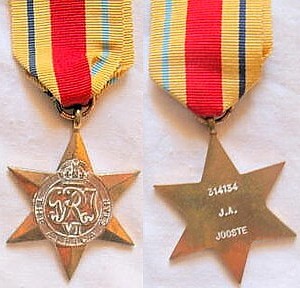
The Africa Star is a military campaign medal, instituted by the United Kingdom on 8 July 1943 for award to British and Commonwealth forces who served in North Africa between 10 June 1940 and 12 May 1943 during the Second World War.

The Norwegian Campaign was the attempted Allied liberation of the Scandinavian nation of Norway from Nazi Germany during the early stages of World War II and directly following the German invasion and occupation of the Norwegian mainland and government. It took place from April 9, 1940, until June 10, 1940. The Allied campaign did not succeed, and it resulted in the fleeing of King Haakon VII along with the remainder of the royal family to Great Britain.
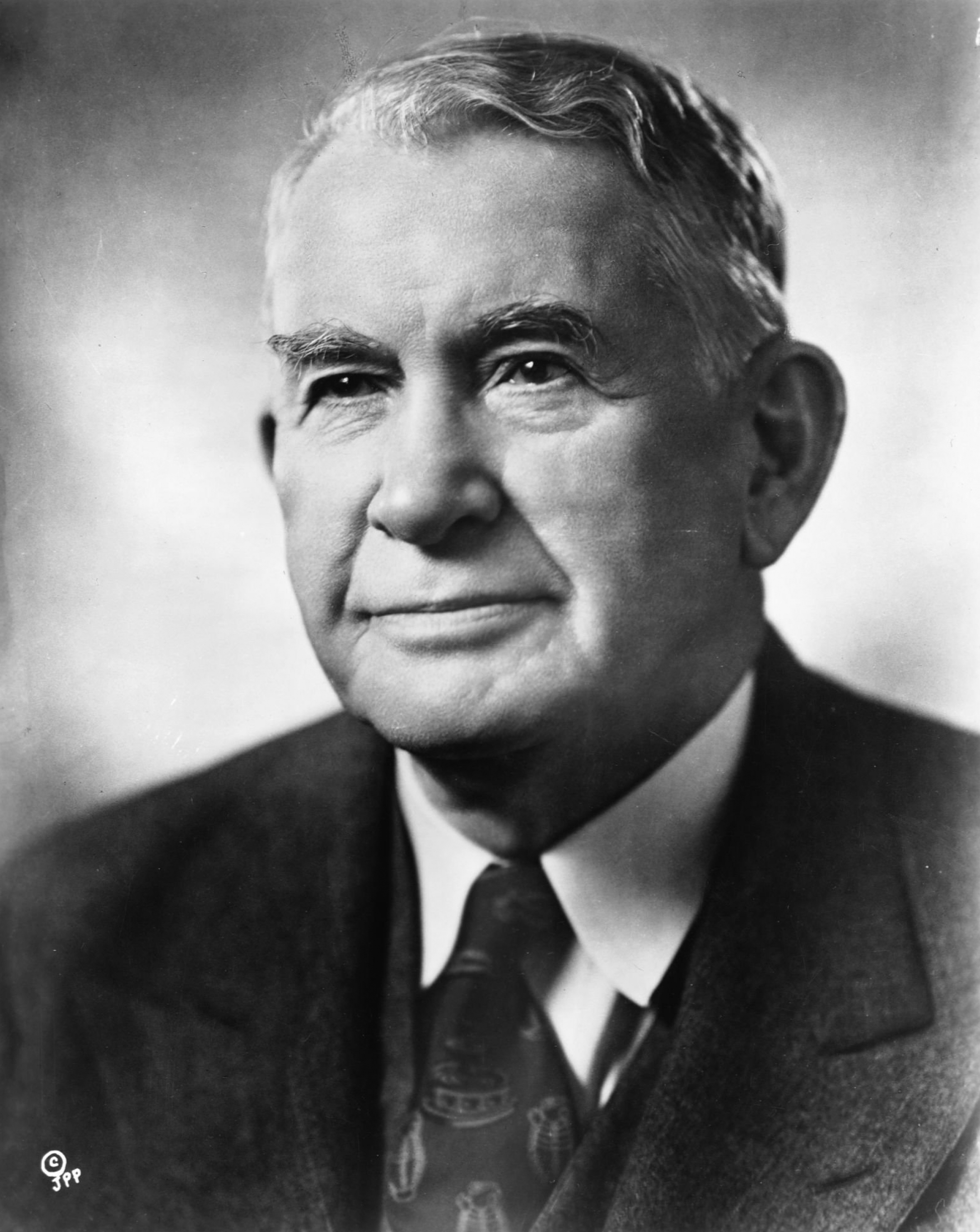
The United States Senate elections of 1940 coincided with the election of Franklin D. Roosevelt to his third term as President.

The 1940 United States House of Representatives elections coincided with President Franklin D. Roosevelt's re-election to an unprecedented third term. His Democratic Party narrowly gained seats from the opposition Republican Party, cementing their majority. However, the election gave firm control of the US House of Representatives and Senate to the New Dealers once again, as Progressives dominated the election.
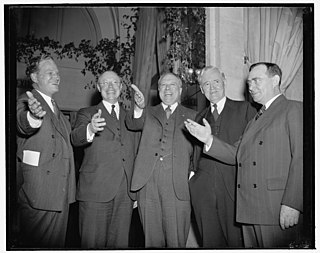
John Daniel Miller Hamilton was a Republican politician from the U.S. state of Kansas.
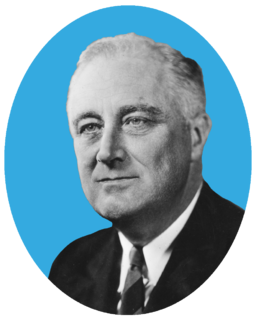
The 1940 Democratic National Convention was held at the Chicago Stadium in Chicago, Illinois from July 15 to July 18, 1940. The convention resulted in the nomination of President Franklin D. Roosevelt for an unprecedented third term. Secretary of Agriculture Henry A. Wallace from Iowa was nominated for Vice President.

The 1940 Republican National Convention was held in Philadelphia, Pennsylvania, from June 24 to June 28, 1940. It nominated Wendell Willkie of New York for President and Senator Charles McNary of Oregon for Vice-President.

The Allied leaders of World War II listed below comprise the important political and military figures who fought for or supported the Allies during World War II. Engaged in total war, they had to adapt to new types of modern warfare, on the military, psychological and economic fronts.
The following outline is provided as an overview of and topical guide to World War II:

United States gubernatorial elections were held in 1940, in 34 states, concurrent with the House, Senate elections and presidential election, on November 5, 1940.
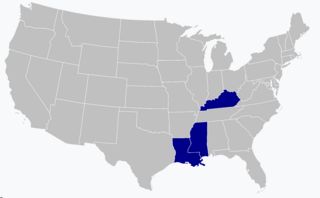
United States gubernatorial elections were held in 1939, in three states. Kentucky, Louisiana and Mississippi hold their gubernatorial elections in odd numbered years, every 4 years, preceding the United States presidential election year.
Gubernatorial elections were held in Massachusetts on November 5, 1940.


