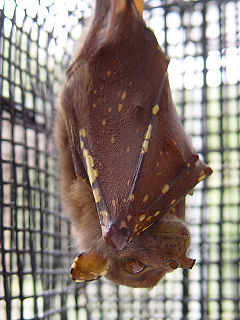
The eastern or Queensland tube-nosed bat is a megabat in the family Pteropodidae that lives in north-eastern Australia. N. robinsoni is one of the few species in Pteropodidae that roosts solitarily. They get their common name from their raised tubular nostrils which is unlike most other species in the family. They are a deep brown with gray heads and sparse yellow spotting.
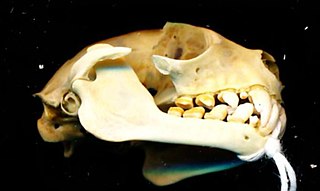
The broad-striped tube-nosed fruit bat, also known as the greater tube-nosed bat is a species of megabat in the genus Nyctimene. It is found in West Papua, Indonesia and Papua New Guinea. Although this species is believed to exist at low densities, the IUCN estimates its population to be stable and has no major threats to its continued existence. The IUCN classifies Nyctimene celaenoThomas, 1922 as a synonym of this species, however as of 2013 the ITIS lists it as a separate species.

The common tube-nosed fruit bat is a species of megabat in the family Pteropodidae. It is found in Australia, Indonesia, Papua New Guinea, The Philippines and the Solomon Islands.

The Pallas's tube-nosed bat, Torresian tube-nosed bat or northern tube-nosed bat, is a species of megabat in the Nyctimene genus found in Indonesia. Its range may extend to New Guinea, but sightings may be attributable to misidentification. Its range may at one time also have extended to Timor, but was extirpated due to habitat loss.

The mountain tube-nosed fruit bat is a species of megabat in the family Pteropodidae. It is endemic to New Guinea island within Papua New Guinea (nation) and Western New Guinea of Indonesia; and to New Britain Island of Papua New Guinea.

The round-eared tube-nosed fruit bat is a species of bat in the family Pteropodidae. It is possibly conspecific with Nyctimene certans, although the taxonomy remains unresolved. The possible synonymy of the species was investigated by Randolph L. Peterson in 1991, finding the species split into two distinct groups based on morphology. It is found in West Papua and Mansuar Island in Indonesia.

The dragon tube-nosed fruit bat is a species of bat in the family Pteropodidae. It is found on both sides of New Guinea: West Papua, Indonesia and Papua New Guinea. It is slightly smaller and very similar in appearance to N. albiventer, differing by having more profuse, dark spotting on its wing membranes, and smaller shorter canines. The similarity between the species has been a source of possible misidentifications. The records of this species from Papua New Guinea are associated with freshwater swamps and rivers.

The island tube-nosed fruit bat is a species of bat in the family Pteropodidae. It is found in Papua New Guinea and the Solomon islands.

The Malaita tube-nosed fruit bat is a species of bat in the family Pteropodidae. It is endemic only to the islands of Malaita and Makira in the Solomon Islands. The species occurs in primary tropical moist forest.

The demonic tube-nosed fruit bat is a species of bat in the family Pteropodidae. It is endemic to Papua New Guinea. The holotype specimen was collected in 1979 on New Ireland, in the Bismarck Archipelago. It was described as a new species in 1983. The range of the species may extend to other islands, however the extent of the range is not presently known.

The lesser tube-nosed bat is a species of megabat in the family Pteropodidae. It is native to two of the Maluku Islands in northern Indonesia.

The Philippine tube-nosed fruit bat locally known in Tagalog as Bayakan is a species of bat in the family Pteropodidae. It is endemic to the Philippines and known from the islands of Cebu, Negros and Sibuyan. It occurs in and near primary and secondary forests. It is often found near water. It is threatened by habitat loss due to deforestation. The species is named for Dioscoro S. Rabor who, with several others, first collected the species.
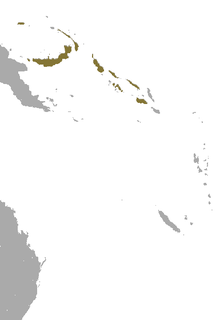
The Umboi tube-nosed fruit bat is a species of megabat in the family Pteropodidae. It is found in Papua New Guinea and the Solomon Islands.

The Keast's tube-nosed fruit bat is a species of megabat in the family Pteropodidae found in Babar, Tanimbar, and the Kai Islands.
Paranyctimene is a genus of bats in the family Pteropodidae. They are distributed in Indonesia
This page is based on this
Wikipedia article Text is available under the
CC BY-SA 4.0 license; additional terms may apply.
Images, videos and audio are available under their respective licenses.

