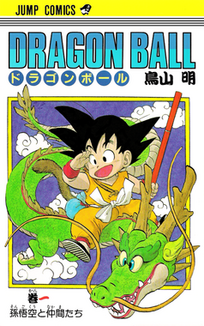
Dragon Ball is a Japanese manga series written and illustrated by Akira Toriyama. Originally serialized in Weekly Shōnen Jump magazine from 1984 to 1995, the 519 individual chapters were printed in 42 tankōbon volumes by the publisher Shueisha. Dragon Ball was inspired by the Chinese novel Journey to the West as well as Hong Kong martial arts films. It initially had a comedy focus but later became an action-packed fighting series. The story follows the adventures of Son Goku, from childhood to adulthood, as he trains in martial arts and explores the world in search of the Dragon Balls, seven magical orbs which summon a wish-granting dragon when gathered. Along his journey, Goku makes several friends and battles villains, many of whom also seek the Dragon Balls.

Master Roshi, commonly referred to in the original Japanese as the Turtle Hermit and also known as Muten Rōshi , is a fictional character from the Dragon Ball series created by Akira Toriyama. He is an ancient and wise martial arts master, as well as the creator of the Kamehame-ha (かめはめ波) technique. His students include Grandpa Gohan, The Ox-King, Son Goku, Krillin and Yamcha.

Dragon Ball is a Japanese anime television series produced by Toei Animation. It is an adaptation of the first 194 chapters of the manga of the same name created by Akira Toriyama, which were published in Weekly Shōnen Jump from 1984 to 1988. The anime is composed of 153 episodes that were broadcast on Fuji TV from February 26, 1986, to April 19, 1989. It was broadcast in 81 countries worldwide. It is part of the Dragon Ball media franchise.
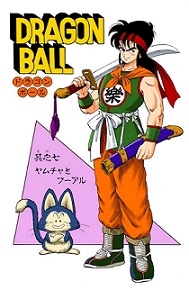
Yamcha is a fictional character in the Dragon Ball manga series created by Akira Toriyama. He is first introduced as a desert bandit and an antagonist of Son Goku in chapter #7 Yamcha and Pu'ar , published in Weekly Shōnen Jump magazine on September 11, 1984, alongside his constant companion Pu'ar. He is eventually depicted as being reformed, becoming an ally of Goku's.

Son Goku is a fictional character and main protagonist of the Dragon Ball manga series created by Akira Toriyama. He is based on Sun Wukong, a main character in the classic Chinese novel Journey to the West. Goku first made his debut in Dragon Ball chapter #1 Bulma and Son Goku , originally published in Japan's Weekly Shōnen Jump magazine on June 19, 1984, as an eccentric, monkey-tailed boy who practices martial arts and possesses superhuman strength. He meets Bulma and joins her on a journey to find the wish-granting Dragon Balls. Along the way, he finds new friends who follow him on his journey.

Dragon Ball Z: The World's Strongest , also known by Toei's own English title The Strongest Guy in the World, is a 1990 Japanese animated science fiction martial arts film and the second feature movie in the Dragon Ball Z franchise. It was originally released in Japan on March 10 between episodes 39 and 40 of DBZ, at the "Toei Manga Matsuri" film festival along with the second Akuma-kun movie and the 1990 movie version of Sally the Witch.

Yie Ar Kung-Fu is a 1985 arcade fighting game developed and published by Konami. Along with 1984's Karate Champ, which influenced Yie-Ar Kung Fu, it is one of the games that established the basis for modern fighting games.

Dragon Ball: Sleeping Princess in Devil's Castle is a 1987 Japanese anime fantasy martial arts adventure film and the second anime feature film based on the Dragon Ball manga by Akira Toriyama. It was originally released in Japan on July 18 at the "Toei Manga Matsuri" film festival as part of a quadruple feature along with the first Saint Seiya movie and the film versions of Hikari Sentai Maskman and Choujinki Metalder. An English dub by Funimation Productions was released on VHS in 1998.

Dragon Ball: The Path to Power , is a 1996 Japanese animated fantasy martial arts adventure film and the seventeenth animated feature film based on Akira Toriyama's Dragon Ball manga, following the first three Dragon Ball films and thirteen Dragon Ball Z films. It is a re-telling of the original Dragon Ball anime series, mixing the elements from the first Dragon Ball search and the later Red Ribbon storyline. It was originally released in Japan on March 2 at the Toei Anime Fair, along with the movie version of Neighborhood Story. The film was produced to commemorate the tenth anniversary of the original Dragon Ball anime. It was also the last theatrically released Dragon Ball movie produced up until the release of Dragon Ball Z: Battle of Gods in 2013.
Naoki Tatsuta is a Japanese voice actor affiliated with Aoni Production.

Dragon Ball: Curse of the Blood Rubies, known in Japan as Dragon Ball during its initial theatrical release and later retitled Dragon Ball: Shenron no Densetsu for its home video release, is a 1986 Japanese anime fantasy martial arts adventure film and the first alternate continuity in a series of feature films in the Dragon Ball anime franchise, based on the manga of the same name by Akira Toriyama. The film is a modified adaptation of the initial story arc in the manga, with the original character King Gurumes substituting Emperor Pilaf's role as the main antagonist. Like in the manga, it depicts how Goku meets up with Bulma, as well as Oolong, Yamcha, Puar and finally Master Roshi during his first search for the Dragon Balls.
Dragon Ball: The Magic Begins, also released as or Dragon Ball: Ultimate Edition, is an unofficial live-action remake of the first Dragon Ball animated film Curse of the Blood Rubies, made in 1986. The plot revolves around a rag-tag group of heroes, led by Son Goku trying to stop the antagonist named King Horn from using the wish-granting Dragon Balls to rule the world.
Dragon Ball , sometimes styled as Dragonball, is a Japanese media franchise created by Akira Toriyama in 1984. The initial manga, written and illustrated by Toriyama, was serialized in Weekly Shōnen Jump from 1984 to 1995, with the 519 individual chapters collected into 42 tankōbon volumes by its publisher Shueisha. Dragon Ball was initially inspired by the classical Chinese novel Journey to the West, as well as Hong Kong martial arts films. The series follows the adventures of the protagonist, Son Goku, from his childhood through adulthood as he trains in martial arts and explores the world in search of the seven orbs known as the Dragon Balls, which summon a wish-granting dragon when gathered. Along his journey, Goku makes several friends and battles a wide variety of villains, many of whom also seek the Dragon Balls.
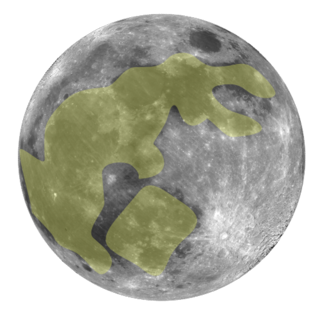
The moon rabbit in folklore is a rabbit that lives on the Moon, based on pareidolia that identifies the markings of the Moon as a rabbit. The folklore originated in China, and then spread to other Asian cultures. In East Asian folklore, it is seen pounding with a mortar and pestle, but the contents of the mortar differ among Chinese, Japanese, and Korean folklore. In Chinese folklore, it is often portrayed as a companion of the Moon goddess Chang'e, constantly pounding the elixir of life for her; but in Japanese and Korean versions, it is pounding the ingredients for rice cake. In some Chinese versions, the rabbit pounds medicine for the mortals.
Bradford "Brad" Jackson is an American voice actor at Funimation/OkraTron 5000 who provides the voices for a number of English versions of Japanese anime series. He also is a cast member at the American dinner theatre chain Medieval Times
Puff-Puff is a Japanese term for the placing of a person's face between a woman's breasts, often for sexual pleasure.

Bulma is a fictional character in the Dragon Ball manga series created by Akira Toriyama. She debuted in the first chapter Bulma and Son Goku , published in Weekly Shōnen Jump magazine on June 19, 1984, meeting Goku and recruiting him as her bodyguard to travel and find the wish-granting Dragon Balls. Bulma is the daughter of Dr. Briefs, the founder of the Capsule Corporation, a company that creates special small capsules that shrink and hold objects of various sizes for easy storage. Being the daughter of a brilliant scientist, Bulma is also a scientific genius, as well as an inventor and engineer. Along with creating the Dragon Radar, a device that detects the energy signal emitted by a Dragon Ball, Bulma's role as an inventor becomes important at several points in the series; including the time machine that brings her future son Trunks to the past.