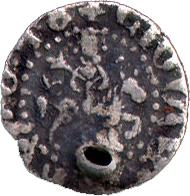
Constantine II, , born Guy de Lusignan, was elected the first Latin King of Armenian Cilicia of the Poitiers-Lusignan dynasty, ruling from 1342 until his death in 1344.

Constantine III was the King of Armenian Cilicia from 1344 to 1362. He was the son of Baldwin, Lord of Neghir, and second cousin of Constantine II.

Constantine IV was the King of Armenian Cilicia from 1362 until his death. He was the son of Hethum of Neghir, a nephew of Hethum I of Armenia. Constantine came to the throne on the death of his cousin Constantine III, whose widow, Maria, daughter of Oshin of Corycos, he married.
Oshin of Korikos served as regent of the Armenian Kingdom of Cilicia from 1320 to 1329. He was the son of the historian Hayton of Korikos. He became regent for Leo IV on the death of King Oshin in 1320, whom he was rumoured to have poisoned. Oshin was also probably responsible for the deaths of King Oshin's sister Princess Isabella of Armenia and two of her sons, in order to remove rival claimants.

Leo IV or Leon IV was the last Hethumid king of Cilicia, ruling from 1320 until his death. He was the son of Oshin of Armenia and Isabel of Korikos, and came to the throne on the death of his father. His name is sometimes spelled as Leo or Leon.

Leo II or Leon II was king of the Armenian Kingdom of Cilicia, ruling from 1269/1270 to 1289. He was the son of King Hetoum I and Queen Isabella and was a member of the Hetoumid family.
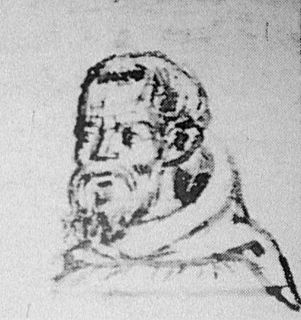
Hethum II, also known by several other romanizations, was king of the Armenian Kingdom of Cilicia, ruling from 1289 to 1293, 1295 to 1296 and 1299 to 1303, while Armenia was a subject state of the Mongol Empire. He abdicated twice in order to take vows in the Franciscan order, while still remaining the power behind the throne as "Grand Baron of Armenia" and later as Regent for his nephew. He was the son of Leo II of Armenia and Kyranna de Lampron, and was part of the Hethumid dynasty, being the grandson of Hethum I, who had originally submitted Cilicia to the Mongols in 1247. He was assassinated with his nephew and successor Leo III by the Mongol general Bilarghu, who himself was later executed for this by the Mongol Ilkhan ruler Öljaitü.
Leo III Armenian: Լեիոն Գ, Levon III) (occasionally numbered Leo IV; was a young king of the Armenian Kingdom of Cilicia, ruling from 1303 or 1305 to 1307, along with his uncle Hethum II. A member of the Hethumid dynasty, he was the son of Thoros III of Armenia and Margaret of Lusignan, who was the daughter of King Hugh III of Cyprus.
Thoros III or Toros III was king of the Armenian Kingdom of Cilicia, ruling from 1293 to 1298. He was the son of Leo II of Armenia and Kyranna de Lampron, and was part of the Hethumid dynasty. In 1293 his brother Hethum II abdicated in his favour; however, Thoros recalled Hethum to the throne in 1295. The two brought their sister Rita of Armenia to Constantinople to marry Michael IX Palaiologos in 1296, but were imprisoned upon their return in Bardzrberd by their brother Sempad, who had usurped the throne in their absence. Thoros was murdered, strangled to death on July 23, 1298 in Bardzrberd by Oshin, Marshal of Armenia, on Sempad's orders.
Toros II the Great, also Thoros II, was the sixth lord of Armenian Cilicia or “Lord of the Mountains” (1144/1145–1169).
The Hethumids, also known as the House of Lampron, were the rulers of the Armenian Kingdom of Cilicia from 1226 to 1373. Hethum I, the first of the Hethumids, came to power when he married Queen Isabella of Armenia who had inherited the throne from her father.

The Armenian Kingdom of Cilicia, also known as the Cilician Armenia, Lesser Armenia, or New Armenia, was an independent principality formed during the High Middle Ages by Armenian refugees fleeing the Seljuq invasion of Armenia. Located outside the Armenian Highland and distinct from the Armenian Kingdom of antiquity, it was centered in the Cilicia region northwest of the Gulf of Alexandretta.
Toros I, also Thoros I, was the third lord of Armenian Cilicia or “Lord of the Mountains”.
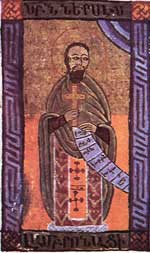
Saint Nerses of Lambron (1153–1198) was the Archbishop of Tarsus in the Armenian Kingdom of Cilicia who is remembered as one of the most significant figures in Armenian literature and ecclesiastical history.
Bilarghu, also Pilargh'ou, was a Mongol general of the ruler Ghazan during the end of the 13th and the beginning of the 14th century.
Joan of Taranto was a Queen consort of Armenia by marriage to Oshin, King of Armenia. She was daughter of Philip I, Prince of Taranto, and his first wife Thamar Angelina Komnene. She was a member of the Capetian House of Anjou.
Alice of Korikos was Queen of Armenia by marriage to Leo IV, King of Armenia. She was the only daughter of Oshin of Korikos and his first wife Margaret of Ibelin.


